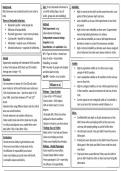
Background Aim: To test bystander behaviour in Reliability
Kitty Genovese was murdered and no one came to a real life setting (type, race of High in control as they did it at the same time and in a set
help. victim, group size and modelling). period of time between April and June.
Theory of bystander behaviour Lacks reliability as it was a field experiment so low levels
Bystander apathy = what people do. Method of control.
Diffusion of Responsibility Field experiment using High in inter-rater reliability as there were 2 experiments
Pluralistic ignorance = reject norm privately. observational techniques. overserving helping behaviours on subway.
Cost benefit = benefit for individual. Independent measures design. Lacks internal reliability as it was a field experiment and
Attribution = explain cause of behaviour. Snapshot study therefore, harder to control for extraneous variables.
Altruistic behaviour = opposite of selfishness. Quantitative and qualitative data. High in internal reliability as females were always assigned
IV’s = Type of victim = drunk/cane role of observer but males were always model or victim.
Sample Race of victim = black/white
Opportunity sampling with estimated 4450 travellers Modelling/ no model Validity
on New York subway (45% black and 55% white) DV = Number of people who helped High in population validity as it as there was a large
Average per carriage = 43. and time taken to help. sample of 4450 travellers.
Sub-DV = Gender, race, location Low in population validity as all travellers on the sub-way
Procedure
were in New York.
-16 researchers in teams of 4 (2m/2f) and males Piliavin et al. High in ecological validity as it was a field experiment and,
were model or victim and females were observers.
Findings – Type of victim in the travellers, natural environment of sub-way in New
-103 trials between 1am – 3pm from April 15-26
-Cane victim = 95% helped. York.
June 1986. Used trains between 59th and 125th
-Drunk victim = 50% helped. Can be argued as not ecologically valid as it is probably a
street.
-60% of victims had 2 or more rare occurrence that someone would collapse on a
-Boarded train using different doors and the critical
helpers. subway.
area was varied locations.
-34 people left critical area when Ethics
-Female observers sat outside critical area.
collapsed in drunk condition. Confidentiality was kept as all ppts anonymous as they
-Male model stood and victim stood next to pole.
-Quicker to help in cane than drunk. didn’t know who was helping victim as they were on a
-In critical and adjacent area, model either went
Findings- Race of Victim sub-way with people getting on and off all the time.
early (after 70s) or late (after 150s).
-Black victim = less help and slower. No informed consent a the ppts didn’t know they were
Conclusions -Same race helping occurred. taking part.
-Drunk were less likely to get help than cane. -Males more helpful than females. Participants were deceived as they didn’t know they were
-Men were more likely to help male victim. Findings – Model/Passengers taking part in the study and didn’t know what the study
-No diffusion of responsibility was found. -Early model has more affect. was about.
-Same race helping occurred more with drunk. -People helped before model. May have been caused distress if they saw the victim in
-Contradicts Latane and Darley. -More passenger in CA = more help. pain or didn’t help the victim as they may have felt guilty
-No difusion of responsibility. afterwards.
Kitty Genovese was murdered and no one came to a real life setting (type, race of High in control as they did it at the same time and in a set
help. victim, group size and modelling). period of time between April and June.
Theory of bystander behaviour Lacks reliability as it was a field experiment so low levels
Bystander apathy = what people do. Method of control.
Diffusion of Responsibility Field experiment using High in inter-rater reliability as there were 2 experiments
Pluralistic ignorance = reject norm privately. observational techniques. overserving helping behaviours on subway.
Cost benefit = benefit for individual. Independent measures design. Lacks internal reliability as it was a field experiment and
Attribution = explain cause of behaviour. Snapshot study therefore, harder to control for extraneous variables.
Altruistic behaviour = opposite of selfishness. Quantitative and qualitative data. High in internal reliability as females were always assigned
IV’s = Type of victim = drunk/cane role of observer but males were always model or victim.
Sample Race of victim = black/white
Opportunity sampling with estimated 4450 travellers Modelling/ no model Validity
on New York subway (45% black and 55% white) DV = Number of people who helped High in population validity as it as there was a large
Average per carriage = 43. and time taken to help. sample of 4450 travellers.
Sub-DV = Gender, race, location Low in population validity as all travellers on the sub-way
Procedure
were in New York.
-16 researchers in teams of 4 (2m/2f) and males Piliavin et al. High in ecological validity as it was a field experiment and,
were model or victim and females were observers.
Findings – Type of victim in the travellers, natural environment of sub-way in New
-103 trials between 1am – 3pm from April 15-26
-Cane victim = 95% helped. York.
June 1986. Used trains between 59th and 125th
-Drunk victim = 50% helped. Can be argued as not ecologically valid as it is probably a
street.
-60% of victims had 2 or more rare occurrence that someone would collapse on a
-Boarded train using different doors and the critical
helpers. subway.
area was varied locations.
-34 people left critical area when Ethics
-Female observers sat outside critical area.
collapsed in drunk condition. Confidentiality was kept as all ppts anonymous as they
-Male model stood and victim stood next to pole.
-Quicker to help in cane than drunk. didn’t know who was helping victim as they were on a
-In critical and adjacent area, model either went
Findings- Race of Victim sub-way with people getting on and off all the time.
early (after 70s) or late (after 150s).
-Black victim = less help and slower. No informed consent a the ppts didn’t know they were
Conclusions -Same race helping occurred. taking part.
-Drunk were less likely to get help than cane. -Males more helpful than females. Participants were deceived as they didn’t know they were
-Men were more likely to help male victim. Findings – Model/Passengers taking part in the study and didn’t know what the study
-No diffusion of responsibility was found. -Early model has more affect. was about.
-Same race helping occurred more with drunk. -People helped before model. May have been caused distress if they saw the victim in
-Contradicts Latane and Darley. -More passenger in CA = more help. pain or didn’t help the victim as they may have felt guilty
-No difusion of responsibility. afterwards.