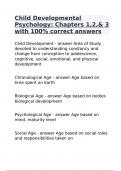
Child Developmental Psychology: Chapters 1,2,& 3 with 100% correct answers
Child Development Area of Study devoted to understanding constancy and change from conception to adolescence, cognitive, social, emotional, and physical development Chronological Age Age based on time spent on Earth Biological Age Age based on bodies biological development Psychological Age Age based on mind, maturity level Social Age Age based on social roles and responsibilities taken on Universal vs. Individual Development [One Course or Many Courses] Does everyone develop in the same way (Piaget), or does everyone develop on an individual basis (Brofenbrenner) Continuity vs. Discontinuity Is development a gradual change over time [Continuous] or one level to the next, "stage like" [Discontinuous] Nature vs. Nurture Is development based more on your genetic information you're born with [Nature] or more based on your environment and you're interactions with your environment [Nurture] Classical Conditioning A type of learning in which one learns to link two or more stimuli and anticipate events Operant Conditioning A type of learning in which behavior is strengthened if followed by a reinforcer or diminished if followed by a punisher. Social-Cognitive Theory Focuses on how individual and environment interact; proposed by Bandura Behavioral/Social Cognitive People learn through experience and observation, [Continuous, Many Possible Courses, Emphasis on Nurture] Psychoanalytic Perspective Children develop based on how they deal with biological and social conflicts, in stages, their coping ability will help determine their ability to get along with others, learn, and cope with anxiety [Discontinuous, One Course, Both Nature and Nurture] Psychosexual Theory How Parents manage their child's sexual and aggressive drives in the first few years is crucial for healthy personality development Psychosocial Theory 8 stages of development characterized by psychological conflicts that must be resolved for healthy development to occur Cognitive- Development Theory/ Piaget Actively construct knowledge as they manipulate and explore their world, Sensiomotor(language), Preoperational(imagination), Concrete Operational(logic), Formal Operational(abstract) [Discontinuous, One Course, Both Nature and Nurture] Sociocultural Theory How cultural beliefs are transferred to the next generation [Continuous, Many Courses, Nurture}] Ethology Adaptive, survival value of behavior and evolutionary history Imprinting The process by which certain animals form attachments during a critical period very early in life. Critical Period a specific time in development when certain skills or abilities are most easily learned Sensitive Period A limited phase in an animal's development that is the only time when certain behaviors can be learned. Evolutionary-Developmental Psychology Seeks to understand the adaptive value of species-wide cognitive, emotional, and social competencies as those competencies change with age [Continuous and Discontinuous, One Course, Both Nature and Nurture] Ethological Systems Theory Child develops with a complicated system of relationships affected by multiple levels of surrounding environments [Continuous, Many Courses, Both Nature and Nurture] Micosystem Innermost level of the environment, activities and interaction patterns in child's immediate surroundings (family, childcare, play area) Mesosystem Connections between Microsystems Exosystem Social settings the child does not actively visit, but affects child's experience (external family, parents work) Macrosystem Consists of cultural values, customs, laws Chronosystem Place in time/sociohistocial conditions Dynamic Systems Perspective Child's mind, body, and physical/social worlds form an integrated system that guides new skills, dynamic and always in motion [Both Continuous and Discontinuous, Many Courses, Both Nature and Nurture] 2 THEORIES; CONTINUITY, COURSES, NA OR NU? Piaget/ Cognitive-Developmental Theory 1. Discontinuous: Development Occurs in Stages 2. One Course: Universal for all Children 3. Both Nature and Nurture: Development occurs as brain grows and children excersice drive to discover reality in environment Dynamic Systems Perspective 1. Both Continuous and Discontinuous: Change in system is always ongoing, stagelike transformations occur as child recognizes behavior so system works as functioning whole 2. Many Courses: Biological makeup, everyday tasks, and social experiences for each child may vary 3. Both Nature and Nurture: Mind, Body, and Physical/social surroundings form integrated system that guides mastery of new skills Clinical Interview Flexible, Normal Conversation Structured Interview Each individual can only be asked prepared questions, and in the same way Verbal Reports/ Surveys, Questionnaires, Interviews (+): Good amount of info, be more personal, can take less time, baseline of information (-): Hard to summarize, can be bias, people may have trouble articulating what they mean, wording can change opinions, babies can't take Naturalistic Observation observing and recording behavior in naturally occurring situations without trying to manipulate and control the situation Naturalistic Observations +/- (+): Directly see everyday behavior, babies allowed, many researchers-less bias, behavior/response may be more natural (-): Not everyone may have chance to display specific behavior, may be influenced by observer influence/bias, takes time Structured Observations Researchers can set up a situation and observe that participant's behavior Structured Observations +/- (+): Greater control over situation, good for observing behavior that may not be used in everyday life (-): Cannot be sure participants will behave the same way in a lab as they do in real life, may be influenced by observer influence/bias, Psychological Measures Measures relationship between nervous system and behavior (+): Any Age, Hard to Lie (-): Cannot be sure why certain stimulus was exhibited, hunger, fatigue?, pricey, ethical issues Case Study Gathers a wide range of information on 1 child, interviews, observations, tests, sometimes psychological, very detailed (+): Details, Complete Picture (-): Not generalizble Population General population of people that the experiment will benefit or help Sample People selected to represent the population Random Sample How to select participators for sample from population Correlation Measure that indicates the relationship between two variables, NOT CAUSATION Correlation Coeffecient Range from -1 to +1 and represent the strongest correlation whereas 0 represents the weakest/no correlation, [+= direct relationship, fall together, rise together, -=inverse relationship, one falls, one rises, vica versa. Quasi Experimental Cannot change IV but other factors are experimental Independent Variable The variable that is varied or manipulated by the researcher.

Geschreven voor
- Instelling
- Child Development Psychology
- Vak
- Child Development Psychology
Documentinformatie
- Geüpload op
- 11 juli 2024
- Aantal pagina's
- 29
- Geschreven in
- 2023/2024
- Type
- Tentamen (uitwerkingen)
- Bevat
- Vragen en antwoorden
Onderwerpen
-
child developmental psychology chapters 12 3

Ook beschikbaar in voordeelbundel