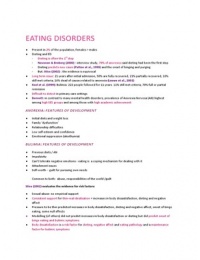
EATING DISORDERS
Present in 2% of the population, females > males
Dieting and ED
- Dieting is often the 1st step
- Nevonen & Broberg (2000) - interview study, 70% of anorexics said dieting had been the first step
- Dieting predicts new cases (Patton et al., 1999) and the onset of binging and purging
- But: Stice (2002) : the evidence is equivocal
Long term issue: 21 years after initial admission, 50% are fully recovered, 21% partially recovered, 10%
still met criteria, 16% dead of causes related to anorexia (Loewe et al., 2001)
Keel et al. (1999): Bulimia: 222 people followed for 11 years. 11% still met criteria, 70% full or partial
remission
Difficult to detect in primary care settings
Bennett: in contrast to many mental health disorders, prevalence of Anorexia Nervosa (AN) highest
among high SES groups and among those with high academic achievement
ANOREXIA: FEATURES OF DEVELOPMENT
Initial diets and weight loss
Family ‘dysfunction’
Relationship difficulties
Low self esteem and confidence
Emotional suppression (alexthymia)
BULIMIA: FEATURES OF DEVELOPMENT
Previous diets / AN
Impulsivity
Can’t tolerate negative emotions - eating is a coping mechanism for dealing with it
Attachment issues
Self-worth - guilt for pursuing own needs
Common to both: abuse, responsibilities of the world /guilt
Stice (2002) evaluates the evidence for risk factors:
Sexual abuse: no empirical support
Consistent support for thin-real idealisation = increases in body dissastisfaction, dieting and negative
affect
Pressure to be thin predicted increases in body dissatisfaction, dieting and negative affect, onset of binge
eating, some null effects
Modelling (of others) did not predict increases in body dissatisfaction or dieting but did predict onset of
binge eating and bulimic symptoms
Body dissatisfaction is a risk factor for dieting, negative affect and eating pathology and a maintenance
factor for bulimic symptoms
, Dieting = increased negative affect, bulimic symptoms and eating pathology, although some mixed
evidence
Concludes dieting is a risk factor for bulimic pathology but rather attenuates overeating tendencies
Perfectionism – mixed results, collectively findings support perfectionism as a risk factor for bulimic
pathology and a maintenance factor for eating pathology
Prevention programmes should focus on reducing malleable risk factors like thin-ideal internalisation,
body dissatisfaction and negative affect and also strive to increase protective factors like self esteem and
social support
Risk factors can be used to identify high risk groups
Need better research
Genetics - Strober et al (2000): female relatives with AN were 11x more likely than relatives of controls to get
AN. BN: 3.7 x more likely for relative of those with BN
ANOREXIA NERVOSA (AN)
“nervous appetite”
The criteria:
- Refusal to maintain body weight over minimally normal weight (85% generally)
- Intense fear of gaining weight
- Disturbance of body-size evaluations
- Amenorrhoea (if post-pubertal) for at least 3 cycles ( no period)
- Distinguish: a) restricting type (starvation - much more common), b) binge-purging type (less
common, more like bulimia)
The stats:
- William Gull (1873) first described and named
- Average age of onset 16-18
- As young as 7 reported
- Females > males - for every 10-12 females there is one male (Lucas, 1999)
- Highest mortality rate of any psychiatric disorder - 10% long term (e.g. Battle & Brownwell, 1996)
- Suicide risk x 23 higher than normal (Harris and Barraclough, 1997)
- Comorbidity with depression 63% (Herzog et al., 1992), OCD 35% (Rastam, 1992)
- Reduced brain volume (Swayze et al., 1996)
BULIMIA NERVOSA
The criteria
- Recurrent binge eating - more than usual plus sense of loss of control - usually on really strict diet
then if have a slip up will think it’s all over and will binge, then have to compensate
- Inappropriate compensatory behaviour - vomiting, laxatives, exercise, fasting
- Both occurring as least twice a week for at least 3 months
- Self esteem influenced by weight
- No evidence of AN
- Purging subtype (vomiting, laxatives)
- Non-purging (fasting , exercise)
The stats:
- Gerald Russell (1979) first described and named
Present in 2% of the population, females > males
Dieting and ED
- Dieting is often the 1st step
- Nevonen & Broberg (2000) - interview study, 70% of anorexics said dieting had been the first step
- Dieting predicts new cases (Patton et al., 1999) and the onset of binging and purging
- But: Stice (2002) : the evidence is equivocal
Long term issue: 21 years after initial admission, 50% are fully recovered, 21% partially recovered, 10%
still met criteria, 16% dead of causes related to anorexia (Loewe et al., 2001)
Keel et al. (1999): Bulimia: 222 people followed for 11 years. 11% still met criteria, 70% full or partial
remission
Difficult to detect in primary care settings
Bennett: in contrast to many mental health disorders, prevalence of Anorexia Nervosa (AN) highest
among high SES groups and among those with high academic achievement
ANOREXIA: FEATURES OF DEVELOPMENT
Initial diets and weight loss
Family ‘dysfunction’
Relationship difficulties
Low self esteem and confidence
Emotional suppression (alexthymia)
BULIMIA: FEATURES OF DEVELOPMENT
Previous diets / AN
Impulsivity
Can’t tolerate negative emotions - eating is a coping mechanism for dealing with it
Attachment issues
Self-worth - guilt for pursuing own needs
Common to both: abuse, responsibilities of the world /guilt
Stice (2002) evaluates the evidence for risk factors:
Sexual abuse: no empirical support
Consistent support for thin-real idealisation = increases in body dissastisfaction, dieting and negative
affect
Pressure to be thin predicted increases in body dissatisfaction, dieting and negative affect, onset of binge
eating, some null effects
Modelling (of others) did not predict increases in body dissatisfaction or dieting but did predict onset of
binge eating and bulimic symptoms
Body dissatisfaction is a risk factor for dieting, negative affect and eating pathology and a maintenance
factor for bulimic symptoms
, Dieting = increased negative affect, bulimic symptoms and eating pathology, although some mixed
evidence
Concludes dieting is a risk factor for bulimic pathology but rather attenuates overeating tendencies
Perfectionism – mixed results, collectively findings support perfectionism as a risk factor for bulimic
pathology and a maintenance factor for eating pathology
Prevention programmes should focus on reducing malleable risk factors like thin-ideal internalisation,
body dissatisfaction and negative affect and also strive to increase protective factors like self esteem and
social support
Risk factors can be used to identify high risk groups
Need better research
Genetics - Strober et al (2000): female relatives with AN were 11x more likely than relatives of controls to get
AN. BN: 3.7 x more likely for relative of those with BN
ANOREXIA NERVOSA (AN)
“nervous appetite”
The criteria:
- Refusal to maintain body weight over minimally normal weight (85% generally)
- Intense fear of gaining weight
- Disturbance of body-size evaluations
- Amenorrhoea (if post-pubertal) for at least 3 cycles ( no period)
- Distinguish: a) restricting type (starvation - much more common), b) binge-purging type (less
common, more like bulimia)
The stats:
- William Gull (1873) first described and named
- Average age of onset 16-18
- As young as 7 reported
- Females > males - for every 10-12 females there is one male (Lucas, 1999)
- Highest mortality rate of any psychiatric disorder - 10% long term (e.g. Battle & Brownwell, 1996)
- Suicide risk x 23 higher than normal (Harris and Barraclough, 1997)
- Comorbidity with depression 63% (Herzog et al., 1992), OCD 35% (Rastam, 1992)
- Reduced brain volume (Swayze et al., 1996)
BULIMIA NERVOSA
The criteria
- Recurrent binge eating - more than usual plus sense of loss of control - usually on really strict diet
then if have a slip up will think it’s all over and will binge, then have to compensate
- Inappropriate compensatory behaviour - vomiting, laxatives, exercise, fasting
- Both occurring as least twice a week for at least 3 months
- Self esteem influenced by weight
- No evidence of AN
- Purging subtype (vomiting, laxatives)
- Non-purging (fasting , exercise)
The stats:
- Gerald Russell (1979) first described and named