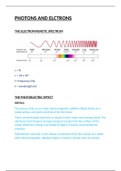
PHOTONS AND ELCTRONS
THE ELECTROMAGNETIC SPECTRUM
c = fλ
c = 3.8 x 10⁸
f = frequency (Hz)
λ = wavelength (m)
THE PHOTOELECTRIC EFFECT
METALS
The process that occurs when electromagnetic radiation (light) shines on a
metal surface and ejects electrons from the metal
There are delocalized electrons in metals in their outer most energy levels. The
electrons must be given enough energy to escape from the surface of the
metal. When this energy is provided by light it is known as photoelectric
emission
Photoelectric emission is the release of electrons from the surface of a metal
when electromagnetic radiation (light) is incident (shone) onto its surface.
, THE GOLD LEAF ELECTROSCOPE AND THE PHOTOELECTRIC EFFECT
When visible light is incident there is no effect (no matter the intensity)
When ultra-violet light is incident the gold leaf drops as electrons are
ejected (when the intensity is increased the rate at which electrons are
ejected also increases)
The ejected electrons are known as photoelectrons
NOTE:
Electrons are ejected immediately
Electrons are only ejected when the frequency of the incident radiation
is higher than that of the threshold frequency
If the frequency is less than the threshold frequency electrons will not
eject (no matter the intensity)
If the frequency is higher than the threshold frequency, increasing the
intensity will increase the number of ejected electrons per second
Different metals have different threshold frequencies
THRESHOLD FREQUENCY
Threshold frequency – the minimum frequency of incident radiation at which
electrons will be emitted from a particular metal
THE WAVE THEORY OF LIGHT COULDN’T EXPLAIN THE PHOTOELCTRIC EFFECT
The predictions made based on the wave theory did not explain the
observations made. The quantum theory was made to explain these
observations
THE ELECTROMAGNETIC SPECTRUM
c = fλ
c = 3.8 x 10⁸
f = frequency (Hz)
λ = wavelength (m)
THE PHOTOELECTRIC EFFECT
METALS
The process that occurs when electromagnetic radiation (light) shines on a
metal surface and ejects electrons from the metal
There are delocalized electrons in metals in their outer most energy levels. The
electrons must be given enough energy to escape from the surface of the
metal. When this energy is provided by light it is known as photoelectric
emission
Photoelectric emission is the release of electrons from the surface of a metal
when electromagnetic radiation (light) is incident (shone) onto its surface.
, THE GOLD LEAF ELECTROSCOPE AND THE PHOTOELECTRIC EFFECT
When visible light is incident there is no effect (no matter the intensity)
When ultra-violet light is incident the gold leaf drops as electrons are
ejected (when the intensity is increased the rate at which electrons are
ejected also increases)
The ejected electrons are known as photoelectrons
NOTE:
Electrons are ejected immediately
Electrons are only ejected when the frequency of the incident radiation
is higher than that of the threshold frequency
If the frequency is less than the threshold frequency electrons will not
eject (no matter the intensity)
If the frequency is higher than the threshold frequency, increasing the
intensity will increase the number of ejected electrons per second
Different metals have different threshold frequencies
THRESHOLD FREQUENCY
Threshold frequency – the minimum frequency of incident radiation at which
electrons will be emitted from a particular metal
THE WAVE THEORY OF LIGHT COULDN’T EXPLAIN THE PHOTOELCTRIC EFFECT
The predictions made based on the wave theory did not explain the
observations made. The quantum theory was made to explain these
observations