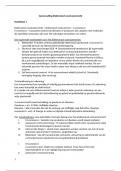
Queensland Bar – Cases exam verified
Jones v Dunkel Evidence (Civil) Adverse inferences may be drawn from the unexplained failure of a party to adduce particular evidence where such evidence would be reasonably expected to shed light on a matter. Case about man killed by a truck driven by D. D fails to appear as W. Corresponds to ss 9 (EAC doesnt affect CL) and 20 (failed to provide evidence) of tge EAC. Cases where judge can comment should be rare and exceptional - ie Weissensteiner Bale v Mills Ethics. Treatment of witnesses. Any W should be confronted with and afforded an opportunity of dealing with an allegation of dishonesty. Case concerned a new trial being ordered for making adverse credibility findings against a solicitor in circumstances where allegation of dishonesty had not been put to him in XXN. Despite P alleging that Browne v Dunn should be waived for non-compliance, judge decided that the waiver was not applicable as the judge has an obligation to ensure fair trial including fair treatment of W where the judge is asked to make a finding impeaching W's credit. Weissensteiner Evidence (Criminal) - D not testifying Two people owned a boat that disappeared. D was found in possession of the boat and charged. D did not call any evidence at his trial, nor did he take the witness stand. As a result of this, the trial judge directed the jury that they were entitled to draw an inference of guilt due to D's failure to explain the circumstances surrounding the case, in circumstances where he was likely to have some knowledge of what had in fact occurred. A negative inference cannot be drawn from D's decision to stay silent. A jury can only draw an inference of guilt which is made available by the Prosecution's facts, facts that are given some additional credibility by D's unwillingness to provide evidence to the contrary. R v Edwards (1993) Evidence - Admissions. A case where D was convicted for procuring another prisoner to give him a "head job" by threats of "bashing" and D lied about it in the W box. Other prisoners also assaulted that prisoner. A lie can constitute an admission against interest only if it is concerned with some circumstance or event connected with the offence and if it was told by the accused in circumstances in which the explanation for the lie is that he knew that the truth would implicate him in the offence. EG, a false alibi. Bunning v Cross Evidence - Improperly Obtained. Extension of Ireland discretion. Applicant was cleared of charge of driving under influence because the police did not use the correct procedure to test for alcohol when they stopped him. Court has discretion to exclude evidence improperly obtained which can rightly be exercised where the unfairness to the D outweighs the public interest in enforcement of the law and obtaining evidence to aid that enforcement. Evidence may also be excluded by an exercise of judicial discretion where the extent to which it would produce a fair trial outweighs its probative value. 5 element test: 1) did police deliberately disregard the law? 2) does illegality of attaining evidence result in lower reliability of the evidence? 3) how easy would it have been for the police to comply with the law? 4) what is the nature of the offence? 5) in what manner does legislation appear to control police actions? Makita v Sprowles Evidence - Admissibility of Expert Opinion. decision on whether an employer failed to provide a safe means of access between the car park and offices. A central issue was whether the stairs were safe and an expert gave his opinion that the stairs were slippery at the time of the accident. The admissibility of his opinion was questioned as the tests forming the basis of his opinion were performed nine years after the accident. 7 steps: 1) it must be demonstrated that there is a field of specialised knowledge; 2) there must be an identified aspect of that field in which W demonstrates that by reason of specified training, study or experience, W has become an expert; 3) it must be demonstrated that the opinion proffered is wholly or substantially based on the W's expert knowledge; 4) the expert must identify the assumptions of primary fact on which the opinion is offered (the "assumption identification rule"); 5) the opinion is not admissible unless evidence has been, or will be, admitted, whether from the expert or from some other source, which is capable of supporting finding of primary fact which are "sufficiently like" those factual assumptions to render the opinion of the expert of value (the "basis rule"); 6) there must be a demonstration that the facts on which the opinion is based form a proper foundation for it; 7) the opinion of an expert requires demonstrations or examination of the scientific or other intellectual basis of the conclusions reached. Tripodi Evidence (Criminal) - Co-accused v Coconspirator. When the case for the prosecution is that in the commission of a crime a number of persons have acted in preconcert, once reasonable evidence of the preconcert has been adduced, evidence of directions, instructions, arrangements or utterances accompanying acts given or made by one of the persons in the absence of the other or others in furtherance of the common purpose which constitutes or forms an element of the crime becomes admissible against the other or others, assuming it not to be otherwise admissible. The basal reason for

Geschreven voor
- Instelling
- QLD
- Vak
- QLD
Documentinformatie
- Geüpload op
- 27 juni 2024
- Aantal pagina's
- 21
- Geschreven in
- 2023/2024
- Type
- Tentamen (uitwerkingen)
- Bevat
- Vragen en antwoorden
Onderwerpen
-
queensland bar cases exam verified