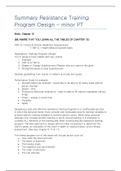
Summary Resistance Training
Program Design – minor PT
Book: Chapter 15
(BE AWARE THAT YOU LEARN ALL THE TABLES OF CHAPTER 15)
PAR-Q = Physical Activity Readiness Questionnaire
-> HM-Q = Health Medical Questionnaire.
Resistance Training Program Design
You’re going to have intakes with your clients.
1. Interview
2. PAR-Q of HM-Q
3. Stages of Change Questionnaire (Reason why you came to the gym)
4. Strength/Endurance Goal Questionnaire
Develop goalsetting from clients in midterm and long term goals.
Performance Goals for example:
Strength (Muscular strength: I would like to be able to lift heavy loads without
get an injuring).
Speed – time
Endurance (Muscular endurance: I want to able to lift objects repeatedly without
tiring).
Power – energy in some time
Flexibility
Agility
Designing a safe and effective resistance training programs is a multifaceted process
in which the personal trainer must consider and manipulate specific training variables to
achieve specific training variables to achieve specific goals. While many personal
trainings only consider aerobic training or sprint interval training, it is important to
consider ALL elements of the training plan when constructing the resistance training
program. The best approach to begins with an initial consultation to determine the
client’s goals; an evaluation of the client’s health or medical history, and a fitness
assessment. (See also chapter 9, 10 & 11).
The fitness program out of this assist will include factors such as:
How often the client will train
The types of exercises
The training loads
The repetition and set schemes
The order of exercises
The rest intervals.
, Periodization can ensure that appropriate training variation and progression are used so
as to minimize the potential for overtraining while maximizing improvements in the
targeted training outcomes.
General Training Principles
Four basic principles should guide the development of effective resistance training
programs:
1. Specificity
2. Overload
3. Variation
4. Progression
Ignoring any of these factors can limit the program’s ability to stimulate the desired
outcome (that can result in a failure to meet client goals), decrease adherence to the
program, and increase the probability of injury and legal risk.
Specificity:
The principle of specificity is the foundational aspect of every effective training
program. Specificity of training refers to training a client in a specific way to produce a
targeted change or result. The personal trainer can accomplish this by targeting
specific muscle groups, energetic systems, movement velocity, movement patterns of
muscle action types.
Overload:
Overload refers to a training stress or intensity that is greater than what a client is used
to. If a program fails to adhere to the principle of overload, it will produce limited
results. The most common methods of inducing overload include increasing
the weight lifted,
having the client perform more repetitions or sets of a given exercise,
shortening the rest interval between sets,
increasing the number of training sessions in a week.
Variation:
Variation refers to the manipulation of specific training variables such as
volume
intensity
exercise selection
frequency of training
rest interval
speed of movement
The application of appropriate training variation is essential when one is attempting to
ensure long-term adaptation. The best way to apply training variation is through use of
the principles of periodization, which refers to the logical phasic manipulation of
training factors to optimize specific training outcomes at specific time points.
Program Design – minor PT
Book: Chapter 15
(BE AWARE THAT YOU LEARN ALL THE TABLES OF CHAPTER 15)
PAR-Q = Physical Activity Readiness Questionnaire
-> HM-Q = Health Medical Questionnaire.
Resistance Training Program Design
You’re going to have intakes with your clients.
1. Interview
2. PAR-Q of HM-Q
3. Stages of Change Questionnaire (Reason why you came to the gym)
4. Strength/Endurance Goal Questionnaire
Develop goalsetting from clients in midterm and long term goals.
Performance Goals for example:
Strength (Muscular strength: I would like to be able to lift heavy loads without
get an injuring).
Speed – time
Endurance (Muscular endurance: I want to able to lift objects repeatedly without
tiring).
Power – energy in some time
Flexibility
Agility
Designing a safe and effective resistance training programs is a multifaceted process
in which the personal trainer must consider and manipulate specific training variables to
achieve specific training variables to achieve specific goals. While many personal
trainings only consider aerobic training or sprint interval training, it is important to
consider ALL elements of the training plan when constructing the resistance training
program. The best approach to begins with an initial consultation to determine the
client’s goals; an evaluation of the client’s health or medical history, and a fitness
assessment. (See also chapter 9, 10 & 11).
The fitness program out of this assist will include factors such as:
How often the client will train
The types of exercises
The training loads
The repetition and set schemes
The order of exercises
The rest intervals.
, Periodization can ensure that appropriate training variation and progression are used so
as to minimize the potential for overtraining while maximizing improvements in the
targeted training outcomes.
General Training Principles
Four basic principles should guide the development of effective resistance training
programs:
1. Specificity
2. Overload
3. Variation
4. Progression
Ignoring any of these factors can limit the program’s ability to stimulate the desired
outcome (that can result in a failure to meet client goals), decrease adherence to the
program, and increase the probability of injury and legal risk.
Specificity:
The principle of specificity is the foundational aspect of every effective training
program. Specificity of training refers to training a client in a specific way to produce a
targeted change or result. The personal trainer can accomplish this by targeting
specific muscle groups, energetic systems, movement velocity, movement patterns of
muscle action types.
Overload:
Overload refers to a training stress or intensity that is greater than what a client is used
to. If a program fails to adhere to the principle of overload, it will produce limited
results. The most common methods of inducing overload include increasing
the weight lifted,
having the client perform more repetitions or sets of a given exercise,
shortening the rest interval between sets,
increasing the number of training sessions in a week.
Variation:
Variation refers to the manipulation of specific training variables such as
volume
intensity
exercise selection
frequency of training
rest interval
speed of movement
The application of appropriate training variation is essential when one is attempting to
ensure long-term adaptation. The best way to apply training variation is through use of
the principles of periodization, which refers to the logical phasic manipulation of
training factors to optimize specific training outcomes at specific time points.