Clinical Immunology Evelien Floor
HC4 Autoimmune diseases and atopy
Immune-mediated diseases caused by derangements at multiple levels of the
immune response
Inflammation in the context of hypersensitivity
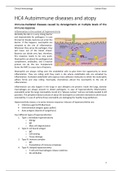
Normally the skin is a very strong barrier
and impenetrable for pathogens. In case
this barrier breaks, bacteria can enter the
dermis. If this happens, neutrophils are
attracted to the site of inflammation.
Whenever they sense the pathogen, they
will move out of the blood stream.
Bacteria can divide very fast; therefore,
this response needs to be very quick.
Neutrophils can attack the pathogens but
complement, antibodies, and C-reactive
protein can do this too. Complement
forms the MAC to cause lysis of bacteria.
Neutrophils are always rolling over the endothelial cells to give them the opportunity to sense
inflammation. They are rolling until they reach a site where endothelial cells are activated by
inflammation. Activated endothelial cells express more adhesion molecules to which the neutrophils
adhere firmly and stop rolling. Eventually, chemokines attract the neutrophils to the site of
inflammation.
Inflammation can also happen in the lungs in case allergens are present. Inside the lungs, alveolar
macrophages are always present to detect pathogens. In case of hypersensitivity inflammation,
eosinophils enter the lungs. Eosinophils consist of a “glasses nucleus” and are normally needed to kill
parasites. The peripheral blood consists of about 3% eosinophils so selective mechanisms drive tissue
eosinophilia. In case of asthma those eosinophils are damaging the healthy lung epithelium.
Hypersensitivity means; a to active immune response. Inducers of hypersensitivities are:
• Infectious agents (TB-Mantoux)
• Environmental antigens (grass pollen)
• Auto-antigens (islands of Langerhans)
Four different types of hypersensitivities:
1. Type I: immediate hypersensitivity
o Allergy
o IgE
o Mast cell degranulation
2. Type II: cell bound antigen
o IgG
o Cell binding
o Tissue damage
3. Type III: immune complex
o IgG
o Precipitation of immune complexes
4. Type IV: delayed hypersensitivity
o T cells and macrophages release cytokines
o No antibodies
1
, Clinical Immunology Evelien Floor
Common genes
Genome-wide linkage searches of autoimmune and inflammatory immune disorders have identified a
large number of non-major histocompatibility complex loci that collectively contribute to disease
susceptibility. A comparison was made of the linkage results from 23 published autoimmune or
immune-mediated disease genome-wide scans (non-HLA-linkages only). Human diseases included
multiple sclerosis, Crohn’s disease, familial psoriasis, asthma, and type-I diabetes (IDDM).
Those disease loci are not distributed throughout the genome randomly; there are so called hotspots.
6p21.31 is linked to the production of TNF-a which is linked to asthma, SLE, psoriasis, celiac, leprosy,
GVHD, and chronic bronchitis. This are all different diseases but there are similar mechanisms involved.
This indicates that blocking TNF-a could be used to treat those diseases.
Thus, there is a related genetic background for susceptibility of clinically distinct autoimmune or
inflammatory diseases. In addition, genes in the clusters are involved in primary or secondary
regulation of the immune system (Th17, Tregs). Finally, shared genes among distinct diseases may lead
to common early diagnostic criteria and therapeutic strategies (anti-TNF-a, cyclosporin).
Allergy
Atopy is the genetic predisposition to an excessive IgE reaction. In case of allergy, not only IgE levels
are increased. Also tissue factors play a role:
• Skin (atopic dermatitis):
o Primed keratinocytes
o FceRI-positive epidermal Langerhans cells
o Allergen-specific T cells
o Local chemokines
• Lung (allergic asthma)
o Continuous “intrinsic” epithelial activation:
o Inflammatory cytokines and mediators
o Continuous airway remodeling
To develop atopy two factors are playing a role:
• Genetic factors
o Presence of specific HLA alleles
o Polymorphisms of T cell receptor
o Polymorphisms of IL-4 family genes
o Polymorphisms of CD14
• Environmental factors
o Allergen sensitization
o Having few siblings
o Growing up on a farm
o Tabaco smoke
After the development of atopy there also need to be:
• Change in target organs
o Lung
o Skin
o Gut
• Triggers
o Viral infections
o Exposure of allergens
o Tabaco smoke
o Indoor and outdoor pollutants
2
HC4 Autoimmune diseases and atopy
Immune-mediated diseases caused by derangements at multiple levels of the
immune response
Inflammation in the context of hypersensitivity
Normally the skin is a very strong barrier
and impenetrable for pathogens. In case
this barrier breaks, bacteria can enter the
dermis. If this happens, neutrophils are
attracted to the site of inflammation.
Whenever they sense the pathogen, they
will move out of the blood stream.
Bacteria can divide very fast; therefore,
this response needs to be very quick.
Neutrophils can attack the pathogens but
complement, antibodies, and C-reactive
protein can do this too. Complement
forms the MAC to cause lysis of bacteria.
Neutrophils are always rolling over the endothelial cells to give them the opportunity to sense
inflammation. They are rolling until they reach a site where endothelial cells are activated by
inflammation. Activated endothelial cells express more adhesion molecules to which the neutrophils
adhere firmly and stop rolling. Eventually, chemokines attract the neutrophils to the site of
inflammation.
Inflammation can also happen in the lungs in case allergens are present. Inside the lungs, alveolar
macrophages are always present to detect pathogens. In case of hypersensitivity inflammation,
eosinophils enter the lungs. Eosinophils consist of a “glasses nucleus” and are normally needed to kill
parasites. The peripheral blood consists of about 3% eosinophils so selective mechanisms drive tissue
eosinophilia. In case of asthma those eosinophils are damaging the healthy lung epithelium.
Hypersensitivity means; a to active immune response. Inducers of hypersensitivities are:
• Infectious agents (TB-Mantoux)
• Environmental antigens (grass pollen)
• Auto-antigens (islands of Langerhans)
Four different types of hypersensitivities:
1. Type I: immediate hypersensitivity
o Allergy
o IgE
o Mast cell degranulation
2. Type II: cell bound antigen
o IgG
o Cell binding
o Tissue damage
3. Type III: immune complex
o IgG
o Precipitation of immune complexes
4. Type IV: delayed hypersensitivity
o T cells and macrophages release cytokines
o No antibodies
1
, Clinical Immunology Evelien Floor
Common genes
Genome-wide linkage searches of autoimmune and inflammatory immune disorders have identified a
large number of non-major histocompatibility complex loci that collectively contribute to disease
susceptibility. A comparison was made of the linkage results from 23 published autoimmune or
immune-mediated disease genome-wide scans (non-HLA-linkages only). Human diseases included
multiple sclerosis, Crohn’s disease, familial psoriasis, asthma, and type-I diabetes (IDDM).
Those disease loci are not distributed throughout the genome randomly; there are so called hotspots.
6p21.31 is linked to the production of TNF-a which is linked to asthma, SLE, psoriasis, celiac, leprosy,
GVHD, and chronic bronchitis. This are all different diseases but there are similar mechanisms involved.
This indicates that blocking TNF-a could be used to treat those diseases.
Thus, there is a related genetic background for susceptibility of clinically distinct autoimmune or
inflammatory diseases. In addition, genes in the clusters are involved in primary or secondary
regulation of the immune system (Th17, Tregs). Finally, shared genes among distinct diseases may lead
to common early diagnostic criteria and therapeutic strategies (anti-TNF-a, cyclosporin).
Allergy
Atopy is the genetic predisposition to an excessive IgE reaction. In case of allergy, not only IgE levels
are increased. Also tissue factors play a role:
• Skin (atopic dermatitis):
o Primed keratinocytes
o FceRI-positive epidermal Langerhans cells
o Allergen-specific T cells
o Local chemokines
• Lung (allergic asthma)
o Continuous “intrinsic” epithelial activation:
o Inflammatory cytokines and mediators
o Continuous airway remodeling
To develop atopy two factors are playing a role:
• Genetic factors
o Presence of specific HLA alleles
o Polymorphisms of T cell receptor
o Polymorphisms of IL-4 family genes
o Polymorphisms of CD14
• Environmental factors
o Allergen sensitization
o Having few siblings
o Growing up on a farm
o Tabaco smoke
After the development of atopy there also need to be:
• Change in target organs
o Lung
o Skin
o Gut
• Triggers
o Viral infections
o Exposure of allergens
o Tabaco smoke
o Indoor and outdoor pollutants
2