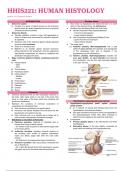
HHIS221: HUMAN HISTOLOGY
Lesson 10 | Endocrine System
INTRODUCTION Pituitary Gland
● Endocrine system ● Also known as hypophysis, lies below the brain in a small
➔ Consists of a group of glands (known as the endocrine cavity on the sphenoid bone, the sella turcica.
glands) which are widely separated and have no physical ● Develops from developing Brain and Oral Cavity
connections with one another ➔ Neural Component: Neurohypophyseal Bud
● Endocrine Glands – forms from diencephalon
➔ Typically epithelial, at least in origin, that aggregated as – future posterior pituitary
cords or clusters and surrounded by extensive networks ➔ Oral Component: Hypophyseal (Rathke) Pouch
of capillaries – grows from the root of pharynx
➔ Secretory cells of the endocrine glands release signaling – future anterior pituitary
products called hormones. ● Two major parts:
➔ There is no secretory duct. (1) Posterior pituitary (Neurohypophysis) has a part
➔ Referred to as ductless glands because hormones called the pars nervosa that develops as a downgrowth
diffuse directly into the bloodstream into the neighboring of the developing brain and is attached in the
vascularized compartment for uptake by capillaries and hypothalamus by the infundibulum.
distribution throughout the body. (2) Anterior pituitary (Adenohypophysis) includes the
● Major endocrine glands & Organs containing endocrine large pars distalis, the pars tuberalis that surrounds
cells the infundibulum, and the thin pars intermedia adjacent
(1) Pituitary Gland to the pars nervosa.
– APG
– PPG
(2) Thyroid Gland
(3) Parathyroid Gland
(4) Adrenal Gland
– Medulla
– Cortex
(5) Pineal Gland
(6) Hypothalamus
(7) Pancreas
(8) Ovaries
(9) Testes
Hormones
● Chemical substances that act like messenger molecules in
the body. After being made in one part of the body, they
travel to other parts of the body where they influence cell
growth and metabolism Hypothalamic-hypophyseal portal system
● Maintains the constancy of chemical composition of ● Hypothalamic-hypophyseal portal system (pituitary
extracellular and intracellular fluid portal system)
➔ Each hormone is produced by a specific gland. ➔ It’s a network of vessels that transport blood from the
➔ Hormones are directly released from the tissue into the hypothalamus to the anterior pituitary
bloodstream and carried to the site. ➔ has great importance because it carries neuropeptides to
➔ Each hormone acts on a specific site or target cell to the adenohypophysis where they either stimulate or
induce certain characteristic biochemical changes. inhibit hormone release by the endocrine cells there.
● Distribution or Secretion of Hormones ● Components:
(1) Paracrine secretion: dispersal in interstitial fluid or ➔ Primary capillary plexus in the infundibulum and lower
through short loops of blood vessels hypothalamus
– Ex: Gastrin made by pyloric G cells reaches target cells ➔ Secondary plexus in the pars distalis, connected by
in the fundic glands portal veins and draining to the hypophyseal vein.
(2) Juxtacrine secretion: signaling molecule remains on
the secreting cell’s surface or adjacent extracellular
matrix and affects target cells when the cells make
contact.
– Ex: Embryonic and regenerative tissue interactions
(3) Autocrine secretion: cells may produce molecules that
act on themselves.
– Ex: Insulin-like growth factor (IGF) produced by several
cell types may act on the same cells that produced it.
1
, Neurons of the Posterior Pituitary Gland and their
Hormone Secretions
● Bundle of axons called the hypothalamic-hypophyseal tract
courses into the neurohypophysis from two important
hypothalamic nuclei.
➔ Supraoptic nucleus: ADH (antidiuretic hormone)/
Vasopressin
– is released in response to increased blood tonicity
(hypertonic), sensed by osmoreceptor cells in the
hypothalamus.
– increases the permeability of the renal collecting ducts
to water so that more water is reabsorbed from the filtrate
in these tubules and osmotic balance of body fluids is
restored.
➔ Paraventricular nucleus: Oxytocin
– stimulates contraction of uterine smooth muscle during
childbirth and the myoepithelial cells in the mammary
gland
● Both hormones undergo axonal transport and accumulate
temporarily in the axons of the hypothalamic-hypophyseal
tract before their release and uptake by capillaries branching
from the inferior arteries.
● Acidophils and basophils can be identified as to which
pituitary hormone they produce using immunohistochemistry
and antibodies against specific hormones.
(1) Acidophils are primarily somatotrophs producing
somatotropin (growth hormone), or lactotrophs (or
mammotrophs) producing prolactin (PRL).
(2) Basophils include gonadotrophs producing FSH and LH
and thyrotrophs making TSH.
● A third type of basophil is the corticotroph, synthesizes
protein POMC pro-opiomelanocortin (POMC), that is cleaved
by proteases into the polypeptide hormones adrenocortical
trophic hormone (ACTH) and β-lipotropin (β-LPH).
CELL CELL TYPE HORMONE PRODUCED
GROUP
Cells in the Anterior Pituitary Gland and
their Hormone Secretions Acidophil Somatroph Somatotropin (Growth
● Endocrine cells of the anterior pituitary can be called Hormone)
acidophils, basophils, or chromophobes based on their
general staining properties; the latter lack secretory granules Lactotroph Prolactin (PRL)
and stain poorly.
(1) Chromophils (acidophils,and basophils)- are secretory Basophil Gonadotroph Follicle Stimulating Hormone
cells in which hormone (FSH)
➔ are secretory cells in which hormone is stored in
Luteinizing Hormone (LH)
cytoplasmic granules
➔ Acidophils and basophils can be identified as to
Thyrotrophs Thyroid Stimulating
which pituitary hormone they produce using Hormone (TSH)
immunohistochemistry and antibodies against
specific hormones. Corticotrophs Adrenocorticotropic
(2) Chromophobes Hormone (ACTH)
➔ they have few or totally lack secretory granules and
stain poorly. Beta-Lipotropic Hormone
(LPH)
2
Lesson 10 | Endocrine System
INTRODUCTION Pituitary Gland
● Endocrine system ● Also known as hypophysis, lies below the brain in a small
➔ Consists of a group of glands (known as the endocrine cavity on the sphenoid bone, the sella turcica.
glands) which are widely separated and have no physical ● Develops from developing Brain and Oral Cavity
connections with one another ➔ Neural Component: Neurohypophyseal Bud
● Endocrine Glands – forms from diencephalon
➔ Typically epithelial, at least in origin, that aggregated as – future posterior pituitary
cords or clusters and surrounded by extensive networks ➔ Oral Component: Hypophyseal (Rathke) Pouch
of capillaries – grows from the root of pharynx
➔ Secretory cells of the endocrine glands release signaling – future anterior pituitary
products called hormones. ● Two major parts:
➔ There is no secretory duct. (1) Posterior pituitary (Neurohypophysis) has a part
➔ Referred to as ductless glands because hormones called the pars nervosa that develops as a downgrowth
diffuse directly into the bloodstream into the neighboring of the developing brain and is attached in the
vascularized compartment for uptake by capillaries and hypothalamus by the infundibulum.
distribution throughout the body. (2) Anterior pituitary (Adenohypophysis) includes the
● Major endocrine glands & Organs containing endocrine large pars distalis, the pars tuberalis that surrounds
cells the infundibulum, and the thin pars intermedia adjacent
(1) Pituitary Gland to the pars nervosa.
– APG
– PPG
(2) Thyroid Gland
(3) Parathyroid Gland
(4) Adrenal Gland
– Medulla
– Cortex
(5) Pineal Gland
(6) Hypothalamus
(7) Pancreas
(8) Ovaries
(9) Testes
Hormones
● Chemical substances that act like messenger molecules in
the body. After being made in one part of the body, they
travel to other parts of the body where they influence cell
growth and metabolism Hypothalamic-hypophyseal portal system
● Maintains the constancy of chemical composition of ● Hypothalamic-hypophyseal portal system (pituitary
extracellular and intracellular fluid portal system)
➔ Each hormone is produced by a specific gland. ➔ It’s a network of vessels that transport blood from the
➔ Hormones are directly released from the tissue into the hypothalamus to the anterior pituitary
bloodstream and carried to the site. ➔ has great importance because it carries neuropeptides to
➔ Each hormone acts on a specific site or target cell to the adenohypophysis where they either stimulate or
induce certain characteristic biochemical changes. inhibit hormone release by the endocrine cells there.
● Distribution or Secretion of Hormones ● Components:
(1) Paracrine secretion: dispersal in interstitial fluid or ➔ Primary capillary plexus in the infundibulum and lower
through short loops of blood vessels hypothalamus
– Ex: Gastrin made by pyloric G cells reaches target cells ➔ Secondary plexus in the pars distalis, connected by
in the fundic glands portal veins and draining to the hypophyseal vein.
(2) Juxtacrine secretion: signaling molecule remains on
the secreting cell’s surface or adjacent extracellular
matrix and affects target cells when the cells make
contact.
– Ex: Embryonic and regenerative tissue interactions
(3) Autocrine secretion: cells may produce molecules that
act on themselves.
– Ex: Insulin-like growth factor (IGF) produced by several
cell types may act on the same cells that produced it.
1
, Neurons of the Posterior Pituitary Gland and their
Hormone Secretions
● Bundle of axons called the hypothalamic-hypophyseal tract
courses into the neurohypophysis from two important
hypothalamic nuclei.
➔ Supraoptic nucleus: ADH (antidiuretic hormone)/
Vasopressin
– is released in response to increased blood tonicity
(hypertonic), sensed by osmoreceptor cells in the
hypothalamus.
– increases the permeability of the renal collecting ducts
to water so that more water is reabsorbed from the filtrate
in these tubules and osmotic balance of body fluids is
restored.
➔ Paraventricular nucleus: Oxytocin
– stimulates contraction of uterine smooth muscle during
childbirth and the myoepithelial cells in the mammary
gland
● Both hormones undergo axonal transport and accumulate
temporarily in the axons of the hypothalamic-hypophyseal
tract before their release and uptake by capillaries branching
from the inferior arteries.
● Acidophils and basophils can be identified as to which
pituitary hormone they produce using immunohistochemistry
and antibodies against specific hormones.
(1) Acidophils are primarily somatotrophs producing
somatotropin (growth hormone), or lactotrophs (or
mammotrophs) producing prolactin (PRL).
(2) Basophils include gonadotrophs producing FSH and LH
and thyrotrophs making TSH.
● A third type of basophil is the corticotroph, synthesizes
protein POMC pro-opiomelanocortin (POMC), that is cleaved
by proteases into the polypeptide hormones adrenocortical
trophic hormone (ACTH) and β-lipotropin (β-LPH).
CELL CELL TYPE HORMONE PRODUCED
GROUP
Cells in the Anterior Pituitary Gland and
their Hormone Secretions Acidophil Somatroph Somatotropin (Growth
● Endocrine cells of the anterior pituitary can be called Hormone)
acidophils, basophils, or chromophobes based on their
general staining properties; the latter lack secretory granules Lactotroph Prolactin (PRL)
and stain poorly.
(1) Chromophils (acidophils,and basophils)- are secretory Basophil Gonadotroph Follicle Stimulating Hormone
cells in which hormone (FSH)
➔ are secretory cells in which hormone is stored in
Luteinizing Hormone (LH)
cytoplasmic granules
➔ Acidophils and basophils can be identified as to
Thyrotrophs Thyroid Stimulating
which pituitary hormone they produce using Hormone (TSH)
immunohistochemistry and antibodies against
specific hormones. Corticotrophs Adrenocorticotropic
(2) Chromophobes Hormone (ACTH)
➔ they have few or totally lack secretory granules and
stain poorly. Beta-Lipotropic Hormone
(LPH)
2