A Level Biology
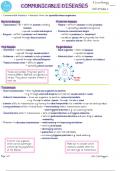
COMMUNICABLE DISEASES OCR A Module 4
• Communicable diseases → diseases that can spread between organisms
Bacterial diseases Protoctist diseases
• Tuberculosis (TB) → affects animals including • Malaria → affects animals including humans
humans → spread by a vector (mosquitos)
→ spread via infected droplets • Potato (or tomato) late blight
• Ring rot → affects potatoes and tomatoes → affects potatoes (or tomatoes)
→ spread through direct contact → produces spores during reproduction that
are spread in the air to other hosts
Viral diseases Fungal diseases
• HIV/AIDS → affects humans • Black sigatoka → affects bananas
→ spread through sexual contact → spread via spores
• Influenza → affects animals including humans • Athlete’s foot → affects humans
→ spread through infected droplets → spread by direct and indirect
• Tobacco mosaic virus → affects plants #A
*
contact
→ spread by direct contact
"
i
Ni
Viruses are acellular. They have genetic
material (RNA or DNA) but no organelles or
nucleus. They cannot replicate without a The HIV
host cell. a
=
virus
Transmission
• Direct transmission → directly from one organism to another
→ e.g. through infected droplets (not plants), sexual contact, touch
• Indirect transmission → from one organism to another via an intermediate
→ e.g. through a vector, spores, through the air or food
• Climate affects transmission e.g. having the ideal temperature for a vector to survive and reproduce
• Living conditions affect transmission → overcrowding makes transmission easier
→ poor hygiene practises e.g. not washing hands
• Social factors affect transmission → lack of sexual education and hygiene education
→ lack of good healthcare facilities and poor drug or vaccine
availability
• Measures to decrease transmission → mask wearing and improving ventilation
→ meeting less people
→ destroying vectors
→ quarantine of infected individuals
→ increasing hygiene practises e.g. hand washing
→ restrict travel
A vector is an organism
which carries a pathogen Make sure to consider which
without getting symptoms measures would be effective
of the disease. for each type of transmission.
Page 1 of 1 © Dr Zoë Huggett
, A Level Biology
PRIMARY DEFENCES OCR A Module 4
Plant defences against pathogens
• Cell walls act as a physical barrier to pathogens → callose can be deposited between the cell wall and
plasma membrane which acts as an extra barrier
• Waxy cuticles are a physical barrier
• Production of toxic antimicrobial chemicals
→ e.g. production of chitinases to break down chitin cell walls of fungi
→ e.g. phytoalexins inhibit growth and reproduction of bacteria and fungi
• Leaf drop → some plants will lose leaves to prevent pathogens from spreading around the plant
Animal primary non-specific defences
• Skin → physical barrier
→ produces antimicrobial chemicals which lower the pH
• Blood clotting → blood clots are a mesh of protein fibres, platelets, and erythrocytes
→ platelets release a substance which results in a soluble plasma protein (fibrinogen)
being converted into an insoluble protein (fibrin) which can trap erythrocytes and
platelets to form a clot
→ blood clots are a physical barrier at wounds
• Wound repair → skin can be repaired by skin cell division and collagen fibres
• Inflammation → mast cells (a type of white blood cell) release histamine
→ histamine increases blood flow through vasodilation, and increases permeability of
the capillaries
→ more white blood cells can enter the affected area
• Expulsive reflexes → coughing and sneezing expels pathogens from the respiratory tract
• Mucous membranes → found at openings to the body e.g. the trachea
→ can contain goblet cells which secrete mucus
→ mucus traps pathogens and contains lysozyme
Page 1 of 1 © Dr Zoë Huggett
COMMUNICABLE DISEASES OCR A Module 4
• Communicable diseases → diseases that can spread between organisms
Bacterial diseases Protoctist diseases
• Tuberculosis (TB) → affects animals including • Malaria → affects animals including humans
humans → spread by a vector (mosquitos)
→ spread via infected droplets • Potato (or tomato) late blight
• Ring rot → affects potatoes and tomatoes → affects potatoes (or tomatoes)
→ spread through direct contact → produces spores during reproduction that
are spread in the air to other hosts
Viral diseases Fungal diseases
• HIV/AIDS → affects humans • Black sigatoka → affects bananas
→ spread through sexual contact → spread via spores
• Influenza → affects animals including humans • Athlete’s foot → affects humans
→ spread through infected droplets → spread by direct and indirect
• Tobacco mosaic virus → affects plants #A
*
contact
→ spread by direct contact
"
i
Ni
Viruses are acellular. They have genetic
material (RNA or DNA) but no organelles or
nucleus. They cannot replicate without a The HIV
host cell. a
=
virus
Transmission
• Direct transmission → directly from one organism to another
→ e.g. through infected droplets (not plants), sexual contact, touch
• Indirect transmission → from one organism to another via an intermediate
→ e.g. through a vector, spores, through the air or food
• Climate affects transmission e.g. having the ideal temperature for a vector to survive and reproduce
• Living conditions affect transmission → overcrowding makes transmission easier
→ poor hygiene practises e.g. not washing hands
• Social factors affect transmission → lack of sexual education and hygiene education
→ lack of good healthcare facilities and poor drug or vaccine
availability
• Measures to decrease transmission → mask wearing and improving ventilation
→ meeting less people
→ destroying vectors
→ quarantine of infected individuals
→ increasing hygiene practises e.g. hand washing
→ restrict travel
A vector is an organism
which carries a pathogen Make sure to consider which
without getting symptoms measures would be effective
of the disease. for each type of transmission.
Page 1 of 1 © Dr Zoë Huggett
, A Level Biology
PRIMARY DEFENCES OCR A Module 4
Plant defences against pathogens
• Cell walls act as a physical barrier to pathogens → callose can be deposited between the cell wall and
plasma membrane which acts as an extra barrier
• Waxy cuticles are a physical barrier
• Production of toxic antimicrobial chemicals
→ e.g. production of chitinases to break down chitin cell walls of fungi
→ e.g. phytoalexins inhibit growth and reproduction of bacteria and fungi
• Leaf drop → some plants will lose leaves to prevent pathogens from spreading around the plant
Animal primary non-specific defences
• Skin → physical barrier
→ produces antimicrobial chemicals which lower the pH
• Blood clotting → blood clots are a mesh of protein fibres, platelets, and erythrocytes
→ platelets release a substance which results in a soluble plasma protein (fibrinogen)
being converted into an insoluble protein (fibrin) which can trap erythrocytes and
platelets to form a clot
→ blood clots are a physical barrier at wounds
• Wound repair → skin can be repaired by skin cell division and collagen fibres
• Inflammation → mast cells (a type of white blood cell) release histamine
→ histamine increases blood flow through vasodilation, and increases permeability of
the capillaries
→ more white blood cells can enter the affected area
• Expulsive reflexes → coughing and sneezing expels pathogens from the respiratory tract
• Mucous membranes → found at openings to the body e.g. the trachea
→ can contain goblet cells which secrete mucus
→ mucus traps pathogens and contains lysozyme
Page 1 of 1 © Dr Zoë Huggett