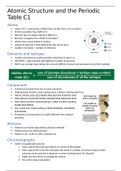
Atomic Structure and the Periodic
Table C1
Atoms
radius of 0.1 nanometres (1000x times smaller than a micro metre)
Proton is positive has a RAM of 1
Neutron has no charge and has a RAM of 1
Electron is negative has a RAM of virtually 0
whole mass concentrated in nucleus
volume of electron’s orbit determines the size of atom
number of protons = number of electrons
Elements and Isotopes
number of protons in nucleus decides what kind of atom it is
ISOTOPES- same element with different number of neutrons
RAM is an average mass taking into account different masses and abundances of all the isotopes
Compounds
Substances formed from two or more elements
Making bonds involves atoms giving away, taking or sharing electrons
METAL ATOMS LOSE ELECTRONS AND BECOME POSITIVE IONS
NON-METALS GAIN ELECTRONS AND BECOME NEGATIVE IONS
Non-Metal and Non-metal bonding is called Covalent bonding-
SHARE ELECTRONS
Non-metal and metal bonding is IONIC BONDING- TRANSFER
ELECTRONS
Properties of compounds are totally different from original
elements
Mixtures
Mixtures are easily separated by physical methods
Mixtures have no chemical bond
Mixtures: air, crude oil, milk, seawater etc
Chromatography
Used to separate dyes and ink
1. Draw a pencil line near the bottom of a sheet of filter paper
2. Add a spot of ink to the line and place the sheet in a beaker of solvent (water) {other
solvents can be used but it depends on what is being tested, EG ethanol}
3. Make sure the ink isn’t touching the solvent
4. Put a lid to stop evaporation
Table C1
Atoms
radius of 0.1 nanometres (1000x times smaller than a micro metre)
Proton is positive has a RAM of 1
Neutron has no charge and has a RAM of 1
Electron is negative has a RAM of virtually 0
whole mass concentrated in nucleus
volume of electron’s orbit determines the size of atom
number of protons = number of electrons
Elements and Isotopes
number of protons in nucleus decides what kind of atom it is
ISOTOPES- same element with different number of neutrons
RAM is an average mass taking into account different masses and abundances of all the isotopes
Compounds
Substances formed from two or more elements
Making bonds involves atoms giving away, taking or sharing electrons
METAL ATOMS LOSE ELECTRONS AND BECOME POSITIVE IONS
NON-METALS GAIN ELECTRONS AND BECOME NEGATIVE IONS
Non-Metal and Non-metal bonding is called Covalent bonding-
SHARE ELECTRONS
Non-metal and metal bonding is IONIC BONDING- TRANSFER
ELECTRONS
Properties of compounds are totally different from original
elements
Mixtures
Mixtures are easily separated by physical methods
Mixtures have no chemical bond
Mixtures: air, crude oil, milk, seawater etc
Chromatography
Used to separate dyes and ink
1. Draw a pencil line near the bottom of a sheet of filter paper
2. Add a spot of ink to the line and place the sheet in a beaker of solvent (water) {other
solvents can be used but it depends on what is being tested, EG ethanol}
3. Make sure the ink isn’t touching the solvent
4. Put a lid to stop evaporation