OTHELLO
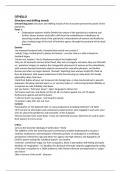
Structure and shifting moods
Overarching point: structure and shifting moods of the characters present the power of the
patriarchy
Point 1:
Shakespeare explores within Othello the nature of the patriarchy to mistreat and
further silence women via Emilia’s shift from the embodiment of obedience to
becoming vocally critical of the patriarchy’s mistreatment of women and finally the
play’s ending image of the lack of feminine agency through the portrayal of the dead
feminine.
Quotes:
‘my wayward husband hath a hundred time woo’d me to steal it’
‘and giv’t Iago I nothing but to please his fantasy’- sees her role as a wife to keep her
husband happy
‘I know not, madam’- lies to Desdemona about the hankercheif
‘they are all stomachs and we all but food, they eat us hungerly and when they are full belch
us’- gustatory imagery to explore the misogynistic placement of women as the subordinate,
with women deemed inanimate objects consumed for masculine pleasure, and further
thrown out when no longer desired. ‘stomach’ depicting how women simply fill a hole to
then be disposed, with sexual undertones of this line focusing on male desire for female
physicality rather than love.
‘slack their duties ad pour our treasures into foreign laps, or else may break out in peevish
jealousies, throwing restraint upon us; or say they strike us’- referencing female infidelity as
a response to male infidelity and abuse
‘get you home’, ‘hold your peace’- Iago’s language to silence her
‘let heaven and men and devils, let the all, all cry shame against me, yet I’ll speak’-
fearlessness against patriarchal power
‘I will not charm my tongue. I am bound to speak.’
‘tis proper I obey him, but not now’
Context:
Presentation of ‘the battered wife’ in many productions including Clint Dyer’s of 2022.
1547 sermon of whoredom and uncleanness stated women who engaged in such acts were
seen to ‘abuse the gentleness and humanity’ of her husband.
Thomas Coryate 1611 travel book: ‘many are esteemed so loose, that they are said to open
their quivers to every arrow’
Critics:
‘prey to the domestic ideology of wifely duty’- Neely
The addition of the her damning social commentary enables Shakespeare to escape a
‘stylised, emberlancic representation of female passivity’ in exchange for a conflicting
perspective of feminine rage and desire for agency, the high rhetoric and hypophora of
Emilia’s speech acting like a political speech- Lisa Jardine
‘common, sometimes vulgar..far from scrupulous, blunt in perception and feeling and quite
destitute of imagination’- A.C Bradley, the dismissal of female inequity suggesting the reality
of the play’s reception to a 1600s audience, with women silenced and expressed as ‘vulgar’
and ‘blunt’
‘dies in service of the truth’- Simpson
,‘othello is concerned…with men’s misunderstanding of women’- Gayle Green
Point 2:
Further Shakespeare expresses an initially contrasting female experience through
Desdemona’s shift from an initially assertive nature to becoming blind sighted into
obedience due to the internalisation of patriarchal ideals. Yet ultimately alike Emilia,
Shakespeare’s structuring of the play finds Desdemona too manifested into the dead
feminine, highlighting the consistent prevalence of male power.
Quotes:
‘devoured up my discourse’
;that I did love the Moor to live with him’
‘she did deceive her father, marrying you, and when she seemed to shake and fear your
looks, she loved the most’- Iago
‘his unkindness may defeat my life but never taint my love’
‘or that mine eyes, mine ears or any sense delighted them in any other form’- apologising for
her beauty
‘smothers her’- Othello’s murder of her
‘nobody. I myself. Farewell.’ – in response to Emilia asking who killed her
Context:
Controlling access to woman’s bodies was a cultural obsession due to the need for a
patriarchal heir
Robert Cleaver 1603 ‘A Godly Forme of Household government’ dictated the need for
patriarchal power structure in the home.
Critics:
‘in spite of her masculine assertiveness in choosing her own husband, Desdemona accepts
her cultures dictum that she must be obedient to males and is self denying in the extreme
when she dies’- Marylin French
A symbol of feminine passivity in the face of adversity -Lisa Jardine
‘the perfection of women is to be characterless…everyone wishes Desdemona for a wife’-
Coleridge
‘Jacobean tragedies offer up their scenes of excessive punishment as if mutilating the female
would correct political corruption’ with the smothering of Desdemona ‘an example of the
silencing of the female political voice’- Tennenhouse
‘a pathetic victim of circumstances’- Penny Gay
the men of the text create ‘the space where in a wife can be killed by her husband’
Point 3:
Finally, the patriarchy is presented by Shakespeare as the paramount source of
validation for other men, allowing access into masculine omnipotence. This is
portrayed via Othello’s shift from choosing his love for Desdemona despite its
unconventional nature in 1570s Venice, to his shift in allegiance to men over and
above his wife as a means to upkeep his status of virility.
Quotes:
‘I love the gentle Desdemona’
, Holds significant military rank within Venetian army having receiving his ‘life and being from
men of royal siege’
‘keep up your bright swords, for the dew will rust them’- eloquent diction and prising for
peace, placing him in the position of an Aristotelian hero.
‘ill-starred’ , ‘fate’- stages the murder as unavoidable
‘where should Othello go?’ uses third person, emphasising the curating of a story and
distancing of himself from his own actions
‘blow me about in winds, roast me in sulphur, wash me in steep down gulfs of liquid fire’-
hyperbolic hellish imagery the abundance of which twists his narrative to appear ingenuine.
‘I have done the state some service and they know it’- seeks to portray a hypermasculine
image
‘like the base Indian’ thrown ‘a pearl away- again upkeeping a story of male power,
objectifying his wife to ‘pearl’
‘a malignant and turbaned Turk’- draws on imagery of war and violence to project himself as
connoted with these images of masculine power.
‘great of heart’- his male comrades are successfully manipulated by Othello.
Context:
Location of Cyprus as a bastion for male power, being close to war and therefore prioritising
military relationships
Historical war of Cyprus 1570-1573 as a backdrop, specifically Battle of Lepanto 1571, where
Cyprus was under Venetian rule and defended from the Turks.
Critics:
‘the most romantic figure among Shakespeare’s heroes’ to whom the audience feel
‘admiration and love’ through his final speech- A.C Bradley 1901
Othello is guilty of self-dramatization and seeking to evade responsibility -T.S Elliot
Othello dies playing his ideal part, he is a static character and sentimentalises himself rather
than growing from tragedy’- F.R Levis
Othello’s love of Desdemona is ‘the love of a possession. She is a prize, a spoil of war’
‘one wonders…whether the men are capable of unselfish love’- Eaj Honigman
‘death was preferable o dishonour’- marian Cox
Uncertainty and suffering
Overarching point: societal standards creates uncertainty and suffering
Point 1:
Shakespeare expresses suffering as stemming from societal inherent beliefs in the
duplicity of women, prevalent within the play when these beliefs create Othello’s
initial uncertainty of Desdemona’s loyalty, which is exacerbated by his peers,
resulting in his malicious destruction of their relationship.
Quotes:
‘virtuous’, ;honest’, ‘gentle,’ fresh and delicate’, ‘obedient’, ‘modest’- language initially used
by Cassio and Othello to describe Desdemona
‘I saw Cassio use this handkerchief to wipe his beard with’ – Iago’s manipulations of Othello
as the handkerchief becomes a metonymic representation of Othello and Desdemona’s
wedding sheets
‘in Venice they do let God see the pranks they dare not show their husbands. Their best
conscience is not leave’t undone, but keep’t unknown’
‘her name, that was as fresh as Dian’s visage is now begremined and black as mine own face’
Structure and shifting moods
Overarching point: structure and shifting moods of the characters present the power of the
patriarchy
Point 1:
Shakespeare explores within Othello the nature of the patriarchy to mistreat and
further silence women via Emilia’s shift from the embodiment of obedience to
becoming vocally critical of the patriarchy’s mistreatment of women and finally the
play’s ending image of the lack of feminine agency through the portrayal of the dead
feminine.
Quotes:
‘my wayward husband hath a hundred time woo’d me to steal it’
‘and giv’t Iago I nothing but to please his fantasy’- sees her role as a wife to keep her
husband happy
‘I know not, madam’- lies to Desdemona about the hankercheif
‘they are all stomachs and we all but food, they eat us hungerly and when they are full belch
us’- gustatory imagery to explore the misogynistic placement of women as the subordinate,
with women deemed inanimate objects consumed for masculine pleasure, and further
thrown out when no longer desired. ‘stomach’ depicting how women simply fill a hole to
then be disposed, with sexual undertones of this line focusing on male desire for female
physicality rather than love.
‘slack their duties ad pour our treasures into foreign laps, or else may break out in peevish
jealousies, throwing restraint upon us; or say they strike us’- referencing female infidelity as
a response to male infidelity and abuse
‘get you home’, ‘hold your peace’- Iago’s language to silence her
‘let heaven and men and devils, let the all, all cry shame against me, yet I’ll speak’-
fearlessness against patriarchal power
‘I will not charm my tongue. I am bound to speak.’
‘tis proper I obey him, but not now’
Context:
Presentation of ‘the battered wife’ in many productions including Clint Dyer’s of 2022.
1547 sermon of whoredom and uncleanness stated women who engaged in such acts were
seen to ‘abuse the gentleness and humanity’ of her husband.
Thomas Coryate 1611 travel book: ‘many are esteemed so loose, that they are said to open
their quivers to every arrow’
Critics:
‘prey to the domestic ideology of wifely duty’- Neely
The addition of the her damning social commentary enables Shakespeare to escape a
‘stylised, emberlancic representation of female passivity’ in exchange for a conflicting
perspective of feminine rage and desire for agency, the high rhetoric and hypophora of
Emilia’s speech acting like a political speech- Lisa Jardine
‘common, sometimes vulgar..far from scrupulous, blunt in perception and feeling and quite
destitute of imagination’- A.C Bradley, the dismissal of female inequity suggesting the reality
of the play’s reception to a 1600s audience, with women silenced and expressed as ‘vulgar’
and ‘blunt’
‘dies in service of the truth’- Simpson
,‘othello is concerned…with men’s misunderstanding of women’- Gayle Green
Point 2:
Further Shakespeare expresses an initially contrasting female experience through
Desdemona’s shift from an initially assertive nature to becoming blind sighted into
obedience due to the internalisation of patriarchal ideals. Yet ultimately alike Emilia,
Shakespeare’s structuring of the play finds Desdemona too manifested into the dead
feminine, highlighting the consistent prevalence of male power.
Quotes:
‘devoured up my discourse’
;that I did love the Moor to live with him’
‘she did deceive her father, marrying you, and when she seemed to shake and fear your
looks, she loved the most’- Iago
‘his unkindness may defeat my life but never taint my love’
‘or that mine eyes, mine ears or any sense delighted them in any other form’- apologising for
her beauty
‘smothers her’- Othello’s murder of her
‘nobody. I myself. Farewell.’ – in response to Emilia asking who killed her
Context:
Controlling access to woman’s bodies was a cultural obsession due to the need for a
patriarchal heir
Robert Cleaver 1603 ‘A Godly Forme of Household government’ dictated the need for
patriarchal power structure in the home.
Critics:
‘in spite of her masculine assertiveness in choosing her own husband, Desdemona accepts
her cultures dictum that she must be obedient to males and is self denying in the extreme
when she dies’- Marylin French
A symbol of feminine passivity in the face of adversity -Lisa Jardine
‘the perfection of women is to be characterless…everyone wishes Desdemona for a wife’-
Coleridge
‘Jacobean tragedies offer up their scenes of excessive punishment as if mutilating the female
would correct political corruption’ with the smothering of Desdemona ‘an example of the
silencing of the female political voice’- Tennenhouse
‘a pathetic victim of circumstances’- Penny Gay
the men of the text create ‘the space where in a wife can be killed by her husband’
Point 3:
Finally, the patriarchy is presented by Shakespeare as the paramount source of
validation for other men, allowing access into masculine omnipotence. This is
portrayed via Othello’s shift from choosing his love for Desdemona despite its
unconventional nature in 1570s Venice, to his shift in allegiance to men over and
above his wife as a means to upkeep his status of virility.
Quotes:
‘I love the gentle Desdemona’
, Holds significant military rank within Venetian army having receiving his ‘life and being from
men of royal siege’
‘keep up your bright swords, for the dew will rust them’- eloquent diction and prising for
peace, placing him in the position of an Aristotelian hero.
‘ill-starred’ , ‘fate’- stages the murder as unavoidable
‘where should Othello go?’ uses third person, emphasising the curating of a story and
distancing of himself from his own actions
‘blow me about in winds, roast me in sulphur, wash me in steep down gulfs of liquid fire’-
hyperbolic hellish imagery the abundance of which twists his narrative to appear ingenuine.
‘I have done the state some service and they know it’- seeks to portray a hypermasculine
image
‘like the base Indian’ thrown ‘a pearl away- again upkeeping a story of male power,
objectifying his wife to ‘pearl’
‘a malignant and turbaned Turk’- draws on imagery of war and violence to project himself as
connoted with these images of masculine power.
‘great of heart’- his male comrades are successfully manipulated by Othello.
Context:
Location of Cyprus as a bastion for male power, being close to war and therefore prioritising
military relationships
Historical war of Cyprus 1570-1573 as a backdrop, specifically Battle of Lepanto 1571, where
Cyprus was under Venetian rule and defended from the Turks.
Critics:
‘the most romantic figure among Shakespeare’s heroes’ to whom the audience feel
‘admiration and love’ through his final speech- A.C Bradley 1901
Othello is guilty of self-dramatization and seeking to evade responsibility -T.S Elliot
Othello dies playing his ideal part, he is a static character and sentimentalises himself rather
than growing from tragedy’- F.R Levis
Othello’s love of Desdemona is ‘the love of a possession. She is a prize, a spoil of war’
‘one wonders…whether the men are capable of unselfish love’- Eaj Honigman
‘death was preferable o dishonour’- marian Cox
Uncertainty and suffering
Overarching point: societal standards creates uncertainty and suffering
Point 1:
Shakespeare expresses suffering as stemming from societal inherent beliefs in the
duplicity of women, prevalent within the play when these beliefs create Othello’s
initial uncertainty of Desdemona’s loyalty, which is exacerbated by his peers,
resulting in his malicious destruction of their relationship.
Quotes:
‘virtuous’, ;honest’, ‘gentle,’ fresh and delicate’, ‘obedient’, ‘modest’- language initially used
by Cassio and Othello to describe Desdemona
‘I saw Cassio use this handkerchief to wipe his beard with’ – Iago’s manipulations of Othello
as the handkerchief becomes a metonymic representation of Othello and Desdemona’s
wedding sheets
‘in Venice they do let God see the pranks they dare not show their husbands. Their best
conscience is not leave’t undone, but keep’t unknown’
‘her name, that was as fresh as Dian’s visage is now begremined and black as mine own face’