Macbeth
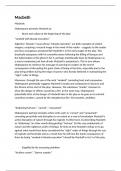
Macbeth:
Shakespeare presents Macbeth as:
- Brave and valiant at the beginning of the play
“smoked with bloody execution”
Adjective “bloody”/ noun phrase “bloody execution” are both examples of violent
imagery, conjuring a visceral image in the mind of the reader – suggests to the reader
just how courageous and powerful Macbeth is in the early stages of the play. This
drastically juxtaposes with his cowardly nature following the killing of Banquo and
the hallucination of his ghost in Act 3, perhaps intentionally done by Shakespeare as
a way to emphasise just how drastic Macbeth’s peripeteia is. This in turn allows
Shakespeare to reinforce his message of warning his readers of the severe
consequence of disrupting the great chain of being at the time, especially due to the
play being written during the reign of James I who heavily believed in maintaining the
“right” order of things.
Moreover, through the use of the verb “smoked” connoting heat and compassion,
Shakespeare potentially suggests Macbeth’s loyalty and compassion to Duncan and
the throne at the start of the play. However, the substance “smoke” is known to
show the danger or effects caused by a fire. In the same way, Shakespeare
potentially hints at the danger of Macbeth later in the play as he goes on to commit
countless murders, caused by the metaphorical fire: his hamartia, ambition.
“disdaining fortune”, “carved”, “unseamed”
Shakespeare perhaps includes active verbs such as “carved” and “unseamed”
connoting proactivity and disruption to an extent as a way to foreshadow Macbeth’s
active disruption of nature through his regicide. Furthermore, by describing Macbeth
as “disdaining” (in other words disregarding) “fortune” (in this case emblematic of
nature and the righteous order of things), he hints at how Macbeth will go on to go
against what would have been considered the “right” order of things through his acts
of regicide and homicide and as a result how he will face the harsh consequence of
them by being “smoked in bloody execution” himself by Macduff in Act 5 of the play.
- Engulfed by his unceasing ambition
“fruitless crown”, “barren sceptre”
Macbeth:
Shakespeare presents Macbeth as:
- Brave and valiant at the beginning of the play
“smoked with bloody execution”
Adjective “bloody”/ noun phrase “bloody execution” are both examples of violent
imagery, conjuring a visceral image in the mind of the reader – suggests to the reader
just how courageous and powerful Macbeth is in the early stages of the play. This
drastically juxtaposes with his cowardly nature following the killing of Banquo and
the hallucination of his ghost in Act 3, perhaps intentionally done by Shakespeare as
a way to emphasise just how drastic Macbeth’s peripeteia is. This in turn allows
Shakespeare to reinforce his message of warning his readers of the severe
consequence of disrupting the great chain of being at the time, especially due to the
play being written during the reign of James I who heavily believed in maintaining the
“right” order of things.
Moreover, through the use of the verb “smoked” connoting heat and compassion,
Shakespeare potentially suggests Macbeth’s loyalty and compassion to Duncan and
the throne at the start of the play. However, the substance “smoke” is known to
show the danger or effects caused by a fire. In the same way, Shakespeare
potentially hints at the danger of Macbeth later in the play as he goes on to commit
countless murders, caused by the metaphorical fire: his hamartia, ambition.
“disdaining fortune”, “carved”, “unseamed”
Shakespeare perhaps includes active verbs such as “carved” and “unseamed”
connoting proactivity and disruption to an extent as a way to foreshadow Macbeth’s
active disruption of nature through his regicide. Furthermore, by describing Macbeth
as “disdaining” (in other words disregarding) “fortune” (in this case emblematic of
nature and the righteous order of things), he hints at how Macbeth will go on to go
against what would have been considered the “right” order of things through his acts
of regicide and homicide and as a result how he will face the harsh consequence of
them by being “smoked in bloody execution” himself by Macduff in Act 5 of the play.
- Engulfed by his unceasing ambition
“fruitless crown”, “barren sceptre”