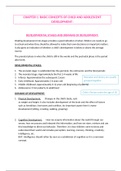
CHAPTER 1: BASIC CONCEPTS OF CHILD AND ADOLESCENT
DEVELOPMENT:
DEVELOPMENTAL STAGES AND DOMAINS OF DEVELOPMENT:
Dividing development into stages provides a good indication of when children are ready to go
to school and when they should be allowed to make their own decisions on important matters.
It also gives an indication of whether a child’s development is below or above the average
(norm).
The prenatal phase is when the child is still in the womb and the postnatal phase is the period
after birth.
DEVELOPMENTAL STAGES:
1. The prenatal stage: Is subdivided into the germinal, the embryonic and the fetal periods
2. The neonatal stage: Approximately the first 2-4 weeks of life
3. Infancy: Approximately the subsequent 2 years Neonatal and infancy are usually
4. Early childhood: Approximately 2-6 years old grouped together
5. Middle childhood: Approximately 6-12 years old (beginning of puberty)
6. Adolescence: From puberty to adulthood
DOMAINS OF DEVELOPMENT: Child = Person under the age of 18
1. Physical Development: Changes in the child’s body, such
as weight and height. It also includes development of the brain and the effect of factors
such as hereditary, hormones and nutrition. An important aspect here is motor
development (sitting, crawling, walking, grasping).
2. Cognitive Development: How we acquire information about the world through our
senses, how we process and interpret this information, and how we store, retrieve and use
this knowledge to direct our behavior. Therefore, it is how children come to know and
understand their world and includes perception, learning, memory, thinking, creativity,
intelligence, etc.
BUT: Intelligence should rather be seen as a subdivision of cognition as it is a narrower
concept.
, 3. Personality Development: The totality of a persons psychological, social, moral and
physical characteristics. (UNIQUE TO EVERY INDIVIDUAL) njvdjvhhhhhhhhhhhhhhhhhhh
The self can be regarded as the core of a person’s personality. The self-concept
refers to a person’s evaluation of their self. Identity is the way a person identifies
themselves in relation to others. The way a person expresses their emotions is also crucial
to who they are.
4. Social Development: Involves interactions and relationships with other people. jjjkkk
It also refers to the influence of society and significant others on the individual. It includes
attachment between caregiver and child, expansion of interpersonal relationships,
modelling of behavior and the development of relationships between the sexes. (DO NOT
CONFUSE WITH SOCIALISATION) nnnnnnnnnnnnnnnnnnnnnnnnnnnnnn
An important aspect is moral development – which involves the views concerning what is
right and wrong as well as the way in which moral judgements are made. nnnnnnnnnn
Religion and spirituality also fall under social development.
DEVELOPMENTAL ISSUES:
- Nature vs. Nurture
- Continuity vs. Discontinuity
- Passive vs. Active Involvement
- Universality vs. Cultural Context
NATURE VS. NURTURE:
-Nature refers to biological determinants such as genetic, neurological and hormonal factors.
-Nurture refers to environmental factors such as the social (parenting styles) and physical
(poverty) environment.
THEREFORE, is it genetic or environmental? =BOTH
-The question now is how these factors contribute to specific behaviors, situations and
individuals.
CONTINUITY VS. DISCONTINUITY:
-Is human development gradual and smooth or is it abrupt and occurring in distinct steps or
stages?
Both are correct – It depends on the type of behavior.
DEVELOPMENT:
DEVELOPMENTAL STAGES AND DOMAINS OF DEVELOPMENT:
Dividing development into stages provides a good indication of when children are ready to go
to school and when they should be allowed to make their own decisions on important matters.
It also gives an indication of whether a child’s development is below or above the average
(norm).
The prenatal phase is when the child is still in the womb and the postnatal phase is the period
after birth.
DEVELOPMENTAL STAGES:
1. The prenatal stage: Is subdivided into the germinal, the embryonic and the fetal periods
2. The neonatal stage: Approximately the first 2-4 weeks of life
3. Infancy: Approximately the subsequent 2 years Neonatal and infancy are usually
4. Early childhood: Approximately 2-6 years old grouped together
5. Middle childhood: Approximately 6-12 years old (beginning of puberty)
6. Adolescence: From puberty to adulthood
DOMAINS OF DEVELOPMENT: Child = Person under the age of 18
1. Physical Development: Changes in the child’s body, such
as weight and height. It also includes development of the brain and the effect of factors
such as hereditary, hormones and nutrition. An important aspect here is motor
development (sitting, crawling, walking, grasping).
2. Cognitive Development: How we acquire information about the world through our
senses, how we process and interpret this information, and how we store, retrieve and use
this knowledge to direct our behavior. Therefore, it is how children come to know and
understand their world and includes perception, learning, memory, thinking, creativity,
intelligence, etc.
BUT: Intelligence should rather be seen as a subdivision of cognition as it is a narrower
concept.
, 3. Personality Development: The totality of a persons psychological, social, moral and
physical characteristics. (UNIQUE TO EVERY INDIVIDUAL) njvdjvhhhhhhhhhhhhhhhhhhh
The self can be regarded as the core of a person’s personality. The self-concept
refers to a person’s evaluation of their self. Identity is the way a person identifies
themselves in relation to others. The way a person expresses their emotions is also crucial
to who they are.
4. Social Development: Involves interactions and relationships with other people. jjjkkk
It also refers to the influence of society and significant others on the individual. It includes
attachment between caregiver and child, expansion of interpersonal relationships,
modelling of behavior and the development of relationships between the sexes. (DO NOT
CONFUSE WITH SOCIALISATION) nnnnnnnnnnnnnnnnnnnnnnnnnnnnnn
An important aspect is moral development – which involves the views concerning what is
right and wrong as well as the way in which moral judgements are made. nnnnnnnnnn
Religion and spirituality also fall under social development.
DEVELOPMENTAL ISSUES:
- Nature vs. Nurture
- Continuity vs. Discontinuity
- Passive vs. Active Involvement
- Universality vs. Cultural Context
NATURE VS. NURTURE:
-Nature refers to biological determinants such as genetic, neurological and hormonal factors.
-Nurture refers to environmental factors such as the social (parenting styles) and physical
(poverty) environment.
THEREFORE, is it genetic or environmental? =BOTH
-The question now is how these factors contribute to specific behaviors, situations and
individuals.
CONTINUITY VS. DISCONTINUITY:
-Is human development gradual and smooth or is it abrupt and occurring in distinct steps or
stages?
Both are correct – It depends on the type of behavior.