Lecture 1: Types of Tissue
Wednesday, 18 March 2015 2:21 p.m.
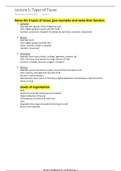
Name the 4 types of tissue, give examples and name their function
1. Epithelial
Example: skin, glands, lining of digestive tract
Cells: tightly packed in layers and little ECM
Function: protection, transport of substances (secretion, excretion, absorption)
2. Muscle
Example: heart
Cells: tightly packed and fibre like
Types: smooth, cardiac or skeletal
Function: movement
3. Connective
Example: bone tissue, blood, cartilage, ligaments, tendons, fat
Cells: not many, very spread out, large amount of ECM
Function: strength, structure, support, transport
4. Nervous
Example: nerves and sensory organs, tissue of brain and spinal cord
Cells: neurons, neuroglia and very little ECM
Function: communication
Operates best when warm so the body is highly adapted to maintaining an optimal heat for
nervous tissue
Levels of organisation
Body
System (functionally related group of organs)
Organ (collection of tissues)
Tissue (group of similar cells and ecm)
Cells
Organelles (tiny organ that aids functioning of a cell)
Atomic and molecular
MUSCULOSKELETAL SYSTEM Page 1
, Lecture 2: Homeostatic Control; Physiological Control
Systems
Wednesday, 18 March 2015 2:15 p.m.
Describe the differences between multicellular and unicellular
organisms
Unicellular organisms like amoeba depends on the immediate external environment to provide
conditions conducive to their survival ->
1. Nutrients
2. Solute concentration
3. Temperature
4. pH
5. Toxins
6. Predators
Being unicellular limits the type of environments which organisms can successfully inhabit because
their immediate surroundings must supply the appropriate nutrients and conditions
Multicellular organisms - cells specialize and then combine to form tissues, organs and organ
systems which are capable of providing individual cells with a stable environment inside the body -
this means that the external environment is less critical and allows multicellular organism to thrive in
a wide variety of conditions
Define homeostasis and explain why ECF composition is regulated in multicellular organisms
Homeostasis is the maintenance of a relatively constant internal environment in the face of internal
or external change.
The ECF is the external environment for the cell, and so must be controlled in order to achieve
homeostasis.
⅔ ICF
⅓ ECF, which is made from 4/5 interstitual fluid in the body and 1/5 is plasma/blood
ECF ICF
Cl- 104 4
K+ 4 150
Na+ 142 12
Understand the importance of controlling selected ECF variables
and be able to state their normal range
Controlling selected ECF variables is important and beneficial because it means that passive
transport/diffusion can be used to get materials inside the cell. If there were too many materials
then too much could diffuse in. If there are too little, the cell would be deficient of ions and
nutrients and not be able to survive.
Normal range of selected ECF variables from most abundant in ECF to least:
Na+ = 135-145 mmol/L
Important in blood pressure, action potential generation, blood volume
Glucose (non fasting e.g. after a meal) = 3.5-8 mmol/L
Used by cells for energy to produce ATP
Glucose (fasting) = 3.5-6 mmol/L
MUSCULOSKELETAL SYSTEM Page 2
,K+ = 3.5-5 mmol/L
Main intracellular cation, RMP determinant, if too low leads to muscle weakness and cardiac
arrhythmia
Ca2+ = 2.1-2.6
Important for bone and teeth, neurotransmission, muscle contraction, coagulation, enzyme function
pH = 7.35-7.45
If too high, alkalosis where you get muscle spasms and convulsions
If too low, acidosis where you get decreased neuronal functioning
Core body temperature = 37 degrees
If too high, enzymes denature
If too low, reactions don't occur as the activation energy not reached
Outline selected transport mechanisms across cell membranes
Diffusion
- Down the concentration gradient
- High concentration to low concentration
- No energy needed
- Passive form of transport
- Molecules such as oxygen, carbon dioxide, steroid hormones and anaesthetic agents travel
this way
Osmosis
- Just water
Facilitated
- Through channels or carrier mediated
- Ions like K+, Ca2+ and Na+ travel this way through channels
- Glucose entry to cells when insulin is present is carrier mediated facilitated diffusion
Active Transport
- Up the concentration gradient
- Low concentration to high concentration
- Requires energy (ATP)
- Uses channels and pumps
- e.g. Ca2+, Na+, K+
Define osmosis, osmolarity and tonicity, and understand their
relevance to cell volume
Osmolarity:
- Stops cells shrinking or exploding
- Creates an osmotic gradient
- 275-300 mmol/L
- Should be the same in ECF and ICF
- Total number of solute particles per litre of solution
Osmosis: the passive diffusion of water across a cell membrane
Tonicity:
- A specific solute's concentration
- Iso = same conc on inside and outside
- Usually used in relative terms
- Hypotonic solutions cause cells to grow as there is a lower conc on the inside of the cell
- Hypertonic solutions cause cells to shrink as there is a higher conc on the inside of cell
MUSCULOSKELETAL SYSTEM Page 3
, - Hypertonic solutions cause cells to shrink as there is a higher conc on the inside of cell
MUSCULOSKELETAL SYSTEM Page 4
Wednesday, 18 March 2015 2:21 p.m.
Name the 4 types of tissue, give examples and name their function
1. Epithelial
Example: skin, glands, lining of digestive tract
Cells: tightly packed in layers and little ECM
Function: protection, transport of substances (secretion, excretion, absorption)
2. Muscle
Example: heart
Cells: tightly packed and fibre like
Types: smooth, cardiac or skeletal
Function: movement
3. Connective
Example: bone tissue, blood, cartilage, ligaments, tendons, fat
Cells: not many, very spread out, large amount of ECM
Function: strength, structure, support, transport
4. Nervous
Example: nerves and sensory organs, tissue of brain and spinal cord
Cells: neurons, neuroglia and very little ECM
Function: communication
Operates best when warm so the body is highly adapted to maintaining an optimal heat for
nervous tissue
Levels of organisation
Body
System (functionally related group of organs)
Organ (collection of tissues)
Tissue (group of similar cells and ecm)
Cells
Organelles (tiny organ that aids functioning of a cell)
Atomic and molecular
MUSCULOSKELETAL SYSTEM Page 1
, Lecture 2: Homeostatic Control; Physiological Control
Systems
Wednesday, 18 March 2015 2:15 p.m.
Describe the differences between multicellular and unicellular
organisms
Unicellular organisms like amoeba depends on the immediate external environment to provide
conditions conducive to their survival ->
1. Nutrients
2. Solute concentration
3. Temperature
4. pH
5. Toxins
6. Predators
Being unicellular limits the type of environments which organisms can successfully inhabit because
their immediate surroundings must supply the appropriate nutrients and conditions
Multicellular organisms - cells specialize and then combine to form tissues, organs and organ
systems which are capable of providing individual cells with a stable environment inside the body -
this means that the external environment is less critical and allows multicellular organism to thrive in
a wide variety of conditions
Define homeostasis and explain why ECF composition is regulated in multicellular organisms
Homeostasis is the maintenance of a relatively constant internal environment in the face of internal
or external change.
The ECF is the external environment for the cell, and so must be controlled in order to achieve
homeostasis.
⅔ ICF
⅓ ECF, which is made from 4/5 interstitual fluid in the body and 1/5 is plasma/blood
ECF ICF
Cl- 104 4
K+ 4 150
Na+ 142 12
Understand the importance of controlling selected ECF variables
and be able to state their normal range
Controlling selected ECF variables is important and beneficial because it means that passive
transport/diffusion can be used to get materials inside the cell. If there were too many materials
then too much could diffuse in. If there are too little, the cell would be deficient of ions and
nutrients and not be able to survive.
Normal range of selected ECF variables from most abundant in ECF to least:
Na+ = 135-145 mmol/L
Important in blood pressure, action potential generation, blood volume
Glucose (non fasting e.g. after a meal) = 3.5-8 mmol/L
Used by cells for energy to produce ATP
Glucose (fasting) = 3.5-6 mmol/L
MUSCULOSKELETAL SYSTEM Page 2
,K+ = 3.5-5 mmol/L
Main intracellular cation, RMP determinant, if too low leads to muscle weakness and cardiac
arrhythmia
Ca2+ = 2.1-2.6
Important for bone and teeth, neurotransmission, muscle contraction, coagulation, enzyme function
pH = 7.35-7.45
If too high, alkalosis where you get muscle spasms and convulsions
If too low, acidosis where you get decreased neuronal functioning
Core body temperature = 37 degrees
If too high, enzymes denature
If too low, reactions don't occur as the activation energy not reached
Outline selected transport mechanisms across cell membranes
Diffusion
- Down the concentration gradient
- High concentration to low concentration
- No energy needed
- Passive form of transport
- Molecules such as oxygen, carbon dioxide, steroid hormones and anaesthetic agents travel
this way
Osmosis
- Just water
Facilitated
- Through channels or carrier mediated
- Ions like K+, Ca2+ and Na+ travel this way through channels
- Glucose entry to cells when insulin is present is carrier mediated facilitated diffusion
Active Transport
- Up the concentration gradient
- Low concentration to high concentration
- Requires energy (ATP)
- Uses channels and pumps
- e.g. Ca2+, Na+, K+
Define osmosis, osmolarity and tonicity, and understand their
relevance to cell volume
Osmolarity:
- Stops cells shrinking or exploding
- Creates an osmotic gradient
- 275-300 mmol/L
- Should be the same in ECF and ICF
- Total number of solute particles per litre of solution
Osmosis: the passive diffusion of water across a cell membrane
Tonicity:
- A specific solute's concentration
- Iso = same conc on inside and outside
- Usually used in relative terms
- Hypotonic solutions cause cells to grow as there is a lower conc on the inside of the cell
- Hypertonic solutions cause cells to shrink as there is a higher conc on the inside of cell
MUSCULOSKELETAL SYSTEM Page 3
, - Hypertonic solutions cause cells to shrink as there is a higher conc on the inside of cell
MUSCULOSKELETAL SYSTEM Page 4