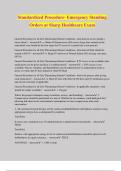
Standardized Procedure- Emergency Standing Orders at Sharp Healthcare Exam
Standardized Procedure- Emergency Standing Orders at Sharp Healthcare Exam General Procedure for all Life-Threatening Patient Conditions- what kind of access should a nurse obtain? - Answer️️ - a. Obtain IV/intraosseous (IO) access (large bore cannula in the antecubital vein should be the first target for IV access if a central line is not present) General Procedure for all Life-Threatening Patient Conditions- what kind of fluid should be started to KVO? - Answer️️ - b. Begin IV infusion of Normal Saline (NS) to keep vein open (KVO) General Procedure for all Life-Threatening Patient Conditions- If IV access is not available what medications can be given and how is it administered? - Answer️️ - c. If IV access is not available: Narcan, Atropine, and Epinephrine may be administered via endotracheal route at doses of 2 times the IV dose diluted in 10ml NS flush General Procedure for all Life-Threatening Patient Conditions- what's the process after giving each medication? - Answer️️ - d. Flush IV line with 20ml of NS after each IV medication given and elevate extremity if applicable. General Procedure for all Life-Threatening Patient Conditions- In applicable situations, what should be readily available? - Answer️️ - e. Oxygen What's the proper techniques using circulation, airway, and breathing? - Answer️️ - 1. Compressions should be performed at a rate of 100/min for two minutes "push hard,push fast" allowing full chest recoil, and minimize interruptions in chest compressions after each intervention. 2. All external electrical therapy will be cardioverted/defibrillated with biphasic monitors using appropriate energy dose as designated by condition. True/False In most cases, treatment (e.g. O2 administration) is administered concurrently. - Answer️️ - TRUE True/False Stickers with appropriate energy levels of cardioversion/defibrillation should be placed on all defibrillators for quick reference. - Answer️️ - TRUE ASYSTOLE - Answer️️ - 1. CPR (2 min) 2. O2 at 15ml/min ambu bag (8-10 breaths/min) 3. Epinephrine (1:10,000) 1mg IVP/IO, repeat q3-5 min as long as asystole persists. BRADYCARDIA UNSTABLE (Heart Rate <60bpm) - Answer️️ - 1. O2 at minimum 10ml/mim NRBM 2. If transvenous leads or epicardial pacing wires present, connect to a pulse generator and initiate pacing control. 3. Atropine 0.5mg IVP/IO, repeat q3-5min up to a total of 0.04mg/kg (or 3mg) 4. Transcutaneous pacing as soon as available 5. If above algorithm is ineffective, start dopamine 400mg/250ml D5W infusion at 5mcg/kg/minute. Titrate until SBP =/> 90mmHg and/or MAP >60mmHg up to 20mcg/kg/min. 6. If no response from above algorithm, initiate Isuprel infusion 1-10mcg/min IV/IO) PULSELESS ELECTRICAL ACTIVITY (PEA) - Answer️️ - 1. CPR (2min) and assess for possible causes. 2. O2 at 15ml/min ambubag (8-10breaths/min) 3. Epinephrine (1:10,000) 1mg IVP/IO, repeat q3-5mim 4. If hypovolemia known or suspected, infuse 250ml LR or NS. Repeat in 5 minutes if no clinical improvement. 5. Stat CXR What are the 7 H's possible causes of PEA? - Answer️️ - 1. Hypovolemia 2. Hypoxia 3. Hydrogen Ion (acidos

Geschreven voor
- Instelling
- Sharp ESO
- Vak
- Sharp ESO
Documentinformatie
- Geüpload op
- 19 april 2024
- Aantal pagina's
- 9
- Geschreven in
- 2023/2024
- Type
- Tentamen (uitwerkingen)
- Bevat
- Vragen en antwoorden
Onderwerpen
-
standardized procedure emergency standing orders

Ook beschikbaar in voordeelbundel