UCLA SOC 1 FINAL EXAM QUESTIONS WITH 100% CORRECT ANSWERS 2024
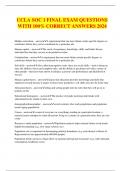
UCLA SOC 1 FINAL EXAM QUESTIONS WITH 100% CORRECT ANSWERS 2024 Hidden curriculum: - answerA requirement that one must obtain certain specific degrees or certificates before they can be considered for a particular job. Human capital: - answerThe stock of experience, knowledge, skills, and habits that an individual has that they can use to do productive labor. Credentialism - answerA requirement that one must obtain certain specific degrees or certificates before they can be considered for a particular job. Soft skills - answerAlso called noncognitive traits, these are social skills—such as being on time, the ability to focus and complete tasks, and the ability to get along well with a variety of other people—that have been shown to enhance a person's job performance and likelihood of success. Human capital theory - answerargues that education provides knowledge and skills that employers reward because it makes workers more productive; soft skills may also be in the ring' Allocation theory - answersifting and sorting people into the roles that they will go on to perform in life. Educational homogamy: - answerThe practice of people marrying individuals with educational levels similar to their own. demography/demographer: - answersocial scientists who study populations and population trends (aging population) Census - answera count of everyone (or everything) residing in a particular location; a national census attempts to count all persons living in a country at a particular time; they are very costly Reasons to study population - answerPopulation analysis helps estimate future social trends helpful for planning (e.g., how many schools, etc.) Population size is important for determining political boundaries (e.g, each district in House of Representatives has approximately 600,000 people) Population trends can have a huge effect on national and regional economies (e.g., labor demand, consumption, healthcare costs) Fertility - answerbirth rate is typically measured by the number of live births per woman of childbearing years Mortality - answerDEATH RATE Migration - answerthe movement into and out of a region or country Total fertility rate - answerdefined by the number of children an average woman has in her lifetime Replacement fertility: - answerthe number of children per woman necessary to replace the population; about 2.1 children per woman Age pyramids: - answerplot the size of the population in each age group for men and women; lower age groups are at the bottom Population momentum - answerOccurs because the cohort of women of childbearing age may still be large or growing even though the fertility rate declined. Epidemiology - answerthe study of health-related events in populations, their characteristics, their causes, and their consequences Epidemiological transition: - answerrefers to the transition of a population from health conditions primarily involving infectious disease... to health conditions primarily involving chronic disease "Baby boom" - answerrefers to the period following World War II from 1946 to 1964, during which the U.S. experienced a temporary spike in fertility Cohort - answerrefers to persons born during the same time period Life expectancy - answerthe average number of years that a population at some age can expect to live Megacity - answercities with populations over 10 million like mexico city Megaregion - answerformed when two or more large cities in geographical proximity are linked together through infrastructure and through economic activity Suburb - answerare areas within metropolitan regions but outside the political boundaries of central cities; fostered by government subsidies for home ownership and highway construction Redlining - answerpredominantly black or racially mixed neighborhoods were outlined in red on maps Suburban sprawl - answerresults from the stretching out of suburban boundaries
Geschreven voor
- Instelling
- UCLA
- Vak
- UCLA
Documentinformatie
- Geüpload op
- 3 april 2024
- Aantal pagina's
- 7
- Geschreven in
- 2023/2024
- Type
- Tentamen (uitwerkingen)
- Bevat
- Vragen en antwoorden
Onderwerpen
-
ucla soc 1 final exam questions with 100 correct

Ook beschikbaar in voordeelbundel