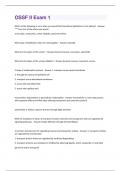
OSSF II Exam 1 Questions and Answers(A+ Solution guide)
Which of the following is not a place you would find transitional epithelium in the kidney? - Answer- *** here are all the places you would renal calyx, renal pelvis, ureter, bladder, proximal urethra What type of epitihelium lines the renal papilla? - Answer-cuboidal What are the layers of the ureter? - Answer-(lumen) mucosa, muscularis, adventitia What are the layers of the urinary bladder? - Answer-(lumen) mucosa, muscularis, serosa 5 steps of reabsorption process - Answer-1. transport across apical membrane 2. through the cytosol of epithelial cell 3. transport across basolateral membrane 4. across the interstitial fluid 5. across the capillary wall transcellular reabsorption vs paracellular reabsorption - Answer-transcellular is a two step process with separate efflux and influx steps utilizing transporters and channels (active?) paracellular is always a passive process through tight junctions With the exception of what, all transport involves channels and transporters that are regulated by signaling pathways. - Answer-simple diffusion through the lipid bilayer 3 common mechanisms for regulating channel and transporter activity - Answer-1. transport proteins are regulated by translocation 2. transport protein levels are regulated by synthesis/degredation 3. transport proteins are activated or inhibited by attaching ligands, either covalently or reversibly (primarily active transport)What is the main driver for Na being reabsorbed? - Answer-electrochemical gradient What allows various reabsorbed constituents "against" their concentration gradients? - Answersymport processes (Na coupled) What transporters are involved in glucose reabsorption? Which of them are insulin independent? - Answer-SGLT 1 and 2 (and GLUT 1 and 2) What transporters are on the apical membrane? - Answer-SGLT 1 (2 Na 1 glucose) and 2 (1 Na and 1 glucose) What transporters are on the basal membrane? - Answer-GLUT 1 and 2 Where does renal glucose reabsorption occur? - Answer-in the proximal convoluted tubule (segments 1, 2, and 3) Where does the majority of glucose get filtered? - Answer-S1 segment of the proximal convoluted tubule 90% happens here via SGLT 2 and GLUT 2 True or False. At normal levels of plasma glucose, all filtered glucose is absorbed and none should be excreted. - Answer-true - why you shouldn't see glucose in the urine When would osmolality (kg) and osmolarity (L) be essentially equivalent? - Answer-in a dilute solution like plasma or serum The number of ionic charges per liter - Answer-milliequivalents/liter At what pH is blood/interstitial fluid regulated? - Answer-7.38 - 7.4 - said we didn't need to memorize numbers but should know its slightly alkaline (which makes sense cause there is lots of bicarb floating around in the blood but not a lot of H+ ions)What activity in the body is dependent on approproiate pH? - Answer-enzyme activity is dependent on appropriate pH Acidemia - Answer-decreased blood pH (below reference interval 7.0) A patient with low pH would be called - Answer-acidemic Alkalemia - Answer-increased blood pH (above reference interval 7.7) A patient with high blood pH would be called - Answer-alkalemic Acidosis - Answer-physiological condition that acts to increase H+ concentration may be caused by the addition of acid or loss of a buffer can be further classified by the type of acid present (ketoacidosis, lactic acidosis, etc) Acidotic - Answer-a patient with acidosis Alkalosis - Answer-physiological condition that acts to decrease H+ concentration cause by increase of buffer/base or loss of acid Alkalotic - Answer-a patient with alkalosis True or false. Patients with acidosis/alkalosis often have pH within the reference interval. - Answertrue - it has to do with H+ ions if it was acidemia or alkalemia than the pH would be abnormal Physiologic pH can be maintained by.... - Answer-buffering compensation (metabolic or respiratory)mixed acid/base abnormalities (acidosis and concurrent alkalosis Types of acids in the body - Answer-volatile acids (Co2 carbonic acid) non volatile acids Co2 (volatile acid) sources in the body - Answer-carbohydrate oxidation (TCA cycle) B oxidation of fatty acids (which provides acetyl CoA to the TCA cycle ** body is constantly producing CO2 just from metabolism Sources of Non-volatile acids - Answer-anaerobic glycolysis (lactic acid) B oxidation of fatty acids (can use ketone production) amino acid metabolism nucleic acid oxidation fecal base loss (loss of base is essentially the same thing as gaining an acid) What is a buffer system? - Answer-a buffer system is formed when a weak acid and its conjugate base are both present in a solution What acids are completely dissociated at physiologic pH and cannot bind or release any H+ ions - Answer-strong acids What acids are incompletely dissociated at physiologic pH? - Answer-weak acids (ex carbonic acid)
Geschreven voor
- Instelling
- OSSF II
- Vak
- OSSF II
Documentinformatie
- Geüpload op
- 1 april 2024
- Aantal pagina's
- 36
- Geschreven in
- 2023/2024
- Type
- Tentamen (uitwerkingen)
- Bevat
- Vragen en antwoorden
Onderwerpen
-
ossf ii

Ook beschikbaar in voordeelbundel