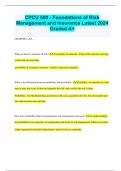
CPCU 500 - Foundations of Risk Management and Insurance Latest 2024 Graded A+
CPCU 500 - Foundations of Risk Management and Insurance Latest 2024 Graded A+ CHAPTER 1 ... What are the two elements of risk? -Uncertainty of outcome - Time of the outcome and type of outcome are uncertain -possibility of a negative outcome - at least 1 outcome is negative What is the difference between probability and possibility? Possibility - an outcome or event may or may not occur. It does not quantify the risk, only verifies the risk is there Probability - the likelihood than an outcome will occur, quantifies the risk. It is measurable and has value between zero and one How does probability help an organizations risk management exposure? -by understanding the probability of an exposure, an organization can focus its risk management efforts to avoid it. -helps organization decided what projects and activities to undertake How does classifying a risk help an organizations risk management process? -can help with assessing risk cause many risks in the same classification have similar attributes -helps manage risks -helps administrative function of RM by helping to ensure the risks in same class are less likely to be overlooked -Compare pure risk with speculative risk -why is it important to distinguish between the 2 what making risk management proceduces pure risk - change of loss or no loss but no gain speculative risk - involves a chance of gain type of SR includes: price risk and credit risk (financial investments involve a distinct set of speculative risks) its important when making RM decisions cause the 2 types must often be managed different. *most insurance policies are not designed to handle speculative risks* *insurable risks are generally classified as pure, objective, and diversafiable* - How does subjective and objective risk differ? subjective risk - perceived amount of risk based on individuals or organizations opinion objective risk - measurable variation in uncertain outcomes based on facts and data where they differ (see page 1.8): 1. Familiarity and control 2. consequences over likelihood 3. Risk Awareness -Contracts diversifiable and nondiversifiable risk? diversifiable risk - is not highly correlated and can be managed through diversification non-d risk - is correlated, losses and gains occur together (type: systemic risk - potential for a major disruption in the function of an entire market or financial system - Describe the quadrants of risk way of categorizing risk is putting them in quadrants: -hazard risk - property, liability, and personnel loss, generally the subject of insurance -operational risks - fall outside hazard cat, arise from people or failure in process, system, or control, including info tech

Geschreven voor
- Instelling
- CPCU 500 - Foundations of Risk Management
- Vak
- CPCU 500 - Foundations of Risk Management
Documentinformatie
- Geüpload op
- 13 maart 2024
- Aantal pagina's
- 22
- Geschreven in
- 2023/2024
- Type
- Tentamen (uitwerkingen)
- Bevat
- Vragen en antwoorden
Onderwerpen
-
cpcu 500 foundations of risk management and insu

Ook beschikbaar in voordeelbundel