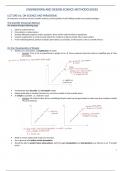
ENGINEERING AND DESIGN SCIENCE METHODOLOGIES
LECTURE A1: ON SCIENCE AND PARADIGMS
On the basics of science and the scientific method, and the pitfalls of self-fulfilling models and rusted paradigms.
The Scientific (Empirical) Method
The method includes following steps:
1. Observe a phenomenon
2. Find patterns in observations
3. Develop fitting descriptions and/or equations: these will be called models or hypotheses
4. Conduct experiments to verify to what extent the models are able to predict future observations
5. If the model/hypothesis predicts multiple observations successfully, it will become a law or scientific theory
On the Characteristics of Models
• Models are a description, a simplification of reality
o Example: Price of car is proportional to weight of car → These sentences describe reality in simplified way → They
are models.
• Fundamental laws describe, do not explain reality
• Appeal preferably to intuition (Human can use these models in best possible ways)
• As simple as possible, i.e., Ockham’s razor
o Example: Fit model to data, but no overfitting (Simple model can be generalized in better way than complex models)
→ Law of Ockham
• Need to remain stable with respect to new data
• Are in general valid within certain boundaries
• Should be able to predict future observations, both through extrapolation and interpolation (e.g. Observe a car → predict
price)
1
LECTURE A1: ON SCIENCE AND PARADIGMS
On the basics of science and the scientific method, and the pitfalls of self-fulfilling models and rusted paradigms.
The Scientific (Empirical) Method
The method includes following steps:
1. Observe a phenomenon
2. Find patterns in observations
3. Develop fitting descriptions and/or equations: these will be called models or hypotheses
4. Conduct experiments to verify to what extent the models are able to predict future observations
5. If the model/hypothesis predicts multiple observations successfully, it will become a law or scientific theory
On the Characteristics of Models
• Models are a description, a simplification of reality
o Example: Price of car is proportional to weight of car → These sentences describe reality in simplified way → They
are models.
• Fundamental laws describe, do not explain reality
• Appeal preferably to intuition (Human can use these models in best possible ways)
• As simple as possible, i.e., Ockham’s razor
o Example: Fit model to data, but no overfitting (Simple model can be generalized in better way than complex models)
→ Law of Ockham
• Need to remain stable with respect to new data
• Are in general valid within certain boundaries
• Should be able to predict future observations, both through extrapolation and interpolation (e.g. Observe a car → predict
price)
1