Tools: Looking ( week 8)
Essential Readings:
Hamlin, J. K., et al (2015). The case for social evaluation in preverbal infants: Gazing toward
one’s goal drives infants’ preferences for Helpers over Hinderers in the hill paradigm.
Frontiers in Psychology, 5, 1563.
Krogh-Jespersen, S., et al (2020). Let us get it together: Infants generate visual predictions
based on collaborative goals. Infant Behaviour and Development, 59, 101446.
Morales, S., et al (2017). Maternal anxiety predicts attentional bias towards threat in infancy.
Emotion, 17, 874-883.
Outline:
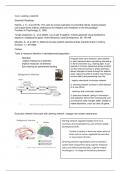
Tools to measure attention in developmental population
- Attention Propose three core networks: alert network-
- explicit measures of attention to alert individual about something interesting
- Implicit measures of attention in the environment e.g., flashing light. It can
- Eye tracking for preferential looking operate in intrinsic awareness phase to block
out the irrelevant stimuli or phase alertness-
abrupt changes to break through the platonic
state- signal and shift to another new thing to
ensure safety and processing new info.
- largely subcortical involuntary network
2. orienting network involved in shift attention
to a new stimuli
- voluntary and involuntary networks
3. executive network- taking in information
and regulation stimuli that is processing such
as emotional state/ hunger state. Leads to
make decisions, such as rules of game.
Executive network links back with alerting network- engage new system awareness
Alerting network regulated largely from locus
coeruleus and norepinephrine, part of brain largely
developed at birth.
- Control of system is driven by newer parts of
brain such as cortex, regulated by executive
or newer parts of brain.
Orienting network regulated by ventral attention
system with components along superior temporal
sulcus and inferior parietal lobe, superior-medial
frontal gyrus- in charge of involuntary attention.
, Frontal parietal system in charge to
control, organise task ins strategic ways,
Cingulo-opercular system – in control of
task shifting and control.
Executive system is very complex which
take a long time to develop.
These two networks involved in
cortex and require more experience
to develop, orienting network takes
two years to peak level, but
executive network takes even
longer, slowly improving beyond 7
years of age.
Question in developmental studies
are children going to have the
control to do the complex tasks in
studies.
Attention:
- The ability to focus on a specific event or stimulus of interest
Implications are far reaching:
- Social development
- Cognitive development
- Memory
- Mental health
, Explicit measures of attention: Rueda et al., 2004
Participants use computer task with fixation cross comes up after various sets of times, cues
appear for a brief moment to activate ethe alerting system and disappears. Target comes up
where participants required to make a response, target can be congruent ( ‘friendly fish’-
what direction central fish is swimming) incongruent ( fish on other side of centre fish
swimming in oppositive direction), trial with no distracting scene stimulus.
- Cue can change to adjust to central cue
- Cues randomly distributed
Measure via reaction times, the different networks,
Alerting network: difference between reaction time no cue - reaction time for double cue.
Orienting network : different between Reaction time for central cue- reaction time for spatial
cue ( where it is located).
Executive network: Reaction time for incongruent – reaction time for congruent stimuli trials
( how well you are to filter irrelevant stimuli).
- This task can be behavioural and connected to neuroimaging- enable to asses’
neural components of attention system.
Essential Readings:
Hamlin, J. K., et al (2015). The case for social evaluation in preverbal infants: Gazing toward
one’s goal drives infants’ preferences for Helpers over Hinderers in the hill paradigm.
Frontiers in Psychology, 5, 1563.
Krogh-Jespersen, S., et al (2020). Let us get it together: Infants generate visual predictions
based on collaborative goals. Infant Behaviour and Development, 59, 101446.
Morales, S., et al (2017). Maternal anxiety predicts attentional bias towards threat in infancy.
Emotion, 17, 874-883.
Outline:
Tools to measure attention in developmental population
- Attention Propose three core networks: alert network-
- explicit measures of attention to alert individual about something interesting
- Implicit measures of attention in the environment e.g., flashing light. It can
- Eye tracking for preferential looking operate in intrinsic awareness phase to block
out the irrelevant stimuli or phase alertness-
abrupt changes to break through the platonic
state- signal and shift to another new thing to
ensure safety and processing new info.
- largely subcortical involuntary network
2. orienting network involved in shift attention
to a new stimuli
- voluntary and involuntary networks
3. executive network- taking in information
and regulation stimuli that is processing such
as emotional state/ hunger state. Leads to
make decisions, such as rules of game.
Executive network links back with alerting network- engage new system awareness
Alerting network regulated largely from locus
coeruleus and norepinephrine, part of brain largely
developed at birth.
- Control of system is driven by newer parts of
brain such as cortex, regulated by executive
or newer parts of brain.
Orienting network regulated by ventral attention
system with components along superior temporal
sulcus and inferior parietal lobe, superior-medial
frontal gyrus- in charge of involuntary attention.
, Frontal parietal system in charge to
control, organise task ins strategic ways,
Cingulo-opercular system – in control of
task shifting and control.
Executive system is very complex which
take a long time to develop.
These two networks involved in
cortex and require more experience
to develop, orienting network takes
two years to peak level, but
executive network takes even
longer, slowly improving beyond 7
years of age.
Question in developmental studies
are children going to have the
control to do the complex tasks in
studies.
Attention:
- The ability to focus on a specific event or stimulus of interest
Implications are far reaching:
- Social development
- Cognitive development
- Memory
- Mental health
, Explicit measures of attention: Rueda et al., 2004
Participants use computer task with fixation cross comes up after various sets of times, cues
appear for a brief moment to activate ethe alerting system and disappears. Target comes up
where participants required to make a response, target can be congruent ( ‘friendly fish’-
what direction central fish is swimming) incongruent ( fish on other side of centre fish
swimming in oppositive direction), trial with no distracting scene stimulus.
- Cue can change to adjust to central cue
- Cues randomly distributed
Measure via reaction times, the different networks,
Alerting network: difference between reaction time no cue - reaction time for double cue.
Orienting network : different between Reaction time for central cue- reaction time for spatial
cue ( where it is located).
Executive network: Reaction time for incongruent – reaction time for congruent stimuli trials
( how well you are to filter irrelevant stimuli).
- This task can be behavioural and connected to neuroimaging- enable to asses’
neural components of attention system.