100% tevredenheidsgarantie Direct beschikbaar na je betaling Lees online óf als PDF Geen vaste maandelijkse kosten 4,6 TrustPilot
logo-home
Samenvatting

Summary functional imaging methods

Beoordeling
-
Verkocht
-
Pagina's
34
Geüpload op
02-02-2024
Geschreven in
2023/2024

Description: This comprehensive text delves into the workings of MRI scanners, elucidating the principles behind neuroimaging techniques such as the application of strong magnetic fields, radiofrequency pulses, and gradient coils. It discusses the behavior of protons under magnetic fields and the role of RF pulses in disrupting their alignment, leading to the generation of MRI signals. The text further explores the intricate processes of spatial encoding using gradient coils and Fourier transform, alongside the creation of tissue contrast through pulse sequences like T1 and T2 contrasts. Additionally, it elaborates on the fascinating realm of BOLD fMRI, highlighting its reliance on changes in local blood flow and oxygenation to detect neural activity. It elucidates concepts like the Hemodynamic Response Function (HRF) and the characteristics of noise in fMRI data. Furthermore, it provides insights into preprocessing steps aimed at enhancing the quality of MRI data for statistical analysis. Moreover, the text extends into MEG and EEG, delineating their biophysical basis and resolutions. It discusses the forward and inverse problems in neuroimaging, along with solutions like dipole fitting and beamforming. Furthermore, it explores Event-Related Potentials (ERPs), categorizing them into endogenous and exogenous components and elucidating their role in cognitive processes through experimental paradigms like the oddball paradigm and semantic processing. In essence, this text serves as a comprehensive guide to understanding the intricate workings of MRI scanners, BOLD fMRI, MEG, EEG, and ERPs, offering valuable insights into the techniques and principles underlying neuroimaging and cognitive neuroscience research. MRI scanner, neuroimaging techniques, radiofrequency pulse, gradient coils, protons, static magnetic field, RF pulse, excitation phase, reception, gradients, Fourier transform, slice selection gradient, frequency encoding gradient, phase encoding gradient, k-space, tissue contrast, pulse sequences, BOLD fMRI, HRF, temporal lag, noise, SNR, preprocessing, slice acquisition time correction, head motion correction, coregistration, normalization, spatial and temporal filtering, MEG, EEG, forward problem, inverse problem, ERPs, endogenous ERPs, exogenous ERPs, oddball paradigm, face processing, semantic processing, P1 component, N1 component, MMN.

Meer zien Lees minder
Instelling
Vak


Oeps! We kunnen je document nu niet laden. Probeer het nog eens of neem contact op met support.

Geschreven voor

Instelling
Studie
Onbekend
Vak

Documentinformatie

Geüpload op
2 februari 2024
Aantal pagina's
34
Geschreven in
2023/2024
Type
Samenvatting

Onderwerpen

Voorbeeld van de inhoud

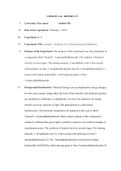
MRI physics

,MRI scanner: how does it work?
• MRI scanners use strong magnetic fields and radio waves to generate very
detailed images of the brain.
• Different components
1. Main magnetic field (B0) to align the hydrogen protons with the magnetic fi
2. Radiofrequency pulse (B1) to temporarily disrupt the alignment of the proto
3. Gradient coils to encode spatial information

,Properties of protons
• When a strong magnetic field is applied protons:
1. align themselves with the main magnetic field. This alignment is often rega
as the ‘phase’ of the protons
2. ‘’spin’ or ‘precess’ around the direction of the main magnetic field at a freq
called Larmor frequency

, Static magnetic field (B0) and RF pulse
• A strong static magnetic field is applied to align hydrogen protons. However,
B0 is not responsible for the image formation.
• Following the B0, an RF pulse is applied. This pulse will resonate at the same
frequency as the Larmor Frequency of the hydrogen protons.
 This pulse temporarily disrupts the alignment of the protons ‘knocking them out of place’. T
called the excitation phase, as protons absorb the energy from the pulse.
 When the RF pulse is turned off, the protons go back to alignment. As they do so, they relea
the energy that was absorbed during the excitation.
 The released energy gets detected by the RF coils during a process called reception. This cr
the MRI signal

€9,50
Krijg toegang tot het volledige document:

100% tevredenheidsgarantie
Direct beschikbaar na je betaling
Lees online óf als PDF
Geen vaste maandelijkse kosten

Maak kennis met de verkoper
Seller avatar
paolacavallaropc

Maak kennis met de verkoper

Seller avatar
paolacavallaropc The University of Nottingham
Volgen Je moet ingelogd zijn om studenten of vakken te kunnen volgen
Verkocht
0
Lid sinds
1 jaar
Aantal volgers
0
Documenten
2
Laatst verkocht
-

0,0

0 beoordelingen

5
0
4
0
3
0
2
0
1
0

Recent door jou bekeken

Waarom studenten kiezen voor Stuvia

Gemaakt door medestudenten, geverifieerd door reviews

Kwaliteit die je kunt vertrouwen: geschreven door studenten die slaagden en beoordeeld door anderen die dit document gebruikten.

Niet tevreden? Kies een ander document

Geen zorgen! Je kunt voor hetzelfde geld direct een ander document kiezen dat beter past bij wat je zoekt.

Betaal zoals je wilt, start meteen met leren

Geen abonnement, geen verplichtingen. Betaal zoals je gewend bent via Bancontact, iDeal of creditcard en download je PDF-document meteen.

Student with book image

“Gekocht, gedownload en geslaagd. Zo eenvoudig kan het zijn.”

Alisha Student

Veelgestelde vragen