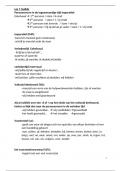
Lec 1: Intro and Red Blood Cells
Functions of Blood
Transports gases, nutrients, hormones and metabolic wastes
Regulates composition of interstitial fluid (e.g. pH, ions, water, etc)
Restricts fluid loss at entry sites via blood clotting
Defends against toxins and pathogens
Regulates body T by absorbing and redistributing heat depending where in the body
blood goes
Constituents of Blood
Hematocrit = % of total blood volume occupied by packed centrifuged red blood
cell, WBC, and platelets (normal “Formed Element”: 37~54%)
Plasma = the rest of the blood, mainly water (92%) along with other ions, organic
molecules including a.a., proteins (albumins, globulins, fibrinogen), lipids, nitrogenous
waste), trace elements and vitamins, and gases
o Post plasma proteins made by liver
Functions of Plasma Proteins
- general: generate colloid osmotic pressure
o i.e. provide osmotic active particles to keep fluid in blood stream
o buffer pH (H+ binds to the a.a. of proteins and act as buffer)
- specific:
o albumins: colloid osmotic pressure; carriers of hormones & other
organic molecules; most abundant
o globulins: group of proteins that run in sections (a, B, y) in gel
Alpha & Beta: clotting factors, enzymes, carriers
Gamma: antibodies
o Fibrinogen: forms fibrin for blood clotting
Formed Elements
- 99.9% = RBC = Erythrocytes
- 0.1% = WBC = leukocytes
- Lymphocytes, monocytes, neutrophils, eosinophils, basophils
o Monocytes & Neutrophils considered ‘phagocytes’
o Neutrophils & Eosinophils & Basophils considered ‘granulocytes’ due to
the granules & vesicles
o the relative ratio / number of leukocytes can give an idea for possible illness
- rest = platelets = thrombocytes
Origin of Cells in blood
- embryo yolk sac, liver, and bone marrow
, - after birth bone marrow (inside the bone)
o surrounds the central sinuses, stroma of marrow,
and nutrient artery o in pelvis, spine, ribs, cranium,
proximal end long bones (thigh bones)
- 1/10,000 cells: pluripotent hematopoietic stem cell
- uncommitted stem cellcommitted progenitor cells OR
lymphocyte stem cells(look diagram)
- In bone marrow, 25% are developing RBC, and 75% are developing
WBC
- Immature blood cells matures fully as it enters circulation
(examples…)
o Reticulocyte erythrocyte
o Megakaryocyte platelets
- Regulation by Cytokines (the growth/ differential factors)
o Colony Stimulating factors (CSF): from endothelial cells and
WBC
Ex. G-CSF (granulocyte CSF) for neutrophil and monocyte
G-CSF used in clinical setting during
chemotherapy to increase the number of
neutrophils and help the immune system
o Interleukins: from WBCs
The two affect survival, proliferation and
differentiation of different cell types
o Erythropoietin (EPO): stimulates erythrocytes;
made in kidney o Thrombopoietin (TPO):
stimulates megakaryocytes; made in liver
Red Blood Cells
- ‘cells’ / bags filled with hemoglobin and enzymes
- functions by anaerobic metabolism
- no nucleus = no new transcription
- life span: 120 days
- 5 x 10^12 cells/L of blood
- contains Hemoglobin (four polypeptides with a heme group + iron)
- changes shapes to fit into small capillaries
, - 2~3 million/second made in the body
- “Erythropoiesis” regulated by EPO
o EPO synthesized and released from kidney, bit in liver in
response to low O2
o Nucleus pinches off and mitochondria & ER break down
o Proerythroblast Polychromatophlic erythroblast
Normoblast Reticulocyte (enters circulation)
Mature erythrocytes
- Removal
o Engulfed by Macrophages in spleen, liver, bone marrow
o Heme broken down to Bilirubin, Iron recycled
Functions of Blood
Transports gases, nutrients, hormones and metabolic wastes
Regulates composition of interstitial fluid (e.g. pH, ions, water, etc)
Restricts fluid loss at entry sites via blood clotting
Defends against toxins and pathogens
Regulates body T by absorbing and redistributing heat depending where in the body
blood goes
Constituents of Blood
Hematocrit = % of total blood volume occupied by packed centrifuged red blood
cell, WBC, and platelets (normal “Formed Element”: 37~54%)
Plasma = the rest of the blood, mainly water (92%) along with other ions, organic
molecules including a.a., proteins (albumins, globulins, fibrinogen), lipids, nitrogenous
waste), trace elements and vitamins, and gases
o Post plasma proteins made by liver
Functions of Plasma Proteins
- general: generate colloid osmotic pressure
o i.e. provide osmotic active particles to keep fluid in blood stream
o buffer pH (H+ binds to the a.a. of proteins and act as buffer)
- specific:
o albumins: colloid osmotic pressure; carriers of hormones & other
organic molecules; most abundant
o globulins: group of proteins that run in sections (a, B, y) in gel
Alpha & Beta: clotting factors, enzymes, carriers
Gamma: antibodies
o Fibrinogen: forms fibrin for blood clotting
Formed Elements
- 99.9% = RBC = Erythrocytes
- 0.1% = WBC = leukocytes
- Lymphocytes, monocytes, neutrophils, eosinophils, basophils
o Monocytes & Neutrophils considered ‘phagocytes’
o Neutrophils & Eosinophils & Basophils considered ‘granulocytes’ due to
the granules & vesicles
o the relative ratio / number of leukocytes can give an idea for possible illness
- rest = platelets = thrombocytes
Origin of Cells in blood
- embryo yolk sac, liver, and bone marrow
, - after birth bone marrow (inside the bone)
o surrounds the central sinuses, stroma of marrow,
and nutrient artery o in pelvis, spine, ribs, cranium,
proximal end long bones (thigh bones)
- 1/10,000 cells: pluripotent hematopoietic stem cell
- uncommitted stem cellcommitted progenitor cells OR
lymphocyte stem cells(look diagram)
- In bone marrow, 25% are developing RBC, and 75% are developing
WBC
- Immature blood cells matures fully as it enters circulation
(examples…)
o Reticulocyte erythrocyte
o Megakaryocyte platelets
- Regulation by Cytokines (the growth/ differential factors)
o Colony Stimulating factors (CSF): from endothelial cells and
WBC
Ex. G-CSF (granulocyte CSF) for neutrophil and monocyte
G-CSF used in clinical setting during
chemotherapy to increase the number of
neutrophils and help the immune system
o Interleukins: from WBCs
The two affect survival, proliferation and
differentiation of different cell types
o Erythropoietin (EPO): stimulates erythrocytes;
made in kidney o Thrombopoietin (TPO):
stimulates megakaryocytes; made in liver
Red Blood Cells
- ‘cells’ / bags filled with hemoglobin and enzymes
- functions by anaerobic metabolism
- no nucleus = no new transcription
- life span: 120 days
- 5 x 10^12 cells/L of blood
- contains Hemoglobin (four polypeptides with a heme group + iron)
- changes shapes to fit into small capillaries
, - 2~3 million/second made in the body
- “Erythropoiesis” regulated by EPO
o EPO synthesized and released from kidney, bit in liver in
response to low O2
o Nucleus pinches off and mitochondria & ER break down
o Proerythroblast Polychromatophlic erythroblast
Normoblast Reticulocyte (enters circulation)
Mature erythrocytes
- Removal
o Engulfed by Macrophages in spleen, liver, bone marrow
o Heme broken down to Bilirubin, Iron recycled