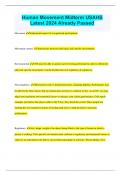
Human Movement Midterm USAHS Latest 2024 Already Passed
Human Movement Midterm USAHS Latest 2024 Already Passed Movement fundamental aspect of occupational participation. Movement control: interactions between individual, task and the environment. Environmental CNS must be able to analyze activity being performed in order to effectively plan task specific movements. Can be divided into non-regulatory & regulatory. Non-regulatory: Distractions such as background noise, changing lighting. Performance may be affected by these factors but movement does not have to conform to this. As an OT, you may adjust non regulatory environmental factors to enhance your clients performance. Golf match example, just before the player walks to the T box, they shush the crowd. These people are limiting the non-regulatory feature of background noise to help the player maximize performance. Regulatory: size, shape, weight of an object being lifted or the type of terrain in which a person is walking. Task specific movements must conform to regulatory environmental factors in order for an individual to be able to successfully participate in activities. Person lifting a box, how would the person respond differently if the box was heavier or lighter? Maybe the task involves pushing rather than lifting? Both of these changes affect an individual's movement response. Individual Motor actions systems, sensory perceptual, and cognitive systems all affect functional motor control. Important to understand the individual systems underlying motor control to help clients improve occupational performance and participation even with impaired movement. Motor action: Elbow flexion, forearm supination which happens due to contraction of biceps brachii and brachialis muscle innervated by musculocutaneous nerve which is a peripheral nerve, a terminal branch of brachial plexus which originated from nerve roots. Consider how CNS and PNS work together as the initial desire to eat comes from your brain. Cognition: Attention, planning, problem solving, motivation, and emotion are cognitive processes involved in motor control. Sensory/Perception: Incoming afferent info is interpreted and given meaning through perception which is done by higher level processing and our peripheral nervous system. Task: Affects neurological organization of motor plan being executed. Degree of monitoring is also due to tasks being performed. Tennis is dynamic and requires ever changing responses, reaching in a cabinet is less dynamic but still requires weight shifting and balance. Subsections of task include mobility, postural control, and upper extremity function. Discrete Movement definite beginning and end, you know when the task begins and when it's over. Many tasks you'll perform with clients will be this type. Transfers, kicking a ball, etc. Continuous movement do not have a definite end. Person performing the task must decide when to stop. Running, riding a bike, etc. Consideration for discrete V continuous movements include impulsivity and cognitive status. Clients must have an understanding of when to start and stop. Transfer example from book. Continuous movements involve the same concept, but also related to endurance of task Closed movement Occur in a relatively fixed and predictable environment. Teeiing off and hitting a ball, looking for consistency of movement. Uses a limited number of movement patterns and skills can be planned in advance. Closed movements are best to practice initially in therapy, as it requires less flexibility. Gradual progressing to an open movement. Open Movement require many different movement patterns. VOLLEYBALL!!!! Participants must constantly adapt to an unpredictable environment. Stability non moving base of support either sitting or standing. Sitting or standing is a stability task. Mobility moving base of support such as jogging. While mobility tasks are completed while moving. This understanding will help you choose assistive devices when working with patients in the progression of gait and movement. Motor control: study of how movement is controlled or how movement is unable to be controlled. Aging, illnesses, or injury can contribute to abnormal gait patterns. Reflex theory combined action of individual reflexes. Sherrington 1906. Believed that complex behavior could be explained in this way. Structure of reflex: receptor, conductor, muscle/effector. Reflex is initiated by outside stimulus (touching a hot stove) Limitations to Reflex Theory -Reflex activated by an outside agent. -Does not explain movement occurring in absence of sensory stimulus -Does not explain fast movements -Fails to explain how a single stimulus can result in varying responses -Does not explain ability to produce novel
Geschreven voor
- Instelling
- Human Movement USAHS
- Vak
- Human Movement USAHS
Documentinformatie
- Geüpload op
- 1 januari 2024
- Aantal pagina's
- 22
- Geschreven in
- 2023/2024
- Type
- Tentamen (uitwerkingen)
- Bevat
- Vragen en antwoorden
Onderwerpen
-
human movement midterm usahs latest 2024 already p

Ook beschikbaar in voordeelbundel