COMPANY LAW CRYPT SHEET
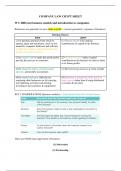
W1: Different business models and introduction to companies
Businesses are generally set up to make a profit (= income generated > expenses of business)
Raising Finance
WHY HOW
(1) to purchase premises from which to (1) Owners invest in by making
operate, plant and machinery, stock or raw contributions of capital to the business
materials, computer hardware and software
in order to be able to manufacture and sell
goods, or provide a service
(2) to employ staff to make the goods and/or (2) Outside investors make a capital
provide the services to customers contribution to the business in order to share
in its future profits
(3) to obtain the advice of professional (3) By borrowing money (e.g. from a bank)
advisers, particularly accountants
(4) to expand and grow either by (a) (4) Retaining a proportion of the profit to
acquiring other businesses or (b) carrying help it grow, rather than it being distributed
out marketing activities (advertising, to owners & investors
investing in new premises & equipment)
KEY CONSIDERATIONS (business models) - Cosima Risked School For Private Finance
There are FOUR main legal forms of business:
(1) Sole trader
(2) Partnership
,Key: two or more people working together w/ a view to profit = automatically a partnership
(there does not need to be intent)
© Partnerships are governed by the provisions of the Partnership Act 1890
o Partners are entitled to share equally in the profits + must share equally in the
losses
Advisable to draft a partnership agreement with an express provision in it
setting out a profit-sharing ratio
o Partners are NOT entitled to a salary
o Decisions are generally decided by a majority, except for change to the nature of
the business = must be unanimous
o A partner cannot be expelled by majority vote unless all the partners have
previously expressed the majority can do this
*Advisable to have a partnership agreement drawn up, otherwise the partnership will be
governed by the default provisions of PA*
(3) Limited partnership
A LP has two different types of partners:
1) Limited partners who have limited liability (aka ‘sleeping partners’)
2) General partners who run the business and have unlimited liability
Key: *There must be at least ONE limited partner and ONE general partner*
© LPs are governed by the Limited Partnership Act 1907.
© LPs are commonly used for investment vehicles.
(4) Limited liability partnership
LLPs are in effect a hybrid between a traditional partnership (with procedural flexibility) and
a company (with limited liability).
© For tax purposes it is treated as a partnership and the members are taxed as partners, each
being liable to pay tax on their shares of the income or gains of the LLP (‘tax
transparency’)
© Section 2(1)(a) LLPA 2000 states that two or more persons associated for carrying on a
lawful business with a view to profit can incorporate an LLP.
o A ‘person’ in this context can be a company as well as an individual.
- Flexible organisational structure
- Members share equally in capital & profits
- Every member may take part in the management, but no member is entitled to
renumeration for managing the LLP
- No person can become a member/assign their membership without the consent of all
existing members.
- Ordinary decision making = by the majority of the members unless it is a change to the
nature of the business where it must be unanimous
- There is no implied power of expulsion of a member by the majority
, Model Structure Advantages Disadvantages
Sole trader The sole trader is the Can start trading Unlimited personal liability
exclusive owner of the immediately Contracts are formed
business. There are no setup between the sole trader and
It is not a separate legal costs/formalities third parties
entity. Can keep all the profits
Full control over decision
making
Complete privacy as no
disclosure requirements
Partnership 2 or more persons own Can start trading Partners have unlimited
the business and share the immediately personal liability
profits. There are no setup Contracts are formed
The partnership is not a costs/formalities between the partners and
separate legal entity Full control over decision third parties
making A partnership agreement
Complete privacy as no will be required otherwise
disclosure requirements the Partnership Act 1890
will apply in default
Limited 2 or more persons All partners have limited There are set-up costs and
liability carrying on a business. liability formalities as an LLP must
partnership The partnership is a The partnership can enter be registered at Companies
separate legal entity contracts with third parties House
Flexible management Must file annual accounts
procedures and has disclosure
obligations
A members’ agreement
will be required otherwise
the provisions of the
Limited Liability
Partnership Regulations
2001 will apply in default.
Private A company is a separate Limited liability as There are set-up costs and
limited legal entity distinct from shareholders = only liable to formalities as a company
company its owners pay any amount unpaid on must be registered at
their shares. Companies House
Minimum of 1 person The Companies Act 2006
required to incorporate imposes strict requirements
Easier to raise finance on how companies are run.
Limited disclosure
obligations
COMPANIES: Governed by Companies Act 2006 which introduced key changes:
© Removal of the requirement for private companies to hold annual General Meetings or
submit Annual Returns replaced w/ a simpler annual Confirmation Statement
© Codification of directors’ duties
© Allowing private companies to pass shareholder resolutions in writing
W1: Different business models and introduction to companies
Businesses are generally set up to make a profit (= income generated > expenses of business)
Raising Finance
WHY HOW
(1) to purchase premises from which to (1) Owners invest in by making
operate, plant and machinery, stock or raw contributions of capital to the business
materials, computer hardware and software
in order to be able to manufacture and sell
goods, or provide a service
(2) to employ staff to make the goods and/or (2) Outside investors make a capital
provide the services to customers contribution to the business in order to share
in its future profits
(3) to obtain the advice of professional (3) By borrowing money (e.g. from a bank)
advisers, particularly accountants
(4) to expand and grow either by (a) (4) Retaining a proportion of the profit to
acquiring other businesses or (b) carrying help it grow, rather than it being distributed
out marketing activities (advertising, to owners & investors
investing in new premises & equipment)
KEY CONSIDERATIONS (business models) - Cosima Risked School For Private Finance
There are FOUR main legal forms of business:
(1) Sole trader
(2) Partnership
,Key: two or more people working together w/ a view to profit = automatically a partnership
(there does not need to be intent)
© Partnerships are governed by the provisions of the Partnership Act 1890
o Partners are entitled to share equally in the profits + must share equally in the
losses
Advisable to draft a partnership agreement with an express provision in it
setting out a profit-sharing ratio
o Partners are NOT entitled to a salary
o Decisions are generally decided by a majority, except for change to the nature of
the business = must be unanimous
o A partner cannot be expelled by majority vote unless all the partners have
previously expressed the majority can do this
*Advisable to have a partnership agreement drawn up, otherwise the partnership will be
governed by the default provisions of PA*
(3) Limited partnership
A LP has two different types of partners:
1) Limited partners who have limited liability (aka ‘sleeping partners’)
2) General partners who run the business and have unlimited liability
Key: *There must be at least ONE limited partner and ONE general partner*
© LPs are governed by the Limited Partnership Act 1907.
© LPs are commonly used for investment vehicles.
(4) Limited liability partnership
LLPs are in effect a hybrid between a traditional partnership (with procedural flexibility) and
a company (with limited liability).
© For tax purposes it is treated as a partnership and the members are taxed as partners, each
being liable to pay tax on their shares of the income or gains of the LLP (‘tax
transparency’)
© Section 2(1)(a) LLPA 2000 states that two or more persons associated for carrying on a
lawful business with a view to profit can incorporate an LLP.
o A ‘person’ in this context can be a company as well as an individual.
- Flexible organisational structure
- Members share equally in capital & profits
- Every member may take part in the management, but no member is entitled to
renumeration for managing the LLP
- No person can become a member/assign their membership without the consent of all
existing members.
- Ordinary decision making = by the majority of the members unless it is a change to the
nature of the business where it must be unanimous
- There is no implied power of expulsion of a member by the majority
, Model Structure Advantages Disadvantages
Sole trader The sole trader is the Can start trading Unlimited personal liability
exclusive owner of the immediately Contracts are formed
business. There are no setup between the sole trader and
It is not a separate legal costs/formalities third parties
entity. Can keep all the profits
Full control over decision
making
Complete privacy as no
disclosure requirements
Partnership 2 or more persons own Can start trading Partners have unlimited
the business and share the immediately personal liability
profits. There are no setup Contracts are formed
The partnership is not a costs/formalities between the partners and
separate legal entity Full control over decision third parties
making A partnership agreement
Complete privacy as no will be required otherwise
disclosure requirements the Partnership Act 1890
will apply in default
Limited 2 or more persons All partners have limited There are set-up costs and
liability carrying on a business. liability formalities as an LLP must
partnership The partnership is a The partnership can enter be registered at Companies
separate legal entity contracts with third parties House
Flexible management Must file annual accounts
procedures and has disclosure
obligations
A members’ agreement
will be required otherwise
the provisions of the
Limited Liability
Partnership Regulations
2001 will apply in default.
Private A company is a separate Limited liability as There are set-up costs and
limited legal entity distinct from shareholders = only liable to formalities as a company
company its owners pay any amount unpaid on must be registered at
their shares. Companies House
Minimum of 1 person The Companies Act 2006
required to incorporate imposes strict requirements
Easier to raise finance on how companies are run.
Limited disclosure
obligations
COMPANIES: Governed by Companies Act 2006 which introduced key changes:
© Removal of the requirement for private companies to hold annual General Meetings or
submit Annual Returns replaced w/ a simpler annual Confirmation Statement
© Codification of directors’ duties
© Allowing private companies to pass shareholder resolutions in writing