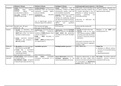
Alzheimer’s Disease Parkinson’s Disease Huntington’s Disease ALS (amyotrophic lateral sclerosis) Pick’ Disease
Symptoms Initially: short term memory deficits. Cardinal symptoms: resting tremors, Initially: restlessness, lack of Stiff muscles, muscle twitching, and Cognitive problems, dementia, loss
Gradually: higher cognitive bradykinesia (slow and decreased coordination, followed by chorea gradually worsening weakness due of speech (aphasia), disinhibition
functions deficits and movement), muscular rigidity, (characteristic random, jerky and to muscles decreasing in size (abnormal social conduct)
neuropsychiatric problems. postural instability. uncontrollable movements). difficulties in walking, movement,
End stage: incapable to perform Complications: dementia, Gradually: progression to complete speaking, swallowing, and
activities of daily living. depression, anxiety. dysfunction difficulties in eventually breathing.
chewing and swallowing, speaking
and abnormal writhing movements. Limb-onset or Bulb-onset ALS
Loss of dopaminergic neurons in Progressive worsening of cognitive variants exist.
substantia nigra of the midbrain. abilities and psychiatric
abnormalities.
Age of onset Sporadic cases: >65 years Risk increases with aging 35-45 years old Initiates late 40s, peaks at 60-
EOFAD: 35<.. <65 Mean age of onset 60-65 years 70 years
Genetics Sporadic: no inheritance, most Familial forms: autosomal dominant Familial form: inherited Huntingtin Sporadic: 90- 95% of the cases Mutations in the MAPT gene
cases, genetic risk factors like the and recessive inheritance, gene with expansion of a CAG triplet Inherited: 5-10% of the cases, encoding protein Tau
ApoE4 gene (other risk factors mutations in PARK1-16 genes. Most repeat stretch (36+ glutamines) most common mutation in SOD1
identified in GWAS studies) common mutations in encoding for the mutant Huntingtin (encoding superoxide dismutase),
PARK1 = SNCA (encoding α- protein resulting in autosomal dominant
EOFAD: autosomal dominant synuclein) inheritance.
inheritance, <1%, mutations in PARK8 = LRRK2 (encoding leucine
APP, PS1 and PS2 rich repeat kinase 2) Other genes increasing risk for ALS
include: Alsin, Dynactin, angiogenin,
senataxin, VAPB,
Molecular Aβ peptides and misprocessing of α-synuclein aggregates Huntingtin protein aggregates SOD1, TDP43, FUS, … Protein Tau
players their precursor protein APP Imbalances in different isoforms
Protein Tau: a microtubuli of Tau (3 or 4 microtubule binding
associated protein, becomes domains)
hyperphosphorylated Hyperphosphorylation
Exact mechanism is not known Exact mechanism is not known
Pathological Amyloid plaques: mainly composed Lewy bodies: eosinophilic Severe inflammation of the brain Progressive degeneration of upper Pick bodies: Tau-positive spherical
hallmarks of amyloid peptides intracellular accumulation of α- Huntingtin aggregates in the (UMN) and lower (LMN) motor cytoplasmic neuronal inclusions,
Neurofibrillary tangles: composed synuclein nucleus and cytoplasm of neurons neurons in the brain and spinal cord composed of 3R Tau only
of hyperphosphorylated protein Tau accumulation of ubiquitinated
proteins (SOD1, TDP43, FUS, …)
,Brain Limbic and cortical regions, Substantia nigra, basal ganglia Early: basal ganglia (indirect Upper (UMN) and lower (LMN) Frontal and temporal cortex, some
regions including higher associative cortex pathway of movement = inhibition motor neurons in the brain and limbic regions, including
involved Dopaminergic neurons: direct and of movement) spinal cord. ALS is the most common hippocampus.
indirect pathway of movement Gradually: cerebral cortex, form of motor neuron disease
become affected akinesia, hippocampus, cerebellum, (MND).
bradykinesia (slowness of hypothalamus, parts of the
movement) thalamus
Treatment Only symptomatic treatment (with Treatment:
small benefit): Acetylcholinesterase L-DOPA, dopamine agonists
inhibitors, NMDA inhibitors Chirurgical treatment: deep- brain
No curative treatment exists stimulation
,ZSO 1 ALZHEIMER
Introduction
Alzheimer’s disease (AD) is a neurodegenerative disorder with early deficits in short-term memory, progressively
affected higher cognitive functions and neuropsychiatric abnormalities (apathy, increased aggression, agitation,
anxiety). In the final stages the patient is unable to perform activities of daily living. Time to death ~ 10 years.
Diagnosis is based on progressive loss of cognitive functions in cognitive tests (MMSE, ADAS-COG,…) and exclusion of
other disorders. Progression is assessed by imaging and detection of bio-markers in CSF and blood. Definitive diagnosis:
post-mortem by identification of the pathological hallmarks. Research is focused on early diagnosis.
Pathological hallmarks of Alzheimer’s Disease brains:
neurofibrillary tangles (NFT) and amyloid plaques, as well as
brain atrophy, astrogliosis, microgliosis, synaptic loss and
neuronal loss.
Pathogenetic mechanism I: Amyloid plaques
Amyloid plaques: deposit of amyloid peptides exhibiting a beta-sheet structure.
Early onset familial Alzheimer's disease (EOFAD),
autosomal dominant.
Mutations in APP gene near cleaving sites.
o Alpha-, beta- and gamma- secretase
cleavage sites.
o Give rise to increased formation of
amyloidogenic amyloid peptides
Mutations in presenilins that cleave APP
o PS1 and PS2 shift to increased formation of
amyloidogenic amyloid peptides.
Amyloid peptides display neurotoxic properties in vitro and in vivo: disrupt synaptic functioning (synaptic plasticity)
and cognitive functioning. They are the causal role in EOFAD and sporadic AD.
Amyloid cascade hypothesis
Altered APP processing increased Aβ42 production and accumulation oligomerization of Aβ42 and deposition
as diffuse plaques neurotoxic effects of oligomeric and protofibrillar Aβ42 on synaptic projections inflammatory
response with activation of microglia and astrocytes increasing synaptic an neuronal injury progressive oxidative
injury and altered neuronal ionic homeostasis changes in intracellular signalling (kinase and phosphatase activity)
Tau hyperphosphorylation and tangle formation extensive neuronal dysfunction, transmitter release deficits
and cell death DEMENTIA
In vivo models I: APP transgenic mice
Generation of mutant APP (and APP/PS1) transgenic (tg) mice.
Transgenic mice with postnatal neuronal expression of APP/Ld,
phenotype Aβ* = Aβtoxic
1. Increased Aβ40/42 (3 months)
2. Behavioural analysis (9 months)
, a. Neuropsychiatric/behavioural abnormalities: increased aggression and neophobic reaction
b. Cognitive deficits: decreased learning and memory in a battery of cognitive tasks (e.g. Morris water
Maze test, ORT,...)
3. Typical amyloid plaque pathology (> 12 months): cerebrovascular amyloid angiopathy (CAA)
Therapeutic strategies
Analysis of the amyloid-modifying potential of therapeutic strategies in APP/Ld transgenic mice
1. Modulation of production of the Aβ peptides alpha, beta or gamma secretase
a. ADAM10
i. Increases alpha-secretase in vivo, with a concomittant decrease in beta-amyloid peptide
production preventing amyloid plaque formation
ii. Overexpression rescues synaptic defects and memory impairments in APP/Ld mice
2. Immunisation therapy
a. Immunization with amyloid-β attenuates Alzheimer-disease-like pathology in the APP mice.
3. Aggregation inhibitors (beta-sheet breakers)
4. Increased degradation of amyloid peptides
a. Many therapeutic targets validated in preclinical studies.
b. Clinical trials in patients but no disease halting/reversing therapies yet. Technical problems to
extrapolate from mouse models to human therapy.
c. Side-effects: meningoencephalitis
Promising results in APP transgenic mice recapitulating robust amyloid pathology
Need models with combined amyloid and Tau pathology as preclinical models
Identity of the toxic form of Aβ*
Relation between amyloid and Tau-pathology
Tau-directed therapy
Preventive anti-amyloid therapy: early!! Side-effects
Curative therapies: diagnosis AD/MCI. Multi-target therapy: late targets!
Tau = important therapeutic target!!
Pathogenetic mechanism II: neurofibrillary tangles
Neurofibrillary tangles (NFT) are composed of hyperphosphorylated Tau.
The progression of NFT correlates closely with loss of cognitive functions and clinical symptoms (β-amyloid
pathology).
Mutations in MAPT are autosomal dominantly linked to Tauopathies: Tau-dysfunction neuronal
dysfunction progressive neurodegeneration.
Transmission and spreading of Tauopathy in transgenic mice: Prion-like seeding of Tau-pathology (self-
propagating effect).
Tau
Tau contains microtubule binding domains and binding motifs. Tau-aggregation = nucleation-elongation phase
controlled by nucleating factors
Interactions with cofactors: polyanions like sulfated glycosaminoglycans, RNA,acidic proteins
Phosphorylation
Other post-translational modifications
Proteolytic processing of Tau
Tau-hypothesis: microtubule Tau hyperphosphorylation PHF NFT
Symptoms Initially: short term memory deficits. Cardinal symptoms: resting tremors, Initially: restlessness, lack of Stiff muscles, muscle twitching, and Cognitive problems, dementia, loss
Gradually: higher cognitive bradykinesia (slow and decreased coordination, followed by chorea gradually worsening weakness due of speech (aphasia), disinhibition
functions deficits and movement), muscular rigidity, (characteristic random, jerky and to muscles decreasing in size (abnormal social conduct)
neuropsychiatric problems. postural instability. uncontrollable movements). difficulties in walking, movement,
End stage: incapable to perform Complications: dementia, Gradually: progression to complete speaking, swallowing, and
activities of daily living. depression, anxiety. dysfunction difficulties in eventually breathing.
chewing and swallowing, speaking
and abnormal writhing movements. Limb-onset or Bulb-onset ALS
Loss of dopaminergic neurons in Progressive worsening of cognitive variants exist.
substantia nigra of the midbrain. abilities and psychiatric
abnormalities.
Age of onset Sporadic cases: >65 years Risk increases with aging 35-45 years old Initiates late 40s, peaks at 60-
EOFAD: 35<.. <65 Mean age of onset 60-65 years 70 years
Genetics Sporadic: no inheritance, most Familial forms: autosomal dominant Familial form: inherited Huntingtin Sporadic: 90- 95% of the cases Mutations in the MAPT gene
cases, genetic risk factors like the and recessive inheritance, gene with expansion of a CAG triplet Inherited: 5-10% of the cases, encoding protein Tau
ApoE4 gene (other risk factors mutations in PARK1-16 genes. Most repeat stretch (36+ glutamines) most common mutation in SOD1
identified in GWAS studies) common mutations in encoding for the mutant Huntingtin (encoding superoxide dismutase),
PARK1 = SNCA (encoding α- protein resulting in autosomal dominant
EOFAD: autosomal dominant synuclein) inheritance.
inheritance, <1%, mutations in PARK8 = LRRK2 (encoding leucine
APP, PS1 and PS2 rich repeat kinase 2) Other genes increasing risk for ALS
include: Alsin, Dynactin, angiogenin,
senataxin, VAPB,
Molecular Aβ peptides and misprocessing of α-synuclein aggregates Huntingtin protein aggregates SOD1, TDP43, FUS, … Protein Tau
players their precursor protein APP Imbalances in different isoforms
Protein Tau: a microtubuli of Tau (3 or 4 microtubule binding
associated protein, becomes domains)
hyperphosphorylated Hyperphosphorylation
Exact mechanism is not known Exact mechanism is not known
Pathological Amyloid plaques: mainly composed Lewy bodies: eosinophilic Severe inflammation of the brain Progressive degeneration of upper Pick bodies: Tau-positive spherical
hallmarks of amyloid peptides intracellular accumulation of α- Huntingtin aggregates in the (UMN) and lower (LMN) motor cytoplasmic neuronal inclusions,
Neurofibrillary tangles: composed synuclein nucleus and cytoplasm of neurons neurons in the brain and spinal cord composed of 3R Tau only
of hyperphosphorylated protein Tau accumulation of ubiquitinated
proteins (SOD1, TDP43, FUS, …)
,Brain Limbic and cortical regions, Substantia nigra, basal ganglia Early: basal ganglia (indirect Upper (UMN) and lower (LMN) Frontal and temporal cortex, some
regions including higher associative cortex pathway of movement = inhibition motor neurons in the brain and limbic regions, including
involved Dopaminergic neurons: direct and of movement) spinal cord. ALS is the most common hippocampus.
indirect pathway of movement Gradually: cerebral cortex, form of motor neuron disease
become affected akinesia, hippocampus, cerebellum, (MND).
bradykinesia (slowness of hypothalamus, parts of the
movement) thalamus
Treatment Only symptomatic treatment (with Treatment:
small benefit): Acetylcholinesterase L-DOPA, dopamine agonists
inhibitors, NMDA inhibitors Chirurgical treatment: deep- brain
No curative treatment exists stimulation
,ZSO 1 ALZHEIMER
Introduction
Alzheimer’s disease (AD) is a neurodegenerative disorder with early deficits in short-term memory, progressively
affected higher cognitive functions and neuropsychiatric abnormalities (apathy, increased aggression, agitation,
anxiety). In the final stages the patient is unable to perform activities of daily living. Time to death ~ 10 years.
Diagnosis is based on progressive loss of cognitive functions in cognitive tests (MMSE, ADAS-COG,…) and exclusion of
other disorders. Progression is assessed by imaging and detection of bio-markers in CSF and blood. Definitive diagnosis:
post-mortem by identification of the pathological hallmarks. Research is focused on early diagnosis.
Pathological hallmarks of Alzheimer’s Disease brains:
neurofibrillary tangles (NFT) and amyloid plaques, as well as
brain atrophy, astrogliosis, microgliosis, synaptic loss and
neuronal loss.
Pathogenetic mechanism I: Amyloid plaques
Amyloid plaques: deposit of amyloid peptides exhibiting a beta-sheet structure.
Early onset familial Alzheimer's disease (EOFAD),
autosomal dominant.
Mutations in APP gene near cleaving sites.
o Alpha-, beta- and gamma- secretase
cleavage sites.
o Give rise to increased formation of
amyloidogenic amyloid peptides
Mutations in presenilins that cleave APP
o PS1 and PS2 shift to increased formation of
amyloidogenic amyloid peptides.
Amyloid peptides display neurotoxic properties in vitro and in vivo: disrupt synaptic functioning (synaptic plasticity)
and cognitive functioning. They are the causal role in EOFAD and sporadic AD.
Amyloid cascade hypothesis
Altered APP processing increased Aβ42 production and accumulation oligomerization of Aβ42 and deposition
as diffuse plaques neurotoxic effects of oligomeric and protofibrillar Aβ42 on synaptic projections inflammatory
response with activation of microglia and astrocytes increasing synaptic an neuronal injury progressive oxidative
injury and altered neuronal ionic homeostasis changes in intracellular signalling (kinase and phosphatase activity)
Tau hyperphosphorylation and tangle formation extensive neuronal dysfunction, transmitter release deficits
and cell death DEMENTIA
In vivo models I: APP transgenic mice
Generation of mutant APP (and APP/PS1) transgenic (tg) mice.
Transgenic mice with postnatal neuronal expression of APP/Ld,
phenotype Aβ* = Aβtoxic
1. Increased Aβ40/42 (3 months)
2. Behavioural analysis (9 months)
, a. Neuropsychiatric/behavioural abnormalities: increased aggression and neophobic reaction
b. Cognitive deficits: decreased learning and memory in a battery of cognitive tasks (e.g. Morris water
Maze test, ORT,...)
3. Typical amyloid plaque pathology (> 12 months): cerebrovascular amyloid angiopathy (CAA)
Therapeutic strategies
Analysis of the amyloid-modifying potential of therapeutic strategies in APP/Ld transgenic mice
1. Modulation of production of the Aβ peptides alpha, beta or gamma secretase
a. ADAM10
i. Increases alpha-secretase in vivo, with a concomittant decrease in beta-amyloid peptide
production preventing amyloid plaque formation
ii. Overexpression rescues synaptic defects and memory impairments in APP/Ld mice
2. Immunisation therapy
a. Immunization with amyloid-β attenuates Alzheimer-disease-like pathology in the APP mice.
3. Aggregation inhibitors (beta-sheet breakers)
4. Increased degradation of amyloid peptides
a. Many therapeutic targets validated in preclinical studies.
b. Clinical trials in patients but no disease halting/reversing therapies yet. Technical problems to
extrapolate from mouse models to human therapy.
c. Side-effects: meningoencephalitis
Promising results in APP transgenic mice recapitulating robust amyloid pathology
Need models with combined amyloid and Tau pathology as preclinical models
Identity of the toxic form of Aβ*
Relation between amyloid and Tau-pathology
Tau-directed therapy
Preventive anti-amyloid therapy: early!! Side-effects
Curative therapies: diagnosis AD/MCI. Multi-target therapy: late targets!
Tau = important therapeutic target!!
Pathogenetic mechanism II: neurofibrillary tangles
Neurofibrillary tangles (NFT) are composed of hyperphosphorylated Tau.
The progression of NFT correlates closely with loss of cognitive functions and clinical symptoms (β-amyloid
pathology).
Mutations in MAPT are autosomal dominantly linked to Tauopathies: Tau-dysfunction neuronal
dysfunction progressive neurodegeneration.
Transmission and spreading of Tauopathy in transgenic mice: Prion-like seeding of Tau-pathology (self-
propagating effect).
Tau
Tau contains microtubule binding domains and binding motifs. Tau-aggregation = nucleation-elongation phase
controlled by nucleating factors
Interactions with cofactors: polyanions like sulfated glycosaminoglycans, RNA,acidic proteins
Phosphorylation
Other post-translational modifications
Proteolytic processing of Tau
Tau-hypothesis: microtubule Tau hyperphosphorylation PHF NFT