1
Transatlantic Travel Writing
Week 1
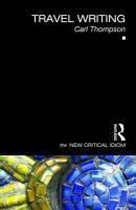
1.1Carl Thompson, Travel Writing (24 p.)
o Chapter 2, “Defining the Genre,” p. 9-33
1.2Hofer, Matthew, and Gary Scharnhorst, Oscar Wilde in America: The
Interviews. University of Illinois Press, 2010. (ca. 15 p.)
o Interviews 29 – 32
1.3Oscar Wilde, “Impressions of America,” lecture written in 1883 (2 p.)
o In the link below, omit the poem “Impressions,” the “Preface” and
“Oscar Wilde in America.” Just read " I fear I cannot ... LIBERTY"
https://www.gutenberg.org/files/41806/41806-h/41806-h.htm
1.1 Thompson Chapter 2: Defining the Genre
Travel can be defined as an encounter between self and other that is brought about by movement
through space, which would mean all travel writing is at some level a record or product of this
encounter, and of the negotiation between similarity and difference that it entailed. A non-narrative
mode of travel writing is when there is only documentation of data. Travel writing has two sides: it is
an account of an unfamiliar people or place, which is to a certain degree influenced by the
preoccupations, assumptions, and values of the writer and/or the culture for which the text is
intended.
There is no scholarly consensus on the definition of travel writing. One researcher, Fussel,
suggests that travel writing is a sub-genre of the memoir, meaning it should be a prose of personal
experience in a journey where one returns with a feeling of being enlightened. However, this is
problematic because this would exclude all travel writing from before 1750 from the genre. It is also
problematic because Fussel does not include fiction in his definition of travel writing, but the
distinction between fiction and non-fiction is not always as clear cut with travel writing.
Many critics define the genre broader and more inclusive. Martel suggests travel books and
guidebooks as two branches of the same genre. Brom makes the distinction between travel books,
which he defines as a non-fiction first-person narrative of travel, and travel writing, which he defines
as a collective term for texts both fictional and non-fictional whose main theme is travel. Certeau
states that every text is travel writing as everything is in a way a movement through space, but this is
a useless definition. Von Martels suggests that poetic prose can also be travel writing (think
Odyssee), but this potentially expands the genre too vastly (think lonely as a cloud), and also
suggests that maps could be considered travel writing. To conclude, there is no clear definition of the
genre, but the first-person non-fiction narrative is most central to the genre.
The distinction between fact and fiction in travel writing is not as clear-cut as you might
initially assume. There is a necessary negotiation between the role of a reporter that seeks to relay
accurate information, and that of a storyteller that seeks to maintain tge reader’s interest which
makes this distinction unclear. Even in a form with apparent immediacy (diary etc.) a writer picks out
significant events and organises those events, and their reflections on them in a form of narrative.
The process of transforming an experience into a text inevitably adds a fictive dimension to some
degree. This causes there to be writers that seek to record their experience as faithfully as possible,
but there are also writers who more will fully invent details and anecdotes. This all leads to travel
writing being the focus of epistemological anxieties, as both writers and readers try and distinguish
fact from fiction in the written context.
Because of this distrust in the authenticity of travel texts, recent decades have witnessed a
wave of travel writing which can be categorised as post-modern. In these texts the narrator/traveller
,2
often casts themselves in the role of trickster-figures, aligning themselves with travel writing’s long
tradition of tall tales and hoaxes, they playfully confound our conventional fiction vs. non-fiction in
order to explore the competing claims of imagination and moral responsibility in our engagement
with the world. Concluding, travel texts can be both fiction and non, yet it is important to keep in
mind that any form of travel text is constructed and not just a transparent window on the world.
In contemporary hierarchy, travel writing sits pretty low. If modern travel writing generally
seems to fall short on full literary status, so too is it usually denied much credibility or authority as a
scientific or intellectual discourse. Contemporary travel writing is seen as amaturistic, but this was
not always the case. Back in the 18th century travel writing had a more well esteemed status.
1.2 Hofer & Scharnhorst: Oscar Wilde Wilde Interviews 29-32
Interview 29: Detailed description of Wilde’s costuming, using words such as peculiar, aesthete,
“strapping clever fellow”, well knowledged. Written retrospectively. Interviewer asks Wilde to give
some comments on aestheticism and explain the meaning of the lily and sunflower (which ends up
being basically “they’re pretty”)
Interview 30: descriptions of Wilde’s reception upon arrival with the ferry. Again, Wilde seems
appreciative of nature. Described as an interesting curiosity, boyish, extravagant dress wear. Talks like
a man with deep thought. Does not seem to like american people.
Interview 31: Present tense, descriptions of his high status. Described as young, slender, tall,
decorated clothing. Amiable expression, keen, altogether charming fellow. Aesthete and interviewer
questions aesthete thoughts. Gives an impression of someone that thinks a lot. Italy (if you havent
been to Italy you have no true knowledge of the artistic world). Wilde has a lot of fans in the states.
Interview 32: The lion in his lair, very theatric descriptions. Seems casual, haughty, supercilious.
Wants to present himself as a dreamer, thinker, seemingly.
Wilde is presented as a flamboyant, extravagant, intelligent, and confident character. It seems like he
also presented himself in this manner, by othering himself in order to stand out. He presents himself
as an art critic observing America. He is a bit elitist, and out of reach for working class people. For the
rich.
1.3 Oscar Wilde: Impressions of America
Americans only wear comfortable clothing (comfort over class), seem to be in a rush which is bad for
the romanticism and aestheticism. Lazy, no care for pretty cities or anything. Have a high interest in
technological development. Describes the gun culture in the Mid-West, and the capitalistic mindset
imprinted on children. Likes SF. Shows disdain for the industrial, capitalist culture of the USA.
1.4 Terms
Anthology is a published collection of poems or other pieces of writing that share a similar
theme. Do not necessarily share the same writer.
Travel Writing is defined as an encounter between self and other that is brought about by
movement through space, and the negotiation between similarity and difference.
Epistemology is the branch of philosophy that explores what knowledge is, and how we
arrive at what we perceive as knowledge. Epistemological concerns are related to the nature,
validity, and reliability of knowledge.
Persona is the public image, or mask of the author. The impression they want to give.
Week 2
, 3
2.1Carl Thompson, Travel Writing
o Chapter 4, “Reporting the World” (33 p.)
2.2Barbara Korte, “Western Travel Writing, 1750 – 1950” (11p.)
2.3Sarah Winnemucca Hopkins, Life among the Piutes (1883)
o “First meeting of Piutes and Whites” (39 p.)
2.4Mary Jane Seacole, Wonderful Adventures of Mrs. Seacole in Many Lands
(1857) (38 p. if the text were printed as a Word document)
o Chapters I – VII (first seven chapters of her
text)https://www.gutenberg.org/files/23031/23031-h/23031-h.htm
2.5Lorraine Mercer, “I Shall Make No Excuse: The Narrative Odyssey of Mary Jane
Seacole” (24 p.)
2.6Lecture
2.1 Thompson: Chapter 4 “Reporting the World”
Every writer prioritises some aspects of their travel experience over other, resulting in every form of
travel writing offers only a partial depiction of the world, no matter their strive for accuracy and
objectivity. Travelogues are a travel account or a travel narrative. A narrative is a text structured so
that it recounts a sequence of events. The modern travel books usually prioritise the aesthetic
pleasure over accuracy of information. This causes epistemological questions; readers often have to
question the validity of the offered knowledge in travel accounts.
Writers tackle this in multiple ways, for one by claiming authority for themselves of the
eyewitness, someone who has observed in order to relay knowledge. This autopsy has been a route
to knowledge in Western culture for a long time. They do this by using first-person forms. However,
this method has its problems: it can make a traveller seem suspicious as their account cannot be
externally verified. It is thus easy to exploit this eye-witness position. Hence the linkage between
travellers and liars in many cultures. This linkage also has to do with the fact that sometimes people
and places described are so foreign to the reader that they don’t believe the account.
Travellers themselves have also been confounded by their encounters with radical difference.
This causes them to struggle with comprehending the events, and for this reason travel can be a
deeply estranging experience. Wonder has been observed to be a recurrent trope in travel writing.
Wonder is a mix of awe and bafflement that will often operate at a pre-rational level. Travellers often
describe having no words, or being rooted to their spot etc. Sublime is a term that denotes a feeling
of awe, in which aesthetic pleasure is mingled with apprehension, and possibly even terror. This all
suggests travellers will sometimes struggle the events in front of them.
The most basic device at the traveller’s disposal in this regard is the simile, which is accordingly a
rhetorical figure much used in travel writing. It does have its downsides, as it can cause foreign
concepts or animals to be mistranslated into some hybrid form of things already known to the
reader. Travellers thus seem to proceed by some sort of ‘principle of attachment’. However, the
necessary process of attaching may lead to ‘over-attachments’, and so to a variety of unwarranted
assumptions and projections about the new phenomenon under consideration.
Travellers are necessarily reliant on the rhetorical trope of synecdoche, meaning they must take
a part as emblematic of a greater whole, since no traveller can survey the entirety of a new
environment. Furthermore, their observations are to some degree subjective, having both
ideological aspects as well as being subjected to their personal taste, morals, preferences etc.
The plausibility and reliability of travel accounts used to be assessed in relation to the account of
the world provided by a well-defined canon of established authorities (think bible). The intellectual
climate of the Middle Ages was not as focussed on personal testimony and therefore there were less
first-person accounts then. Baconian principles (1660 Royal Society) issued numerous directives
seeking to regulate and systematise the information they gathered and the observational methods
they used to gather data.
The keeping of journals was a key directive laid down by the Royal Society and was intended to
ensure that observations were recorded whilst still fresh in the memory, or while happening in front
Transatlantic Travel Writing
Week 1
1.1Carl Thompson, Travel Writing (24 p.)
o Chapter 2, “Defining the Genre,” p. 9-33
1.2Hofer, Matthew, and Gary Scharnhorst, Oscar Wilde in America: The
Interviews. University of Illinois Press, 2010. (ca. 15 p.)
o Interviews 29 – 32
1.3Oscar Wilde, “Impressions of America,” lecture written in 1883 (2 p.)
o In the link below, omit the poem “Impressions,” the “Preface” and
“Oscar Wilde in America.” Just read " I fear I cannot ... LIBERTY"
https://www.gutenberg.org/files/41806/41806-h/41806-h.htm
1.1 Thompson Chapter 2: Defining the Genre
Travel can be defined as an encounter between self and other that is brought about by movement
through space, which would mean all travel writing is at some level a record or product of this
encounter, and of the negotiation between similarity and difference that it entailed. A non-narrative
mode of travel writing is when there is only documentation of data. Travel writing has two sides: it is
an account of an unfamiliar people or place, which is to a certain degree influenced by the
preoccupations, assumptions, and values of the writer and/or the culture for which the text is
intended.
There is no scholarly consensus on the definition of travel writing. One researcher, Fussel,
suggests that travel writing is a sub-genre of the memoir, meaning it should be a prose of personal
experience in a journey where one returns with a feeling of being enlightened. However, this is
problematic because this would exclude all travel writing from before 1750 from the genre. It is also
problematic because Fussel does not include fiction in his definition of travel writing, but the
distinction between fiction and non-fiction is not always as clear cut with travel writing.
Many critics define the genre broader and more inclusive. Martel suggests travel books and
guidebooks as two branches of the same genre. Brom makes the distinction between travel books,
which he defines as a non-fiction first-person narrative of travel, and travel writing, which he defines
as a collective term for texts both fictional and non-fictional whose main theme is travel. Certeau
states that every text is travel writing as everything is in a way a movement through space, but this is
a useless definition. Von Martels suggests that poetic prose can also be travel writing (think
Odyssee), but this potentially expands the genre too vastly (think lonely as a cloud), and also
suggests that maps could be considered travel writing. To conclude, there is no clear definition of the
genre, but the first-person non-fiction narrative is most central to the genre.
The distinction between fact and fiction in travel writing is not as clear-cut as you might
initially assume. There is a necessary negotiation between the role of a reporter that seeks to relay
accurate information, and that of a storyteller that seeks to maintain tge reader’s interest which
makes this distinction unclear. Even in a form with apparent immediacy (diary etc.) a writer picks out
significant events and organises those events, and their reflections on them in a form of narrative.
The process of transforming an experience into a text inevitably adds a fictive dimension to some
degree. This causes there to be writers that seek to record their experience as faithfully as possible,
but there are also writers who more will fully invent details and anecdotes. This all leads to travel
writing being the focus of epistemological anxieties, as both writers and readers try and distinguish
fact from fiction in the written context.
Because of this distrust in the authenticity of travel texts, recent decades have witnessed a
wave of travel writing which can be categorised as post-modern. In these texts the narrator/traveller
,2
often casts themselves in the role of trickster-figures, aligning themselves with travel writing’s long
tradition of tall tales and hoaxes, they playfully confound our conventional fiction vs. non-fiction in
order to explore the competing claims of imagination and moral responsibility in our engagement
with the world. Concluding, travel texts can be both fiction and non, yet it is important to keep in
mind that any form of travel text is constructed and not just a transparent window on the world.
In contemporary hierarchy, travel writing sits pretty low. If modern travel writing generally
seems to fall short on full literary status, so too is it usually denied much credibility or authority as a
scientific or intellectual discourse. Contemporary travel writing is seen as amaturistic, but this was
not always the case. Back in the 18th century travel writing had a more well esteemed status.
1.2 Hofer & Scharnhorst: Oscar Wilde Wilde Interviews 29-32
Interview 29: Detailed description of Wilde’s costuming, using words such as peculiar, aesthete,
“strapping clever fellow”, well knowledged. Written retrospectively. Interviewer asks Wilde to give
some comments on aestheticism and explain the meaning of the lily and sunflower (which ends up
being basically “they’re pretty”)
Interview 30: descriptions of Wilde’s reception upon arrival with the ferry. Again, Wilde seems
appreciative of nature. Described as an interesting curiosity, boyish, extravagant dress wear. Talks like
a man with deep thought. Does not seem to like american people.
Interview 31: Present tense, descriptions of his high status. Described as young, slender, tall,
decorated clothing. Amiable expression, keen, altogether charming fellow. Aesthete and interviewer
questions aesthete thoughts. Gives an impression of someone that thinks a lot. Italy (if you havent
been to Italy you have no true knowledge of the artistic world). Wilde has a lot of fans in the states.
Interview 32: The lion in his lair, very theatric descriptions. Seems casual, haughty, supercilious.
Wants to present himself as a dreamer, thinker, seemingly.
Wilde is presented as a flamboyant, extravagant, intelligent, and confident character. It seems like he
also presented himself in this manner, by othering himself in order to stand out. He presents himself
as an art critic observing America. He is a bit elitist, and out of reach for working class people. For the
rich.
1.3 Oscar Wilde: Impressions of America
Americans only wear comfortable clothing (comfort over class), seem to be in a rush which is bad for
the romanticism and aestheticism. Lazy, no care for pretty cities or anything. Have a high interest in
technological development. Describes the gun culture in the Mid-West, and the capitalistic mindset
imprinted on children. Likes SF. Shows disdain for the industrial, capitalist culture of the USA.
1.4 Terms
Anthology is a published collection of poems or other pieces of writing that share a similar
theme. Do not necessarily share the same writer.
Travel Writing is defined as an encounter between self and other that is brought about by
movement through space, and the negotiation between similarity and difference.
Epistemology is the branch of philosophy that explores what knowledge is, and how we
arrive at what we perceive as knowledge. Epistemological concerns are related to the nature,
validity, and reliability of knowledge.
Persona is the public image, or mask of the author. The impression they want to give.
Week 2
, 3
2.1Carl Thompson, Travel Writing
o Chapter 4, “Reporting the World” (33 p.)
2.2Barbara Korte, “Western Travel Writing, 1750 – 1950” (11p.)
2.3Sarah Winnemucca Hopkins, Life among the Piutes (1883)
o “First meeting of Piutes and Whites” (39 p.)
2.4Mary Jane Seacole, Wonderful Adventures of Mrs. Seacole in Many Lands
(1857) (38 p. if the text were printed as a Word document)
o Chapters I – VII (first seven chapters of her
text)https://www.gutenberg.org/files/23031/23031-h/23031-h.htm
2.5Lorraine Mercer, “I Shall Make No Excuse: The Narrative Odyssey of Mary Jane
Seacole” (24 p.)
2.6Lecture
2.1 Thompson: Chapter 4 “Reporting the World”
Every writer prioritises some aspects of their travel experience over other, resulting in every form of
travel writing offers only a partial depiction of the world, no matter their strive for accuracy and
objectivity. Travelogues are a travel account or a travel narrative. A narrative is a text structured so
that it recounts a sequence of events. The modern travel books usually prioritise the aesthetic
pleasure over accuracy of information. This causes epistemological questions; readers often have to
question the validity of the offered knowledge in travel accounts.
Writers tackle this in multiple ways, for one by claiming authority for themselves of the
eyewitness, someone who has observed in order to relay knowledge. This autopsy has been a route
to knowledge in Western culture for a long time. They do this by using first-person forms. However,
this method has its problems: it can make a traveller seem suspicious as their account cannot be
externally verified. It is thus easy to exploit this eye-witness position. Hence the linkage between
travellers and liars in many cultures. This linkage also has to do with the fact that sometimes people
and places described are so foreign to the reader that they don’t believe the account.
Travellers themselves have also been confounded by their encounters with radical difference.
This causes them to struggle with comprehending the events, and for this reason travel can be a
deeply estranging experience. Wonder has been observed to be a recurrent trope in travel writing.
Wonder is a mix of awe and bafflement that will often operate at a pre-rational level. Travellers often
describe having no words, or being rooted to their spot etc. Sublime is a term that denotes a feeling
of awe, in which aesthetic pleasure is mingled with apprehension, and possibly even terror. This all
suggests travellers will sometimes struggle the events in front of them.
The most basic device at the traveller’s disposal in this regard is the simile, which is accordingly a
rhetorical figure much used in travel writing. It does have its downsides, as it can cause foreign
concepts or animals to be mistranslated into some hybrid form of things already known to the
reader. Travellers thus seem to proceed by some sort of ‘principle of attachment’. However, the
necessary process of attaching may lead to ‘over-attachments’, and so to a variety of unwarranted
assumptions and projections about the new phenomenon under consideration.
Travellers are necessarily reliant on the rhetorical trope of synecdoche, meaning they must take
a part as emblematic of a greater whole, since no traveller can survey the entirety of a new
environment. Furthermore, their observations are to some degree subjective, having both
ideological aspects as well as being subjected to their personal taste, morals, preferences etc.
The plausibility and reliability of travel accounts used to be assessed in relation to the account of
the world provided by a well-defined canon of established authorities (think bible). The intellectual
climate of the Middle Ages was not as focussed on personal testimony and therefore there were less
first-person accounts then. Baconian principles (1660 Royal Society) issued numerous directives
seeking to regulate and systematise the information they gathered and the observational methods
they used to gather data.
The keeping of journals was a key directive laid down by the Royal Society and was intended to
ensure that observations were recorded whilst still fresh in the memory, or while happening in front