Embryology Test Questions| answers updated
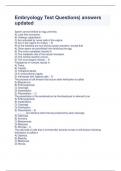
Embryology Test Questions| answers updated Sperm cannot fertilize an egg until they A) Lose their acrosome. B) Undergo capacitation. C) Are activated by nurse cells of the vagina. D) Are in the vagina for 3 days. - B All of the following are true during oocyte activation, except that A) Other sperm are prohibited from fertilizing the egg. B) The ovum completes meiosis II. C) The metabolic rate of the oocyte increases. D) The cortical reaction occurs. E) The ovum begins mitosis. - E Polyspermy in humans results in A) Twins. B) Triplets. C) Tetraploid adults. D) A nonfunctional zygote. E) Individuals with haploid cells - D The process of cell division that occurs after fertilization is called A) Blastula ion. B) Embryogenesis. C) Cleavage. D) Implantation. E) Placentation. - C The penetration of the endometrium by the blastocyst is referred to as A) Embryogenesis. B) Implantation. C) Cleavage. D) Fertilization. E) Placentation - B ________ are identical cells that are produced by early cleavage. A) Gastrulas B) Amnions C) Blastomeres D) Blastulas E) Morulas - C The solid ball of cells that is formed after several rounds of cell division following fertilization is called a A) Gastrula. B) Blastula. C) Blastocyst. D) Morula. E) Chorio - D A blastocyst is a(n) A) Membrane that forms the urinary bladder. B) Extraembryonic membrane that forms blood vessels. C) Hollow ball of cells. D) Solid ball of cells. E) Portion of the placenta. - C The inner cell mass of the blastocyst will A) Form blood vessels of the placenta. B) Form the placenta. C) Form the embryo. D) Form the morula. E) Provide nutrients for early growth. - C During implantation, the A) Entire trophoblast becomes syncytial. B) Inner cell mass is temporarily deprived of nutrients. C) Maternal blood vessels in the endometrium are walled off from the blastocyst. D) Inner cell mass begins to form the placenta. E) Syncytial trophoblast erodes a path through the endometrium - E Separation of the inner cell mass from the trophoblast forms the A) Amniotic cavity. B) Allantois. C) Lacunae. D) Chorion. E) Blastocoele - A At the point in time when the head and tail folds form, the A) Fetus becomes an embryo. B) Embryo is no longer attached to the placenta. C) Embryo becomes a fetus. D) Fetus is fully developed. E) Embryo is physically and developmentally separated from the blastodisc - E During gastrulation, A) Definite organs begin to appear. B) The placenta is formed. C) The blastodisc is formed. D) Germ layers are formed. E) Cells from the hypoblast move to the epiblast. - D The region known as the primitive streak is the site of A) Ectoderm formation. B) Germ cell formation.

Geschreven voor
- Instelling
- Embryology
- Vak
- Embryology
Documentinformatie
- Geüpload op
- 17 oktober 2023
- Aantal pagina's
- 7
- Geschreven in
- 2023/2024
- Type
- Tentamen (uitwerkingen)
- Bevat
- Vragen en antwoorden
Onderwerpen
-
embryology test questions answers updated

Ook beschikbaar in voordeelbundel