Ethics - Brain Machine Interfaces (BMI)
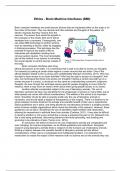
Brain computer interfaces are small sensory devices that are implanted either on the scalp or on
the cortex of the brain. They can decode and infer activities and thoughts of the patient via
electric impulses that they receive from the
neurons. The sensor then sends the signals to
the computer or the robotic limb and it will be
translated into a command. Consequently, one
can utilize BMI technology to perform actions,
such as operating a device, solely by engaging
in thinking processes. This technique has the
potential to improve the quality of life for
individuals with disabilities resulting from
nervous system injuries. The most remarkable
part of this method in our opinion is converting
Figure 1: EEG-based Brain Computer Interface (Gu et.
the neural signals to control devices outside of al, 2021)
the body.
Brain computer interfaces also bring
ethical discussions to the table. It is a technique that is said to be able to access our thoughts.
For instance by looking at certain brain regions or even neurons that are active. One of the
ethical debates related to this is privacy and confidentiality (Monash University, 2017). Who has
the right to have access to our brain activities? Who has the right to access our thoughts? And
also, can techniques like these truly access our thoughts? Seeing a certain area light up on a
screen because it is active, is obviously not the same as understanding someone's subjective
thoughts. So even though this technique seems great for people struggling to move limbs for
instance, there is way more we need to think about when giving people access to our brains.
Another ethically complicated subject is the use of laboratory animals. The use of
laboratory animals has been very beneficial for the progression of science in many fields, but its
wide-spread use comes with ethical considerations. The welfare of the animal is an important
factor. Scientists should be able to properly justify why the use of laboratory animals is
necessary, and should adopt a degree of transparency in this respect. There is a balance to be
struck between humane treatment of animals and scientific benefit of their use in experiments.
Ethical guidelines are in place, and being allowed to use laboratory animals is a lengthy process
which involves multiple organizations which check the ethicality of the research. However, these
guidelines can be blurry. Sometimes the use of painkillers might interfere with observation,
allowing the researchers to withhold them from animals (Carbone, 2011). It may also be difficult
to observe whether or not a prey animal like a mouse is experiencing pain or not. Research into
this is also being performed, discovering behaviors like facial grimacing, nest building and
grooming to be indicators of pain (Turner et al., 2019).
In conclusion, the ethics involved in the use of laboratory animals are complicated and
ever changing. As science progresses, so do ethical guidelines and restrictions. Alongside
research using laboratory animals there is research on the humane use of laboratory animals.
Striking a balance between the scientific benefit of laboratory animals and the ethical
considerations of their use is a complicated and multifaceted problem. It is imperative for
researchers to realize the impact of their research both on science and on the animals they use.
Brain computer interfaces are small sensory devices that are implanted either on the scalp or on
the cortex of the brain. They can decode and infer activities and thoughts of the patient via
electric impulses that they receive from the
neurons. The sensor then sends the signals to
the computer or the robotic limb and it will be
translated into a command. Consequently, one
can utilize BMI technology to perform actions,
such as operating a device, solely by engaging
in thinking processes. This technique has the
potential to improve the quality of life for
individuals with disabilities resulting from
nervous system injuries. The most remarkable
part of this method in our opinion is converting
Figure 1: EEG-based Brain Computer Interface (Gu et.
the neural signals to control devices outside of al, 2021)
the body.
Brain computer interfaces also bring
ethical discussions to the table. It is a technique that is said to be able to access our thoughts.
For instance by looking at certain brain regions or even neurons that are active. One of the
ethical debates related to this is privacy and confidentiality (Monash University, 2017). Who has
the right to have access to our brain activities? Who has the right to access our thoughts? And
also, can techniques like these truly access our thoughts? Seeing a certain area light up on a
screen because it is active, is obviously not the same as understanding someone's subjective
thoughts. So even though this technique seems great for people struggling to move limbs for
instance, there is way more we need to think about when giving people access to our brains.
Another ethically complicated subject is the use of laboratory animals. The use of
laboratory animals has been very beneficial for the progression of science in many fields, but its
wide-spread use comes with ethical considerations. The welfare of the animal is an important
factor. Scientists should be able to properly justify why the use of laboratory animals is
necessary, and should adopt a degree of transparency in this respect. There is a balance to be
struck between humane treatment of animals and scientific benefit of their use in experiments.
Ethical guidelines are in place, and being allowed to use laboratory animals is a lengthy process
which involves multiple organizations which check the ethicality of the research. However, these
guidelines can be blurry. Sometimes the use of painkillers might interfere with observation,
allowing the researchers to withhold them from animals (Carbone, 2011). It may also be difficult
to observe whether or not a prey animal like a mouse is experiencing pain or not. Research into
this is also being performed, discovering behaviors like facial grimacing, nest building and
grooming to be indicators of pain (Turner et al., 2019).
In conclusion, the ethics involved in the use of laboratory animals are complicated and
ever changing. As science progresses, so do ethical guidelines and restrictions. Alongside
research using laboratory animals there is research on the humane use of laboratory animals.
Striking a balance between the scientific benefit of laboratory animals and the ethical
considerations of their use is a complicated and multifaceted problem. It is imperative for
researchers to realize the impact of their research both on science and on the animals they use.