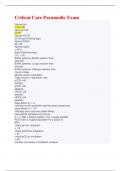
Critical Care Paramedic Exam 2023
Normal pH - Answer- 7.35-7.45 Normal CO2 - Answer- 35-45 Normal HCO3 - Answer- 22-26 (good dating age) Normal PaO2 - Answer- 80-100 Normal SaO2 - Answer- > 95% Base (deficit/excess) - Answer- (-2) - (+2) Buffer systems: Bicarb reaction time - Answer- seconds Buffer systems: Lungs reaction time - Answer- minutes Buffer systems: Kidneys reaction time - Answer- hours to days Minute volume calculation - Answer- Tidal volume x respiratory rate pCO2 >45 - Answer- acidotic pCO2 <35 - Answer- alkalotic HCO3 <22 - Answer- acidotic HCO3 >26 - Answer- alkalotic base deficit of < -4 - Answer- indicator for the potential need for blood transfusion base deficit of < -19 - Answer- indicates poor outcome (death likely) base deficit replacement formula - Answer- 0.1 x (-BE) x patient weight in kg = bicarb needed PO2 of 60 is roughly equivalent to a SaO2 of - Answer- 90% critical pH for intubation - Answer- < 7.2 critical pCO2 for intubation - Answer- > 55 critical pO2 for intubation - Answer- < 60 number one cause of metabolic acidosis - Answer- lactic acidosis (lactate > 4) CO2 is a byproduct of - Answer- metabolism for every __ change in ETCO2, you should expect the pH to change __ in the ___________ direction. - Answer- 10, 0.08, opposite for every __ change in pH, you should expect the HCO3 to change __ in the ___________ direction. - Answer- 0.15, 10, same for every __ change in pH, you should expect the potassium to change __ in the ___________ direction. - Answer- 0.10, 0.6, opposite LEMON - Answer- difficult intubation look, evaluate (3-3-2), mallampati, obstructions, neck mobility HEAVEN - Answer- difficult intubation Hypoxia, extremes of size, anatomic challenges, vomit/blood/fluid, exsanguination, neck mobility issues ramping - Answer- ear to sternal notch without ramping during intubation or transport causes a potential for - Answer- decrease in functional reserve capacity, tidal volume, and preload Sellick's maneuver and BURP - Answer- no longer recommended External laryngeal manipulation (ELM) - Answer- current standard of practice bougie adult size - Answer- 15 Fr bougie pediatric size - Answer- 10 Fr bougie neonatal size - Answer- 6 Fr supraglottic devices - Answer- provide little protection against aspiration ETT cuff pressure - Answer- 20-30 mmHg (25 is standard) gold standard of confirming ET placement - Answer- chest X-Ray distal tip of ET - Answer- 2-3 cm (1 inch) above carina, at T3 or T4 7 p's for RSI success - Answer- preparation, preoxygenation, pretreatment, paralysis with induction, protect/position, placement (with proof), post intubation management LOAD - Answer- pretreatment for RSI lidocaine, opiates, atropine (infants), defasiculating dose fentanyl adult dose - Answer- 1 mcg/kg fentanyl onset - Answer- 3-5 mins fentanyl post intubation management - Answer- 0.5 - 1.5 mcg/kg every 5 minutes fentanyl post intubation management infusion - Answer- 1-3 mcg/kg/hour fentanyl reversal agent - Answer- narcan etomidate adult dose - Answer- 0.3 mg/kg etomidate onset time - Answer- 15-45 seconds etomidate duration - Answer- 3-12 minutes etomidate cautions/contraindications - Answer- hemodynamically unstable patients, adrenal suppression, shock patients, COPD/asthmatic ketamine adult dose - Answer- 1-2 mg/kg ketamine onset - Answer- 40-60 seconds ketamine duration - Answer- 10-20 minutes ketamine is preferred for - Answer- asthmatic patients ketamine post intubation management - Answer- 0.5 - 1 mg/kg ketamine post intubation management infusion - Answer- 1-2 mg/kg/hour versed adult dose - Answer- 2.5-5 mg versed onset - Answer- 30-60 seconds versed duration - Answer- 15-30 minute duration versed post intubation management - Answer- 2-5 mg versed post intubation management infusion - Answer- 0.05 - 0.1 mg/kg/hour versed reversal agent - Answer- flumazenil (romazicon) 0.2 mg propofol (diprivan) adult RSI dose - Answer- 1-2 mg/kg propofol (diprivan) adult maintenance dose - Answer- 25-50 mcg/kg/min propofol (diprivan) onset - Answer- 15-45 seconds propofol (diprivan) duration - Answer- 5-10 minutes propofol (diprivan) cautions - Answer- hemodynamically unstable patients succinylcholine (anectine) - Answer- depolarizing neuromuscular blocker agent succinylcholine (anectine) can cause - Answer- fasciculations hyperkalemia succinylcholine (anectine) requires - Answer- refrigeration succinylcholine (anectine) contraindications - Answer- crush injuries, eye injuries, narrow-angle glaucoma, malignant hyperthermia, burns >24 hours old, hyperkalemia, Guillain- Barre, Myasthenia gravis succinylcholine (anectine) adult dose - Answer- 1-2 mg/kg (max 150) succinylcholine (anectine) onset - Answer- < 1 minute succinylcholine (anectine) duration - Answer- 4-6 minute duration malignant hyperthermia - Answer- rapid body temperature increase and increased ETCO2 malignant hyperthermia treatment - Answer- Dantrolene Sodium (Dantrium) 2.5 mg/kg rapid Rocuronium (Zemeron) - Answer- non-depolarizing neuromuscular blocking agent Rocuronium (Zemeron) adult RSI dose - Answer- 0.6 - 1.2 mg/kg Rocuronium (Zemeron) maintainance dose - Answer- 0.1 - 0.2 mg/kg every 20-30 minutes Rocuronium (Zemeron) onset - Answer- < 2 minutes Rocuronium (Zemeron) duration - Answer- 30 - 60 minutes Rocuronium (Zemeron) requires - Answer- refrigeration Rocuronium (Zemeron) reversal agent - Answer- Sugammadex (Bridion) 16 mg/kg Vecuronium (Norcuron) - Answer- non-depolarizing neuromuscular blocking agent Vecuronium (Norcuron) use - Answer- used after sux or rox to keep the patient paralyzed Vecuronium (Norcuron) adult dose - Answer- 0.15 mg/kg Vecuronium (Norcuron) adult maintenance dose - Answer- 0.01 - 0.1 mg/kg Vecuronium (Norcuron) does not require - Answer- refrigeration Vecuronium (Norcuron) onset - Answer- 90-120 seconds Vecuronium (Norcuron) duration of action - Answer- 60-75 minutes RSI for hemodynamically unstable patients - Answer- 1/2 the induction dose, double to paralytic SALAD - Answer- Suction assisted laryngoscopy airway decontamination under 8 years old - Answer- needle cricothyrotomy tidal volume (Vt) - Answer- how much air the patient breathes in a normal breath Inspiratory Reserve Volume (IRV) - Answer- Amount of air that can be forcefully inhaled after a normal tidal volume inhalation Expiratory Reserve Volume (ERV) - Answer- Amount of air that can be forcefully exhaled after a normal tidal volume exhalation Vital Capacity (VC) - Answer- TV + IRV + ERV Residual Volume (RV) - Answer- amount of air left in lungs after maximum expiration Total Lung Capacity (TLC) - Answer- RV + VC (TV + IRV + ERV) Dead space - Answer- the surfaces of the airway that are not involved in gas exchange (anything other than alveoli) Dead space formula - Answer- 2 ml/kg central chemoreceptors - Answer- medulla/pons, driven by CO2 peripheral chemoreceptors - Answer- aortic arch/carotid bodies, driven by O2 Respiratory patterns: Apneustic - Answer- deep, gasping inspiration brief release decerebrate posturing Respiratory patterns: Ataxic - Answer- irregular poor prognosis Respiratory patterns: Biots - Answer- quick shallow respirations, regular periods of apnea head trauma, cva Respiratory patterns: Cheyne-Stokes - Answer- gradual increasing deep, fast with gradual decrease into temporary apnea decorticate posturing, Cushings Respiratory patterns: Kussmaul - Answer- deep, rapid DKA gold standard for oxygenation - Answer- pulse ox (SPO2) gold standard for ventilation - Answer- capnography (ETCO2) number one cause of iatrogenic death in US - Answer- ventilator acquired pneumonia (VAP) once a patient is on a ventilator - Answer- confirm settings with ABG hypoxic respiratory failure - Answer- inability to diffuse O2

Geschreven voor
- Instelling
- Critical Care Paramedic
- Vak
- Critical Care Paramedic
Documentinformatie
- Geüpload op
- 12 oktober 2023
- Aantal pagina's
- 31
- Geschreven in
- 2023/2024
- Type
- Tentamen (uitwerkingen)
- Bevat
- Vragen en antwoorden
Onderwerpen
-
critical care paramedic exam 2023

Ook beschikbaar in voordeelbundel