Accounting - concepts & principles.
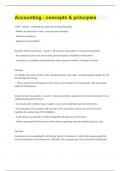
GAAP - Generally Accepted Accounting Principles - Widely accepted set of rules, concepts and principles - Achieve consistency - Approach comparability Business Entity Assumption - All business transactions ≠ personal transactions - Accounting records must not include personal assets or liabilities of the owner. - a business is accounted separately from other business entities, including its owner Example: Mr. Adolfo, the owner of Hair, There and Everywhere hair salon, recently bought supplies for his Art Management Class. — This is a personal transaction of the owner and it should not be recorded in the accounting books of the business Going Concern Assumption - A business entity is assumed to remain in existence for an indeterminate period of time - A company will continue long enough to carry out its objectives and commitments. - The operations of a business will not stop in the near future and it will not be forced to liquidate its assets to pay off its liabilities. - It also allows accountants to defer recognition of expenses in the future. - reflects assumption that business will continue operating instead of being closed or sold Example: Company A rents a building for 10,000 per month. On January 1, 2016, the company paid the rent for two years in the amount of 2,400,000. The company has not yet used the building but they already paid the rent. The accountant records the payment as an asset rather than an expense. (Prepaid rent) — If the company is not a "going concern" then the payment will just be an expense because operations will stop in the near future. going concern a company is not a ——— when they: - Pay obligations on time - Loan defaults - Suppliers do not sell on credit to the company - Legal proceedings against the company Monetary unit Assumption - only transaction data that can be expressed in terms of money be included in the accounting records Example: Hiring an employee — do not record Paying an employee — record Time period Assumption - the economic life of a business can be divided into artificial time periods Fiscal year the 12-month period used by a government and the business world for its record-keeping, budgeting, revenue-collecting, and other financial management purposes Cash basis - revenue recognized when received - not GAAP - Records only cash receipts and cash payments. It ignores receivables, payables and depreciation. - records an expense when its incurred Accrual - revenue recognized when earned and realizable - Records the effect of each transaction as it occurs - GAAP - records only cash receipts as revenue - records only cash payments as expenses - all business transactions are required to be recognized in the period in which they occurred - Financial statements will also be accurate and reliable in terms of assessing the past performance of the company. - Financial statements for a particular period properly reflect the financial transactions pertaining to that period. Example: Andrew established an ukay-ukay in the country. The income from Andrew's business primarily comes for selling goods to customers. Sales to customers can be cash or on credit. — If the goods were sold on credit, the transactions should still be recorded in the accounting records as accounts receivable. The matching principle - the practice of expense recognition - dictates the efforts (expenses) be matched with accomplishments (revenues) - It prevents understatement of expenses in one period, while overstating expenses in the next period. - It shows a cause and effect relationship between revenues and expenses. Example: Virgil works as a car salesman with a monthly salary of 30,000. He also receives commission of 5% for all the sales he made for the month. During the month of December he was able to sell 10 cars amounting to 12 M. 12 M is recorded as the sales of the company. • Compute for the amount of money Virgil will receive. (salary and commission) The monthly salary of Virgil and his commission are expenses of the company. the 630,000 will be recorded as an expense in December. — Why? Because it is related to the 12M in revenues. Revenue Recognition Principle - Revenues are recognized as soon as goods are sold - Services has been rendered - It is recognized when it is earned and when it is realized or realizable - revenue is earned when the earnings process is substantially complete - revenue is realized when goods and services are exchanged for cash or claims to cash - revenue is realized when assets received are convertible into a known amount of cash Example: On June 25, Bilis Serbisyo Repair Shop rendered service to a client for 15,000. The service fee was collected on July 4. — The company should record the revenue of 15,000 in June, the time service was rendered to the customer and not the time cash was received Historical Cost Principle - All assets should be valued and recorded based on actual equivalent or original cost of acquisition - Acquisition cost is the most objective basis Example: Ayos! Computer shop bought a computer set for 30,000. The same computer can be purchased at 25,000 from another vendor. — The accounting record should use the 30,000 as their amount because it is amount given by the vendor Bill's investment firm purchases several pieces of property in Brazil as an investment. Over the last five years, the Brazilian currency has been in double-digit inflation and the investment is not worth nearly what Bill paid for it. — The principle does not adjust asset values based on currency fluctuations, so the property would still be reported as the original purchase price Full Disclosure Principle - requires a company to provide the necessary information so that people who are accustomed to reading financial information can make informed decisions concerning the company. - In the form of foot notes or attachments Example: Guitar Emporium is a nationwide guitar retailer. It reports $10.5M in guitar inventory last year. In the notes of its financial statements, GE should disclose its significant accounting policies. This would include its inventory evaluation methods. GE should disclose whether its financial statements are prepared uses FIFO or LIFO inventory cost methods. Objectivity Principle - accounting information and financial reporting should be independent and supported with unbiased evidence - aimed at making financial statements more relevant and reliable Example: A company is trying to get financing for an extra plant expansion, but the company's bank wants to see a copy of its financial statements before it will loan the company any money. The company's bookkeeper prints out an income statement from its accounting system and mails it to the bank. — Most likely the bank will reject this financial statement because an independent party did not prepare it. In other words, this income statement violates the principle. Materiality Principle - all important financial information that would sway the opinion of a financial statement user should be included in the financial statements. - The concept is relative in size and importance. Example: A large company has a building in the hurricane zone during Hurricane Sandy. The company building is destroyed and after a lengthy battle with the insurance company, the company reports an extra ordinary loss of $10,000. The company has net income of $10,000,000. — The concept states that this loss is immaterial because the average financial statement user would not be concerned with something that is only .1% of net income. Assume the same example from the previous example except the company is a smaller company with only $50,000 of net income. — Now the loss is 20% of net income. This is a substantial loss for the company. Investors and creditors would be concerned about a loss this big. To the smaller company, this $10,000 would be considered material.
Geschreven voor
- Instelling
- Minnesota School Of Business
- Vak
- Accounting Principles
Documentinformatie
- Geüpload op
- 5 oktober 2023
- Aantal pagina's
- 7
- Geschreven in
- 2023/2024
- Type
- Tentamen (uitwerkingen)
- Bevat
- Vragen en antwoorden
Onderwerpen
-
accounting concepts principles

Ook beschikbaar in voordeelbundel