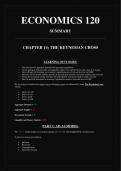
ECONOMICS 120
SUMMARY
CHAPTER 14: THE KEYNESIAN CROSS
LEARNING OUTCOMES:
o The link between aggregate demand and aggregate expenditure
o About aggregate demand (AD) and aggregate supply (AS) and the factors that cause it to change
o How AD and AS determine an economy's equilibrium price level and level of real GDP.
o How the AD-AS model explains periods of demand-pull inflation, cost-push inflation and recession
o About the investment saving schedule (IS) and liquidity and money markets (LM) concepts
o How IS and LM determine an economy's equilibrium intertest rates and level of GDP
We are going to examine how output, prices and interest rates are influenced by using The Keynesian Cross
Theory:
• Derive an AD
• Link it to AS
• Derive an IS
• Link it to LM.
Aggregate Demand = AD
Aggregate Supply = AS
Investment Savings = IS
Liquidity and Money Markets = LM
PART 1: AD-AS MODEL
The AD-AS model enables us to analyse changes in real GDP and the price level simultaneously.
It allows us to keep an insight in:
• Inflation
• Recession
• Unemployment
• Economic Growth
, PART 2: IS-LM MODEL
The IS-LM model enables us to analyse the changes in real GDP and interest rates.
It allows us to keep an insight in:
• Inflation
• Recession
• Unemployment
• Economic growth.
AGGREGATE DEMAND
It is a schedule/curve that shows:
• Real GDP that buyers collectively desire to purchase at each possible price level.
The relationship between real GDP and price level is negative/inversely proportional.
Deviation of the Aggregate Demand Curve is from the
Aggregate Expenditure Model.
There is an association between the Aggregate Demand
Curve and Aggregate Expenditure Model.
Summary:
Increases in the economy's price level will successively shift
its aggregate expenditure schedule downward and will reduce
real GDP.
Basically, increases in prices reduces demand, thereafter, spending (purchasing output).
An increase in aggregate expenditure will result in an increase in real GDP. As spending increases aggregate
demand will increase as well.
NB: A decline in price levels does not necessarily mean an increase in the amount of nominal-income on the
economy as a whole.
REASONS WHY THE AD CURVE IS DOWN-SLOPING
• Real Balances Effect
• Interest Rate Effect
• Foreign Purchases Effect
REAL BALANCES EFFECT
A change in the price levels produces the real balances effect. High price levels reduce the real value or the
purchasing power of the public's accumulated savings balances. The real value assets such as savings accounts
or bonds, diminish.
SUMMARY
CHAPTER 14: THE KEYNESIAN CROSS
LEARNING OUTCOMES:
o The link between aggregate demand and aggregate expenditure
o About aggregate demand (AD) and aggregate supply (AS) and the factors that cause it to change
o How AD and AS determine an economy's equilibrium price level and level of real GDP.
o How the AD-AS model explains periods of demand-pull inflation, cost-push inflation and recession
o About the investment saving schedule (IS) and liquidity and money markets (LM) concepts
o How IS and LM determine an economy's equilibrium intertest rates and level of GDP
We are going to examine how output, prices and interest rates are influenced by using The Keynesian Cross
Theory:
• Derive an AD
• Link it to AS
• Derive an IS
• Link it to LM.
Aggregate Demand = AD
Aggregate Supply = AS
Investment Savings = IS
Liquidity and Money Markets = LM
PART 1: AD-AS MODEL
The AD-AS model enables us to analyse changes in real GDP and the price level simultaneously.
It allows us to keep an insight in:
• Inflation
• Recession
• Unemployment
• Economic Growth
, PART 2: IS-LM MODEL
The IS-LM model enables us to analyse the changes in real GDP and interest rates.
It allows us to keep an insight in:
• Inflation
• Recession
• Unemployment
• Economic growth.
AGGREGATE DEMAND
It is a schedule/curve that shows:
• Real GDP that buyers collectively desire to purchase at each possible price level.
The relationship between real GDP and price level is negative/inversely proportional.
Deviation of the Aggregate Demand Curve is from the
Aggregate Expenditure Model.
There is an association between the Aggregate Demand
Curve and Aggregate Expenditure Model.
Summary:
Increases in the economy's price level will successively shift
its aggregate expenditure schedule downward and will reduce
real GDP.
Basically, increases in prices reduces demand, thereafter, spending (purchasing output).
An increase in aggregate expenditure will result in an increase in real GDP. As spending increases aggregate
demand will increase as well.
NB: A decline in price levels does not necessarily mean an increase in the amount of nominal-income on the
economy as a whole.
REASONS WHY THE AD CURVE IS DOWN-SLOPING
• Real Balances Effect
• Interest Rate Effect
• Foreign Purchases Effect
REAL BALANCES EFFECT
A change in the price levels produces the real balances effect. High price levels reduce the real value or the
purchasing power of the public's accumulated savings balances. The real value assets such as savings accounts
or bonds, diminish.