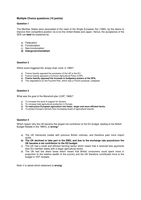
Multiple Choice questions (10 points)
Question 1
The Member States were persuaded of the need of the Single European Act (1985), by the desire to
improve their competitive position vis-à-vis the United States and Japan. Hence, the acceptance of the
SEA can best be explained by:
a) Federalism
b) Functionalism
c) Neo-functionalism
d) Intergovernmentalism
Question 2
Which event triggered the ‘empty-chair crisis’ in 1965?
a) France heavily opposed the accession of the UK to the EU.
b) France heavily opposed a Common Agricultural Policy (CAP).
c) France heavily opposed the increase in budgetary powers of the EPA.
d) The negotiations on the Fouchet Plan, which was a French proposal, collapsed.
Question 3
What was the goal of the Mansholt-plan (CAP, 1968)?
a) To increase the level of support for farmers.
b) To increase total agricultural production in Europe.
c) To restructure European agriculture into fewer, larger and more efficient farms.
d) To protect Europe’s farmers from increasing levels of agricultural imports.
Question 4
Which reason why the UK became the largest net contributor to the EU budget, leading to the British
Budget Rebate in the 1980’s, is wrong?
a) The UK intensively traded with previous British colonies, and therefore paid more import
tariffs.
b) The UK declined to take part in the EMU, and due to the exchange rate pound/euro the
UK became a net contributor to the EU budget.
c) The UK had a small and efficient farming sector which meant that it received less payments
than EU member states with a larger agricultural sector.
d) The UK had low direct taxes which meant that British consumers could spent more in
proportion to the relative wealth of the country and the UK therefore contributed more to the
budget in VAT receipts.
Note: it is asked which statement is wrong!
Question 1
The Member States were persuaded of the need of the Single European Act (1985), by the desire to
improve their competitive position vis-à-vis the United States and Japan. Hence, the acceptance of the
SEA can best be explained by:
a) Federalism
b) Functionalism
c) Neo-functionalism
d) Intergovernmentalism
Question 2
Which event triggered the ‘empty-chair crisis’ in 1965?
a) France heavily opposed the accession of the UK to the EU.
b) France heavily opposed a Common Agricultural Policy (CAP).
c) France heavily opposed the increase in budgetary powers of the EPA.
d) The negotiations on the Fouchet Plan, which was a French proposal, collapsed.
Question 3
What was the goal of the Mansholt-plan (CAP, 1968)?
a) To increase the level of support for farmers.
b) To increase total agricultural production in Europe.
c) To restructure European agriculture into fewer, larger and more efficient farms.
d) To protect Europe’s farmers from increasing levels of agricultural imports.
Question 4
Which reason why the UK became the largest net contributor to the EU budget, leading to the British
Budget Rebate in the 1980’s, is wrong?
a) The UK intensively traded with previous British colonies, and therefore paid more import
tariffs.
b) The UK declined to take part in the EMU, and due to the exchange rate pound/euro the
UK became a net contributor to the EU budget.
c) The UK had a small and efficient farming sector which meant that it received less payments
than EU member states with a larger agricultural sector.
d) The UK had low direct taxes which meant that British consumers could spent more in
proportion to the relative wealth of the country and the UK therefore contributed more to the
budget in VAT receipts.
Note: it is asked which statement is wrong!