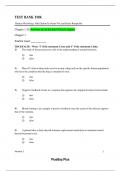
(Intercultural Business Communication 6e Lillian Chaney, Jeanette Martin)
(Test Bank, Answer at the end of this File)
TEST BANK AND ANSWER KEYS
A product called Respondus, which is an assessment tool for learning systems,
can be used to import the exam questions or exams into Blackboard, WebCT, or
other online course delivery systems.
http://www.respondus.com/products/respondus.shtml
The Nature of Intercultural Communication
Chapter 1, Test Questions
True-False. Circle T if the statement is true; circle F if it is false.
1. T F International business is decreasing in the United States.
2. T F Diffusion is the process by which two cultures learn from
each other and adopt practices of the other culture.
3. T F Globalization refers to the interpenetration of the local
and global.
4. T F The Statue of Liberty is considered a U.S. cultural symbol.
5. T F Cultural synergy is the merging of cultures to form a
common culture.
6. T F The terms intercultural and international can be used
interchangeably.
7. T F Ethnocentrists believe that their cultural background is
the correct way to analyze problems.
8. T F The term "American" refers exclusively to someone who
considers his or her home country the United States.
9. T F A stereotype of Latin Americans is that they are polite and
soft spoken.
10. T F A typical stereotype of U.S. people is that they place
great importance on the family.
11. T F Melting pot means a sociocultural assimilation of people of
differing backgrounds and nationalities.
12. T F Backstage culture is information you are willing to share
with outsiders.
13. T F Assimilation is a dimension of enculturation.
14. T F The terms subculture and subgroup may be used
interchangeably.
15. T F Cultural intelligence is the ability to exhibit behaviors
that are culturally tuned to the attitudes and values of
others.
16. T F Physical barriers to communication include personal
feelings of the listener.
Copyright © 2014 Pearson Education, Inc.
2
,17. T F Corporate leaders need a global mindset to be successful in
the international workplace.
18. T F Businesspeople with a domestic mindset are open to
surprises.
Multiple Choice. Circle the letter corresponding to the correct response.
19. Which of the following multinational management orientations considers
the culture of the country in which the firm is located without a
common corporate framework?
a. ethnocentric
b. polycentric
c. geocentric
d. regiocentric
20. In a geocentric multinational management practice
a. all capital investments are in one country.
b. the dominant cultural group is considered.
c. there is a common framework with regional control.
d. facilities are run differently by region.
21. A business is globalized when it
a. sells in another country.
b. has a distributor in another country
c. can market its product anywhere in the world.
d. produces in another country.
22. Which of the following are examples of subgroups?
a. Jews, Christians, and Muslims.
b. Youth gangs, prostitutes, and drug addicts.
c. Senior citizens, teenagers, and babies.
d. Latin Americans, African Americans, and Asian Americans.
23. Norms are
a. learned through enculturation.
b. clarifications of rules.
c. behavioral expectations of a group.
d. unusual group behaviors.
24. Judy was telling all her friends about what happened at the conference;
however, she did not tell them about the job offer she received at the
conference.
a. It was wrong of Judy to not share the job information.
b. Information that Judy was willing to share with friends was
hidden from their view.
c. What Judy was telling her friends was an example of frontstage
culture; however, the job offer is an example of backstage
culture.
d. Judy thought her friends would not want to know about the job
offer.
25. Which of the following communication barriers is due to a lack of
similar life happenings?
a. cultural
b. emotional
c. experiential
d. perceptual
Copyright © 2014 Pearson Education, Inc.
3
,26. Which of the following is NOT a recognized area of cultural
intelligence?
a. interpersonal intelligence
b. linguistic intelligence
c. spatial intelligence
d. synergistic intelligence
27. An acculturated person
a. has become part of the melting pot.
b. has become socioculturally assimilated.
c. understands his or her own culture.
d. accepts another culture’s ideas.
28. Successful corporations have found that the values, beliefs, and
behaviors of the parent corporation
a. do not need to be the beliefs, values, and behaviors of their
offices in other cultures.
b. should be the beliefs, values, and behaviors of their offices in
other cultures.
c. are the most important variables for success.
d. are unimportant variables for success.
29. The primary dimensions of culture include
a. language, physical, and knowledge.
b. language, physical, and psychological.
c. physical, environment, and nonverbal.
d. human behavior, environment, and processes.
30. A stereotype is
a. a particular definitive description of a culture.
b. invariant across all cultures.
c. a perception about a particular group.
d. not culturally based.
31. According to Axtell's research, U.S. persons have certain stereotypes
of people of other nationalities. Which of the following stereotypes
is INACCURATE?
a. The French are rude and chauvinistic.
b. Asians are xenophobic.
c. Italians are demonstrative and talkative.
d. The English are friendly and informal.
32. Which of the following does NOT fit the typical stereotype of persons
in the United States?
a. friendly
b. hard working
c. monolingual
d. stingy
33. Rules are formed to
a. clarify cloudy areas of norms.
b. identify culturally ingrained principles of correct and incorrect
behaviors.
c. clarify behavioral expectations of positions within a culture.
d. provide a means of exchanging information and assistance.
Copyright © 2014 Pearson Education, Inc.
4
, Universal Systems
Chapter 2, Test Questions
True-False. Circle T if the statement is true; circle F if it is false.
1. T F The U.S. economic system is capitalistic with socialistic
overtones.
2. T F Mexico's economy is very similar to that of England.
3. T F Unemployment is lower in Japan than in France.
4. T F Both Canada and Japan have strong economies worldwide.
5. T F Inherited rule will be eliminated in Saudi Arabia after the
current crown prince serves.
6. T F The political systems of England and Japan are quite
different.
7. T F Educational systems in the United States and Japan provide
for open access for all children.
8. T F Japan, Canada, and France have a literacy rate of about 99
percent.
9. T F The literacy rate for Germany and Saudi Arabia is about the
same.
10. T F Cultures that place more emphasis on informal education
include Gambia and Bangladesh.
11. T F The family systems in the United States and Saudi Arabia
are quite similar.
12. T F The family system in Germany is matriarchal.
13. T F Social reciprocity is very important to both the people of
Saudi Arabia and Japan.
14. T F All cultures have punishments that are administered
when cultural norms are violated.
15. T F Although people of the United States do not use
intermediaries, the Japanese do use them.
16. T F Brazil’s literacy rate is not as high as the literacy rate
of South Korea.
17. T F Family ties are more important in Mexico than in the United
States.
18. T F Separation of classes is uncommon in Brazil.
Multiple Choice. Circle the letter corresponding to the correct response.
19. Which of the following statements related to economic systems is
Copyright © 2014 Pearson Education, Inc.
5
(Test Bank, Answer at the end of this File)
TEST BANK AND ANSWER KEYS
A product called Respondus, which is an assessment tool for learning systems,
can be used to import the exam questions or exams into Blackboard, WebCT, or
other online course delivery systems.
http://www.respondus.com/products/respondus.shtml
The Nature of Intercultural Communication
Chapter 1, Test Questions
True-False. Circle T if the statement is true; circle F if it is false.
1. T F International business is decreasing in the United States.
2. T F Diffusion is the process by which two cultures learn from
each other and adopt practices of the other culture.
3. T F Globalization refers to the interpenetration of the local
and global.
4. T F The Statue of Liberty is considered a U.S. cultural symbol.
5. T F Cultural synergy is the merging of cultures to form a
common culture.
6. T F The terms intercultural and international can be used
interchangeably.
7. T F Ethnocentrists believe that their cultural background is
the correct way to analyze problems.
8. T F The term "American" refers exclusively to someone who
considers his or her home country the United States.
9. T F A stereotype of Latin Americans is that they are polite and
soft spoken.
10. T F A typical stereotype of U.S. people is that they place
great importance on the family.
11. T F Melting pot means a sociocultural assimilation of people of
differing backgrounds and nationalities.
12. T F Backstage culture is information you are willing to share
with outsiders.
13. T F Assimilation is a dimension of enculturation.
14. T F The terms subculture and subgroup may be used
interchangeably.
15. T F Cultural intelligence is the ability to exhibit behaviors
that are culturally tuned to the attitudes and values of
others.
16. T F Physical barriers to communication include personal
feelings of the listener.
Copyright © 2014 Pearson Education, Inc.
2
,17. T F Corporate leaders need a global mindset to be successful in
the international workplace.
18. T F Businesspeople with a domestic mindset are open to
surprises.
Multiple Choice. Circle the letter corresponding to the correct response.
19. Which of the following multinational management orientations considers
the culture of the country in which the firm is located without a
common corporate framework?
a. ethnocentric
b. polycentric
c. geocentric
d. regiocentric
20. In a geocentric multinational management practice
a. all capital investments are in one country.
b. the dominant cultural group is considered.
c. there is a common framework with regional control.
d. facilities are run differently by region.
21. A business is globalized when it
a. sells in another country.
b. has a distributor in another country
c. can market its product anywhere in the world.
d. produces in another country.
22. Which of the following are examples of subgroups?
a. Jews, Christians, and Muslims.
b. Youth gangs, prostitutes, and drug addicts.
c. Senior citizens, teenagers, and babies.
d. Latin Americans, African Americans, and Asian Americans.
23. Norms are
a. learned through enculturation.
b. clarifications of rules.
c. behavioral expectations of a group.
d. unusual group behaviors.
24. Judy was telling all her friends about what happened at the conference;
however, she did not tell them about the job offer she received at the
conference.
a. It was wrong of Judy to not share the job information.
b. Information that Judy was willing to share with friends was
hidden from their view.
c. What Judy was telling her friends was an example of frontstage
culture; however, the job offer is an example of backstage
culture.
d. Judy thought her friends would not want to know about the job
offer.
25. Which of the following communication barriers is due to a lack of
similar life happenings?
a. cultural
b. emotional
c. experiential
d. perceptual
Copyright © 2014 Pearson Education, Inc.
3
,26. Which of the following is NOT a recognized area of cultural
intelligence?
a. interpersonal intelligence
b. linguistic intelligence
c. spatial intelligence
d. synergistic intelligence
27. An acculturated person
a. has become part of the melting pot.
b. has become socioculturally assimilated.
c. understands his or her own culture.
d. accepts another culture’s ideas.
28. Successful corporations have found that the values, beliefs, and
behaviors of the parent corporation
a. do not need to be the beliefs, values, and behaviors of their
offices in other cultures.
b. should be the beliefs, values, and behaviors of their offices in
other cultures.
c. are the most important variables for success.
d. are unimportant variables for success.
29. The primary dimensions of culture include
a. language, physical, and knowledge.
b. language, physical, and psychological.
c. physical, environment, and nonverbal.
d. human behavior, environment, and processes.
30. A stereotype is
a. a particular definitive description of a culture.
b. invariant across all cultures.
c. a perception about a particular group.
d. not culturally based.
31. According to Axtell's research, U.S. persons have certain stereotypes
of people of other nationalities. Which of the following stereotypes
is INACCURATE?
a. The French are rude and chauvinistic.
b. Asians are xenophobic.
c. Italians are demonstrative and talkative.
d. The English are friendly and informal.
32. Which of the following does NOT fit the typical stereotype of persons
in the United States?
a. friendly
b. hard working
c. monolingual
d. stingy
33. Rules are formed to
a. clarify cloudy areas of norms.
b. identify culturally ingrained principles of correct and incorrect
behaviors.
c. clarify behavioral expectations of positions within a culture.
d. provide a means of exchanging information and assistance.
Copyright © 2014 Pearson Education, Inc.
4
, Universal Systems
Chapter 2, Test Questions
True-False. Circle T if the statement is true; circle F if it is false.
1. T F The U.S. economic system is capitalistic with socialistic
overtones.
2. T F Mexico's economy is very similar to that of England.
3. T F Unemployment is lower in Japan than in France.
4. T F Both Canada and Japan have strong economies worldwide.
5. T F Inherited rule will be eliminated in Saudi Arabia after the
current crown prince serves.
6. T F The political systems of England and Japan are quite
different.
7. T F Educational systems in the United States and Japan provide
for open access for all children.
8. T F Japan, Canada, and France have a literacy rate of about 99
percent.
9. T F The literacy rate for Germany and Saudi Arabia is about the
same.
10. T F Cultures that place more emphasis on informal education
include Gambia and Bangladesh.
11. T F The family systems in the United States and Saudi Arabia
are quite similar.
12. T F The family system in Germany is matriarchal.
13. T F Social reciprocity is very important to both the people of
Saudi Arabia and Japan.
14. T F All cultures have punishments that are administered
when cultural norms are violated.
15. T F Although people of the United States do not use
intermediaries, the Japanese do use them.
16. T F Brazil’s literacy rate is not as high as the literacy rate
of South Korea.
17. T F Family ties are more important in Mexico than in the United
States.
18. T F Separation of classes is uncommon in Brazil.
Multiple Choice. Circle the letter corresponding to the correct response.
19. Which of the following statements related to economic systems is
Copyright © 2014 Pearson Education, Inc.
5