10. Understanding Work Teams
10.1 Why Have Teams Become So Popular?
Because we believe they are effective
Teams can sometimes achieve things indiv wouldn’t
More flexible and responding to change
10.2 Differences Between Groups and Teams
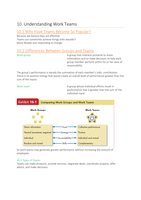
Work group: A group that interacts primarily to share
information and to make decisions to help each
group member perform within his or her area of
responsibility
The group’s performance is merely the summation of each member’s indiv. contribution
There is no positive energy that would create an overall level of performance greater than the
sum of the inputs
Work team: A group whose individual efforts result in
performance that is greater than the sum of the
individual input
So work teams may generate greater performance without increasing the amount of
employees
10.3 Types of Teams
Teams can make products, provide services, negotiate deals, coordinate projects, offer
advice, and make decisions
,10.3.1 Problem-Solving Teams
Problem-solving teams: Groups of 5 to 12 employees from
the same department who meet for a few
hours each week to discuss ways of
improving quality, efficiency, and the work
environment
Only make recommendations
10.3.2 Self-Managed Work Teams
Self-managed work teams: Groups of 10 to 15 people who take on
responsibilities of their former supervisors
Implement solutions and take responsibility for outcomes
Planning and scheduling work, assigning tasks to members, making operating
decisions, taking action on problems, and working with suppliers and customers
Fully self-managed work teams even select their own members and evaluate each other’s
performance
Supervisory positions take on decreased importance and are sometimes even eliminated
Research findings are mixed: more conflict, but if the members feel psychologically safe than
this conflict can boost team performance, higher job satisfaction but sometimes higher rates
of absenteeism and turnover
10.3.3 Cross-Functional Teams
Cross-functional teams: Employees from about the same
hierarchical level, but from different work
areas, who come together to accomplish a
task
Allow people from different areas within an org. to exchange information, develop new ideas,
solve problems and coordinate complex projects
Not simple to manage High need for coordination
Leadership ambiguity because all the members are on the same level
Early stages of development are long, it takes time to build trust and teamwork
Strength: indiv. with diverse skills from a variety of disciplines
,10.3.4 Virtual Teams
Virtual teams: Teams that use computer technology to
tie together physically dispersed members
in order to achieve a common goal
Shared leadership of virtual teams may enhance team performance
For effective virtual teams:
1) Trust among members
2) Progress is monitored closely
3) The efforts and products of the team are publicized throughout the org.
10.3.5 Multiteam Systems
Multiteam system: A collection of two or more
interdependent teams that share a
superordinate goal, a team of teams
Used when ‘normal’ teams becomes to large or with distinct functions need to be highly
coordinated
Think of when a car accidents happens: emergency room then recovery team
The success of a team depends on the success of others
Same goal: safe human life
10.4 Creating Effective Teams
Freelancers: people who are highly specialized in their fields and can provide expertise to org.
on a short-term basis
Freelancers often group together to present a cohesive working unit
The model (next page) attempts to generalize across all varieties of teams, but avoid rigidly
applying its predictions to all teams
Second, the model assumes teamwork is preferable to individual work. Creating “effective”
teams when individuals can do the job better is like perfectly solving the wrong problem
Team effectiveness: objective measures of the team’s productivity managers’ ratings of the
teams’ performance and aggregate measures of member satisfaction
,10.4.1 Team Context: What factors Determine Whether Teams Are
Successful?
1) Adequate Resources
Information, equipment, staffing, encouragement and administrative assistance
2) Leadership and Structure
Especially in multiteams: Leader need to make sure the teams don’t work against each other
but with each other
3) Climate of Trust
Trust is the foundation of leadership
It allows a team to accept and commit to the leader’s goals and decisions
Also interpersonal trust
4) Performance Evaluation and Reward System
Hybrid performance systems
Indiv. and team rewards
10.4.2 Team Composition
The team composition category includes variables that relate to how teams
should be staffed—the ability and personality of team members, allocation of
roles and diversity, size of the team, and members’ preference for teamwork
,1) Abilities of Members
A team’s performance is not merely the summation of its individual members’ abilities
However, these abilities set limits on what members can do and how effectively
they will perform on a team
Solving a complex problem:
high-ability teams—composed of mostly intelligent members—do better than lower-ability
teams
Adapt to changing sit.:
High-ability teams are also more adaptable to changing situations; they can more
effectively apply existing knowledge to new problems
Finally, the ability of the team’s leader also matters. Smart team leaders help
less-intelligent team members when they struggle with a task. But a less intelligent
leader can neutralize the effect of a high-ability team
2) Personality of Members
Conscientiousness is especially important to teams
Good at backing up other members and sense when their support is needed
The more, the better
Openness
Increased performance
Conflict enhances the effect
More ideas, creative and innovative
Agreeableness
Same levels in indiv. is better
One disagreeable member can hurt team performance
3) Allocation of roles
Teams with more experienced and skilled members performed better
This is especially important in the core roles!
, 4) Diversity of Members
Organizational demography: The degree to which members of a work
unit share a common demographic
attribute, such as age, sex, race,
educational level, or length of service
in an organization, and the impact of
this attribute on turnover
Organizational demography suggests that attributes such as age or the date
of joining should help us predict turnover. The logic goes like this: turnover will
be greater among those with dissimilar experiences because communication is
more difficult and conflict is more likely. Increased conflict makes membership
less attractive, so employees are more likely to quit. Similarly, the losers in a
conflict are more apt to leave voluntarily or be forced out
5) Cultural Differences
Cult. dif. Interferes with team processes, at least in short term
Cult. status dif. affect team performance, whereby indiv. in teams with more high cultural-
status members than low cultural-status members realized improved performance for EVERY
member
10.1 Why Have Teams Become So Popular?
Because we believe they are effective
Teams can sometimes achieve things indiv wouldn’t
More flexible and responding to change
10.2 Differences Between Groups and Teams
Work group: A group that interacts primarily to share
information and to make decisions to help each
group member perform within his or her area of
responsibility
The group’s performance is merely the summation of each member’s indiv. contribution
There is no positive energy that would create an overall level of performance greater than the
sum of the inputs
Work team: A group whose individual efforts result in
performance that is greater than the sum of the
individual input
So work teams may generate greater performance without increasing the amount of
employees
10.3 Types of Teams
Teams can make products, provide services, negotiate deals, coordinate projects, offer
advice, and make decisions
,10.3.1 Problem-Solving Teams
Problem-solving teams: Groups of 5 to 12 employees from
the same department who meet for a few
hours each week to discuss ways of
improving quality, efficiency, and the work
environment
Only make recommendations
10.3.2 Self-Managed Work Teams
Self-managed work teams: Groups of 10 to 15 people who take on
responsibilities of their former supervisors
Implement solutions and take responsibility for outcomes
Planning and scheduling work, assigning tasks to members, making operating
decisions, taking action on problems, and working with suppliers and customers
Fully self-managed work teams even select their own members and evaluate each other’s
performance
Supervisory positions take on decreased importance and are sometimes even eliminated
Research findings are mixed: more conflict, but if the members feel psychologically safe than
this conflict can boost team performance, higher job satisfaction but sometimes higher rates
of absenteeism and turnover
10.3.3 Cross-Functional Teams
Cross-functional teams: Employees from about the same
hierarchical level, but from different work
areas, who come together to accomplish a
task
Allow people from different areas within an org. to exchange information, develop new ideas,
solve problems and coordinate complex projects
Not simple to manage High need for coordination
Leadership ambiguity because all the members are on the same level
Early stages of development are long, it takes time to build trust and teamwork
Strength: indiv. with diverse skills from a variety of disciplines
,10.3.4 Virtual Teams
Virtual teams: Teams that use computer technology to
tie together physically dispersed members
in order to achieve a common goal
Shared leadership of virtual teams may enhance team performance
For effective virtual teams:
1) Trust among members
2) Progress is monitored closely
3) The efforts and products of the team are publicized throughout the org.
10.3.5 Multiteam Systems
Multiteam system: A collection of two or more
interdependent teams that share a
superordinate goal, a team of teams
Used when ‘normal’ teams becomes to large or with distinct functions need to be highly
coordinated
Think of when a car accidents happens: emergency room then recovery team
The success of a team depends on the success of others
Same goal: safe human life
10.4 Creating Effective Teams
Freelancers: people who are highly specialized in their fields and can provide expertise to org.
on a short-term basis
Freelancers often group together to present a cohesive working unit
The model (next page) attempts to generalize across all varieties of teams, but avoid rigidly
applying its predictions to all teams
Second, the model assumes teamwork is preferable to individual work. Creating “effective”
teams when individuals can do the job better is like perfectly solving the wrong problem
Team effectiveness: objective measures of the team’s productivity managers’ ratings of the
teams’ performance and aggregate measures of member satisfaction
,10.4.1 Team Context: What factors Determine Whether Teams Are
Successful?
1) Adequate Resources
Information, equipment, staffing, encouragement and administrative assistance
2) Leadership and Structure
Especially in multiteams: Leader need to make sure the teams don’t work against each other
but with each other
3) Climate of Trust
Trust is the foundation of leadership
It allows a team to accept and commit to the leader’s goals and decisions
Also interpersonal trust
4) Performance Evaluation and Reward System
Hybrid performance systems
Indiv. and team rewards
10.4.2 Team Composition
The team composition category includes variables that relate to how teams
should be staffed—the ability and personality of team members, allocation of
roles and diversity, size of the team, and members’ preference for teamwork
,1) Abilities of Members
A team’s performance is not merely the summation of its individual members’ abilities
However, these abilities set limits on what members can do and how effectively
they will perform on a team
Solving a complex problem:
high-ability teams—composed of mostly intelligent members—do better than lower-ability
teams
Adapt to changing sit.:
High-ability teams are also more adaptable to changing situations; they can more
effectively apply existing knowledge to new problems
Finally, the ability of the team’s leader also matters. Smart team leaders help
less-intelligent team members when they struggle with a task. But a less intelligent
leader can neutralize the effect of a high-ability team
2) Personality of Members
Conscientiousness is especially important to teams
Good at backing up other members and sense when their support is needed
The more, the better
Openness
Increased performance
Conflict enhances the effect
More ideas, creative and innovative
Agreeableness
Same levels in indiv. is better
One disagreeable member can hurt team performance
3) Allocation of roles
Teams with more experienced and skilled members performed better
This is especially important in the core roles!
, 4) Diversity of Members
Organizational demography: The degree to which members of a work
unit share a common demographic
attribute, such as age, sex, race,
educational level, or length of service
in an organization, and the impact of
this attribute on turnover
Organizational demography suggests that attributes such as age or the date
of joining should help us predict turnover. The logic goes like this: turnover will
be greater among those with dissimilar experiences because communication is
more difficult and conflict is more likely. Increased conflict makes membership
less attractive, so employees are more likely to quit. Similarly, the losers in a
conflict are more apt to leave voluntarily or be forced out
5) Cultural Differences
Cult. dif. Interferes with team processes, at least in short term
Cult. status dif. affect team performance, whereby indiv. in teams with more high cultural-
status members than low cultural-status members realized improved performance for EVERY
member