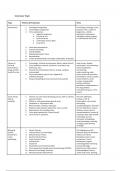
Overview Topic
Topic Theories & Perspectives Terms
Introduction 1. Sociological imagination Criminology, Sociology, crime,
2. Criminological imagination property crime, 3 types of
3. Crime perspectives bulgar (low-, middle-,
a. legalistic/ traditional high-level), victimization,
b. Criminal & civil ontological reality, symbolic
c. Social construct or instrumental role of law,
d. universalist: human rights
e. social harm
4. Social harm perspectives
5. Critical Criminology
6. VIVA & CRAVED
7. Relative Deprivation Thesis
8. Neutralization
9. 3 views problematizing crime (legal, catastrophic, anascopic)
History of 1. Victimology; 3 Strands (conservative, liberal, radical-critical) social crimes, slander,
Crime & 2. Crime definitions (natural, functional, social harm, law, victimization, victim blaming,
Victimization; democracy, etc.) victim precipitation,
Drugs, alcohol, 3. Grounds for criminalization (harms, wrongs, symbolic, over-policing,
health & crime instrumental) under-protecting, ideal
4. Victim participation (pros & cons, legalistic & victim, primary & secondary
individual-focused) victimization, moral crusaders
5. Drug use (Labelling & social constructionist position) & rule enforcers, victim
surveys, missing white
woman syndrome,
prohibition, medicalization of
the drug problem,
recreational drug use, crime
control
Crime trends, 1. Theories on crime trends (Civilizing process, Shift vs. Decline, Terrorism (definition,
Data & post-war trends) motives,), soft- &
methods 2. Official vs. self-reported data (pros & cons) hard-targets, crime trends,
3. Qualitative vs. Quantitative data telescoping,
4. Research types, methods, data types sociodemographics, distortion
5. Response types statistics (awestruck, naive, cynical) of crime data (focus, choices
6. Requirements for recording crime & biases; vicious cycle of
7. Crime drop hypothesis & 5 tests (Farrell) overpresentation), primary &
8. Crime trends in pandemic secondary data, experimental
criminology, surveys,
interviews, ethnography,
social psychology, underdog
sociology, policy-forming
sociology
Biology & 1. Choice Theories The Enlightenment (10
Choice, 2. Classical School of Criminology features), Beccaria, Bentham,
Emotions & 3. Rational Choice Theory Andreas von Hirsch,
social 4. Routine Activity Theory Panopticon prison, homo
psychology 5. Social contract theory economicus, l’uomo
6. Utilitarianism delinquente, eugenic
7. Secularism criminology (Nazi Germany),
8. Situational Crime Prevention (SCP) neurocriminology,
9. Crime prevention through environmental design (CPTED) determinism, Italian school
10. Biosocial Criminology, Positivism (anthropological, telluric,
11. Revised classical model (Hirsch) social), hate crime, lynching,
, 12. Italian School & Lombroso, Ferrie, Garofalo reintegrative shaming,
13. Shame-rage feeling traps biosocial criminology
(Evolutionary, Biological,
Behavior genetics, molecular
genetics, Neurocriminology)
Youth crime, 1. Age-crime curve Life-course persistent,
life course 2. Correlates of youth crime (risk, promotive, protective; distal, adolescent-limited, onset &
perspective proximal) desistence & persistence,
3. Learned delinquency theories juvenile frequent offenders,
a. Differential association dark figure (official vs.
b. Social learning self-report data), risk
4. Control theories assessment, life chances,
a. social bonding theory Intervention approaches
b. self-control theory (Deterrence program,
5. General Theory of Crime restorative justice approach,
6. Age-graded theory of informal social control general deterrence),
7. Life-course theory of cumulative disadvantages Prevention approaches
8. Intervention approaches (Deterrence program, restorative (developmental, situational,
justice approach, general deterrence) community-based, CJ), social
9. Strain theory reformers,
10. Labeling theory
11. 3 views (positivist, labeling, rational actor) (article)
12. Self-control theory & Desistance theory (article)
Strain, 1. Strain theories organic solidarity, modernity
(Sub)culture, a. Anomie, Durkheim & its problems, relative
Control & the b. Classical Strain, Merton (imbalance goals & means, deprivation (Merton),
City 5 types) ecological fallacy,
c. General Strain, Agnew (more strain sources, 3 composition effect,
coping) gentrification
2. Social learning & subculture
a. Differential Association, Sutherland
b. Subcultural theories
i. delinquency & opportunity, Ohlin &
Cloward (goals & means)
ii. delinquent boys (cohen); status
frustration
3. Control theories
a. social control, Hirschi (attachment, commitment,
involvement, belief)
b. Neutralization techniques, Matza
4. The City
a. Chicago school
b. Zonal hypothesis, Burgess
c. Social disorganization, Shaw & McKay (crime
through SD, 4 factors)
d. Collective efficacy, Sampson (cohesion &
willingness to intervene)
5. Broken Window theory
6. The Ghetto - discourse term
Labelling, 1. Original sociological vs. radicalizing theories vs. critical Symbolic interactionism
Conflict & criminology (deviance not act, but
Social Change 2. Labelling theory consequence of label &
3. Primary deviance (committing), Secondary deviance sanctions), risk society
(labelled), deviant identity (self-fulfilling prophecy)
4. Symbolic interactionism (deviance resides within reaction,
not act)
5. Moral entrepreneurs (rule creators & rule enforcers)
6. Moral panics, Cohen
Topic Theories & Perspectives Terms
Introduction 1. Sociological imagination Criminology, Sociology, crime,
2. Criminological imagination property crime, 3 types of
3. Crime perspectives bulgar (low-, middle-,
a. legalistic/ traditional high-level), victimization,
b. Criminal & civil ontological reality, symbolic
c. Social construct or instrumental role of law,
d. universalist: human rights
e. social harm
4. Social harm perspectives
5. Critical Criminology
6. VIVA & CRAVED
7. Relative Deprivation Thesis
8. Neutralization
9. 3 views problematizing crime (legal, catastrophic, anascopic)
History of 1. Victimology; 3 Strands (conservative, liberal, radical-critical) social crimes, slander,
Crime & 2. Crime definitions (natural, functional, social harm, law, victimization, victim blaming,
Victimization; democracy, etc.) victim precipitation,
Drugs, alcohol, 3. Grounds for criminalization (harms, wrongs, symbolic, over-policing,
health & crime instrumental) under-protecting, ideal
4. Victim participation (pros & cons, legalistic & victim, primary & secondary
individual-focused) victimization, moral crusaders
5. Drug use (Labelling & social constructionist position) & rule enforcers, victim
surveys, missing white
woman syndrome,
prohibition, medicalization of
the drug problem,
recreational drug use, crime
control
Crime trends, 1. Theories on crime trends (Civilizing process, Shift vs. Decline, Terrorism (definition,
Data & post-war trends) motives,), soft- &
methods 2. Official vs. self-reported data (pros & cons) hard-targets, crime trends,
3. Qualitative vs. Quantitative data telescoping,
4. Research types, methods, data types sociodemographics, distortion
5. Response types statistics (awestruck, naive, cynical) of crime data (focus, choices
6. Requirements for recording crime & biases; vicious cycle of
7. Crime drop hypothesis & 5 tests (Farrell) overpresentation), primary &
8. Crime trends in pandemic secondary data, experimental
criminology, surveys,
interviews, ethnography,
social psychology, underdog
sociology, policy-forming
sociology
Biology & 1. Choice Theories The Enlightenment (10
Choice, 2. Classical School of Criminology features), Beccaria, Bentham,
Emotions & 3. Rational Choice Theory Andreas von Hirsch,
social 4. Routine Activity Theory Panopticon prison, homo
psychology 5. Social contract theory economicus, l’uomo
6. Utilitarianism delinquente, eugenic
7. Secularism criminology (Nazi Germany),
8. Situational Crime Prevention (SCP) neurocriminology,
9. Crime prevention through environmental design (CPTED) determinism, Italian school
10. Biosocial Criminology, Positivism (anthropological, telluric,
11. Revised classical model (Hirsch) social), hate crime, lynching,
, 12. Italian School & Lombroso, Ferrie, Garofalo reintegrative shaming,
13. Shame-rage feeling traps biosocial criminology
(Evolutionary, Biological,
Behavior genetics, molecular
genetics, Neurocriminology)
Youth crime, 1. Age-crime curve Life-course persistent,
life course 2. Correlates of youth crime (risk, promotive, protective; distal, adolescent-limited, onset &
perspective proximal) desistence & persistence,
3. Learned delinquency theories juvenile frequent offenders,
a. Differential association dark figure (official vs.
b. Social learning self-report data), risk
4. Control theories assessment, life chances,
a. social bonding theory Intervention approaches
b. self-control theory (Deterrence program,
5. General Theory of Crime restorative justice approach,
6. Age-graded theory of informal social control general deterrence),
7. Life-course theory of cumulative disadvantages Prevention approaches
8. Intervention approaches (Deterrence program, restorative (developmental, situational,
justice approach, general deterrence) community-based, CJ), social
9. Strain theory reformers,
10. Labeling theory
11. 3 views (positivist, labeling, rational actor) (article)
12. Self-control theory & Desistance theory (article)
Strain, 1. Strain theories organic solidarity, modernity
(Sub)culture, a. Anomie, Durkheim & its problems, relative
Control & the b. Classical Strain, Merton (imbalance goals & means, deprivation (Merton),
City 5 types) ecological fallacy,
c. General Strain, Agnew (more strain sources, 3 composition effect,
coping) gentrification
2. Social learning & subculture
a. Differential Association, Sutherland
b. Subcultural theories
i. delinquency & opportunity, Ohlin &
Cloward (goals & means)
ii. delinquent boys (cohen); status
frustration
3. Control theories
a. social control, Hirschi (attachment, commitment,
involvement, belief)
b. Neutralization techniques, Matza
4. The City
a. Chicago school
b. Zonal hypothesis, Burgess
c. Social disorganization, Shaw & McKay (crime
through SD, 4 factors)
d. Collective efficacy, Sampson (cohesion &
willingness to intervene)
5. Broken Window theory
6. The Ghetto - discourse term
Labelling, 1. Original sociological vs. radicalizing theories vs. critical Symbolic interactionism
Conflict & criminology (deviance not act, but
Social Change 2. Labelling theory consequence of label &
3. Primary deviance (committing), Secondary deviance sanctions), risk society
(labelled), deviant identity (self-fulfilling prophecy)
4. Symbolic interactionism (deviance resides within reaction,
not act)
5. Moral entrepreneurs (rule creators & rule enforcers)
6. Moral panics, Cohen