CPSI Exam with complete solutions
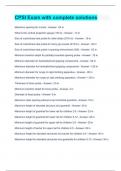
Maximum opening for s-hook - Answer- .04 in What is the vertical projection gauge (1/8 in) - Answer- .12 in Size of crush/shear test probe for roller slides (3/16 in) - Answer- .19 in Size of crush/shear test probe for merry-go-rounds (5/16 in) - Answer- .30 in Size of crush/shear test probe in opening w/movement (5/8) - Answer- .62 in Minimum insertion depth for partially bounded opening probe - Answer- .75 in Minimum diameter for handrails/hand gripping components - Answer- .95 in Maximum diameter for handrails/hand gripping components - Answer- 1.55 in Minimum diameter for rungs on rigid climbing apparatus - Answer- .95 in Maximum diameter for rungs on rigid climbing apparatus - Answer- 1.55 in Thickness of torso probe - Answer- 3.5 in Minimum insertion depth for torso probe - Answer- 4 in Diameter of head probe - Answer- 9 in Maximum clear opening without a top horizontal guardrail - Answer- 15 in Maximum height of elevated structure w/o guardrail - Answer- 20 in Maximum height of guardrail for lower rail for children 2-5 - Answer- 23 in Maximum height of guardrail for lower rail for children 5-12 - Answer- 28 in Minimum height of guardrail for upper rail for children 2-5 - Answer- 29 in Minimum height of barrier for upper rail for children 2-5 - Answer- 29 in Maximum height for elevated structures w/o barrier for children 2-5 - Answer- 30 in Maximum height for elevated structures w/o guardrails for children 5-12 - Answer- 30 in Minimum height of upper rail for guardrails for children 5-12 - Answer- 38 in Minimum height of upper rail for barriers for children 5-12 - Answer- 38 in Maximum height for elevated structures w/o barriers for children 5-12 - Answer- 48 in Minimum use zone for sitting/rocking/springing equip - Answer- 72 in Minimum diameter for non overlapping use zone w/rotating equipment >20 in diameter - Answer- 72 in Minimum side use zone for rotating swing support structure - Answer- 72 in Minimum use zone for slide exit region use zone - Answer- 72 in Minimum use zone for stationary equipment - Answer- 72 in Minimum use zone for to-fro swing support structure - Answer- 72 in Minimum non-overlapping use zone for rotating swing - Answer- Y+72 in Minimum use zone front and back between support structures for to-fro swing - Answer- 2 x X Minimum use zone for track ride - Answer- 72 in Maximum use zone overlap for adjacent play structures <30 in high - Answer- 72 in Minimum non-overlapping use zone for standing rocking equipment - Answer- 84 in Maximum use zone for slide exit region - Answer- 96 in Maximum use zone overlap for adjacent play structures >30 in high - Answer- 108 in First piece of equipment to be removed for safety reasons - Answer- Giant stride CPSC was first published in - Answer- 1981 ASTM was first published in - Answer- 1993 Who can certify playground equipment - Answer- IPEMA F1292 - Answer- Method to test impact attenuation of safety surfacing F1951 - Answer- Method to test wheelchair accessibility on safety surfacing F2075 - Answer- Engineered wood fiber safety F2223 - Answer- Guide for ASTM Standards on playground surfacing F2049 - Answer- Standards for barriers and fencing F1918 - Answer- Contained play systems F1148 - Answer- Residential play equipment Rank the hazard according to - Answer- injury potential A comprehensive program of playground safety includes - Answer- audits, inspections, maintenance ASTM - Answer- reduce life threatening and debilitating injuries (equipment based) CPSC - Answer- create a safer playground environment for all children and contribute to the reduction of playground related deaths The most common cause of injury on public playgrounds - Answer- falls (79%) #1 cause of death and seriously debilitating injury - Answer- entanglement #2 cause of death and seriously debilitating injury - Answer- falls #3 cause of death and seriously debilitating injury - Answer- entrapment Factors that contribute to public playground injuries - Answer- improper use poor maintenance inappropriate design installation errors site planning issues Priority 1 hazards - Answer- a readily accessible hazard that would cause an accident which would result in death/loss of limb Hazard priority level is not based on - Answer- cause of injury assigning priority levels must consider - Answer- possibility probability consequence Range of users for ASTM F1487 - Answer- 5th% tile of 2 yro to 95th% tile of 12 yro compliance with this std does not eliminate the need for playground supervision - Answer- ATSM F1487 Was ordered to be removed from public playgrounds in 1995 by CPSC - Answer- animal swings For overhead swinging rings the length of the chain must not exceed... - Answer- 7 in The overall length of an overhead ring must not exceed - Answer- 15 in CPSC play equipment not recommended for preschool users - Answer- Free standing arch climbers and flexible climber log rolls track rides vertical slide poles

Geschreven voor
- Instelling
- CPSI
- Vak
- CPSI
Documentinformatie
- Geüpload op
- 18 mei 2023
- Aantal pagina's
- 8
- Geschreven in
- 2022/2023
- Type
- Tentamen (uitwerkingen)
- Bevat
- Vragen en antwoorden
Onderwerpen
-
cpsi
-
cpsi exam with complete solutions
-
maximum opening for s hook
-
what is the vertical projection gauge 18 in
-
size of crushshear test probe for roller slides 316 in
-
size of crushshear test pro

Ook beschikbaar in voordeelbundel