Migration & Culture in Educational Relationships
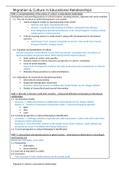
PART 1: conceptualization of the notion of ‘culture’ in educational relationships
Development and parenting practices in cultural context: meaning systems, migration and social condition
1.1. The role of culture in (child) development: core models
‘Social-ecological models’ & ‘developmental niche model’
o Harkness and Super: developmental niche
o Weisner: ecocultural understanding of children’s developmental pathways
o Bose: Bangladeshi parental ethnotheories in the United Kingdom: Towards cultural
collaborations in clinical practice
Cultural meaning systems in understand & coping with developmental & educational
concerns
o Jegathesaan: From symptom recognition to services: How South Asion Muslim
immigrant families navigate autism
1.2. A gradual conceptualisation of culture
Hassan & Rousseau: North African & Latin American parents’ and adolescents’ perceptions of
physical discipline and physical abuse: When dysnormativity begets exclusion.
Static notion of culture: etno-specificy
Dynamic notion of culture: discursive perspective on culture/ creolization
Locus of social inequality
Garcia Coll: An integrative model for the study of developmental competencies in minority
children.
Discipline (theory/practice) as cultural institutions
1.3. Implications for transcultural educational practice
Intercultural communication
Diagnostic/ethnographic assessment
Rousseau: Adressing Trauma in colalborative mental health care for refugee children
Models of transcultural psychosocial intervention
PART 2: Diversity in Western multi-ethic societies – Cultural identification & belonging in educational
relationships
2.1. Acculturation models
Rousseau, C. Addressing trauma in collaborative mental health care for refugee children
Bourhis, R., Towards an interactive acculturation model : A social-psychological approach
BAM
IAM
CAM
2.2. A Family perspective on cultural belonging & identification
Lecompte, V. Challenges related to migration and child attachement: A pilot study with South Asian
immigrant mother-child dyads
Rousseau, C. From the family universe to the outside world: Family relations, school attitude and
perception of racism in Caribbean and Filipino adolescents
2.3. A social perspective on cultural belonging & identification
PART 3: transcultural educational practice in global context – international collaboration in schooling &
psychosocial care
Betancourt: high hopes, grim reality
3.1. Perspectives
Child rights
Social cohesion
3.2. Dual role of education in conflict
3.3. Conclusion
Tekst lecompte & Tekst: family universe tot the outside world
Migration & culture in educational relationships
, - Role of ‘culture’ in educational environments (with parents, at school,…)
- How different ‘cultures’ have an effect on education environments
Open book examination: printouts – readings - notes
PART 1: conceptualization of the notion of ‘culture’ in educational relationships
1.1.The role of culture in (child) development: core models
= De rol van cultuur in ontwikkeling: centrale modellen: hoe zijn kind ontwikkeling en opvoeding
gesitueerd in cultuur
Ecocultural understanding of children’s developmental pathways (Weisner, 2002)
The developmental niche: A conceptualization at the interface of child and culture. International
Journal of Behavioral Development (Harkness, & Super, 1986).
Bangladeshi parental ethnotheories in the United Kingdom: Towards cultural collaborations in
clinical practice. (Bose, 2014)
‘Social-ecological models’ & ‘developmental niche model’
- Analytic focus: the role of culture in de development & parenting
Socialisation means introducing a specific cultural world/context
Every process of socialisation is including culture
Development is defined by a particular, cultural world
- Central interest: an ecological perspective on development:
Cultural & social context as central determinant of individual development/behaviour
Includes always particular, cultural context
Developmental trajectories in children belonging to ethnic minority groups (niet in tekst)
→ (How to look at children’s belonging to an ethnic group)
Comparative paradigm (theoretical left behind)
- Comparing child development in minority vs. majority groups
- ‘Etic’ perspective (= look at developmental trajectories as universality)
- Cultural characteristics as explanation for differential developmental patterns
Ex. lower school results
- Conversion to ‘Deficit perspective’: look at different developmental outcomes and parenting in
minority groups as pathological, those cultural values and behaviours are not the norm
expectation
Criticized because of genetic predisposition (genetische aanleg)
You use the culture of these parents as something negative (= unequal comparism)
Cultural difference paradigm (is used nowadays, more realistic view)
- Problematisation of universal use of Western concepts of development
- Cultural specificity of notions of child development & parenting
Questioning universal patterns of development and parenting
- Measurement of development on the criteria used in those culture’s
Understanding that the care givers-child relationship are shaped by different culture
- ‘emic’ perspective (= meaning & parameters within cultural community)
- Understanding that the care givers-child relationship are shaped by different culture
- Look at what is considered “normal” development within that community
Example: no eye contact vs. eye contact
- Variation in developmental paths & parenting practices
- Analysis of development & parenting from within an understanding of cultural meaning systems
In this course: cultural difference paradigm, but comparative paradigm is still not gone
- Comparative: generalize “that culture is like that”
, - Difference: Looking at how the community looks at a specific phenomenon
Social-economic model (cf. Bronfenbrenner)
- Development in different contexts and on different levels
- 3 different levels, children are in interaction with those levels
- Culture as something exogenous, culture does not play a part in this model
Developmental niche model: eco-cultural perspective on parenting and development (Weisner, 2002)
- In understanding parent-child interaction, look at culture aspect of the community
- Cultural ecology (p. 277, weisner)
Safety of physical context, nutrition, attachment & basic trust, developmental stimulation,
developmental goals
o How do they occur in different cultural ecologies?
A set of cultural patterns in which parent-child interaction is inscribed
Importance of understanding how a community is set with a specific ecology
- Culture pathways in development are the most important ones
- Micro-context is cultural related
- Example: Western countries: protect children from labor, other country’s stimulate development
in participation in daily activities
- Eco-cultural perspective
Takes into account that ecological and institutional factors have an impact on daily
activities from families, focus on the impact of the developmental niche
- How can you enter cultural pathways from parents and children?
EFI = Ecocultural Family Interview (p. 277, Weisner)
Asking parents and children directly about their daily activities/routines
Includes also an observation
Harkness & Super (1986), ‘Developmental niche’-model
→ more a static lens on culture
3 subsystems who provide the cultural regulation of the development
(1) Physical & social setting
(2) Cultural parenting & care practices
(3) Psychology of caretakers: ‘parental ethnotheories/ ‘parental belief systems’
Cultural notions of child development & behaviour
Developmental goals/ parenting strategies/developmental needs
Meaning-systems in understanding behaviour & interactions
→ Those are 1 big system and are continuous in interaction
→ are a homeostatic interaction that forms stabilisation (p. 599, Super & Harkness)
→ In direct interaction with development (>< Bronfenbrenner), micro level
→ Is a conceptualization of the shift from the paradigms
- Conceptualisation of the cultural regulation of the micro-context of child development
- Integration of 2 perspectives: developmental psychology & anthropology (p. 547, Super & Harkness)
Developmental psychology (p. 549 Super & Harkness): limited focus on cultural structuring of
developmental context
Cultural antropology: focus on culture in community, limited focus on children & parenting
(only adults)
→ integrate both of them in the developmental niche model
- Focus on the role of ‘culture’ in the micro-level of child developmental contexts: ‘ecocultural
perspective on development & parenting (Weisner)
Developmental ‘niche-model’ (Harkness & Super, 1986)
- 3 subsystems: (interacting, shaping each other’s)
remains relatively stable: homeostatic model (if 1 subsystems change, the others too)
PART 1: conceptualization of the notion of ‘culture’ in educational relationships
Development and parenting practices in cultural context: meaning systems, migration and social condition
1.1. The role of culture in (child) development: core models
‘Social-ecological models’ & ‘developmental niche model’
o Harkness and Super: developmental niche
o Weisner: ecocultural understanding of children’s developmental pathways
o Bose: Bangladeshi parental ethnotheories in the United Kingdom: Towards cultural
collaborations in clinical practice
Cultural meaning systems in understand & coping with developmental & educational
concerns
o Jegathesaan: From symptom recognition to services: How South Asion Muslim
immigrant families navigate autism
1.2. A gradual conceptualisation of culture
Hassan & Rousseau: North African & Latin American parents’ and adolescents’ perceptions of
physical discipline and physical abuse: When dysnormativity begets exclusion.
Static notion of culture: etno-specificy
Dynamic notion of culture: discursive perspective on culture/ creolization
Locus of social inequality
Garcia Coll: An integrative model for the study of developmental competencies in minority
children.
Discipline (theory/practice) as cultural institutions
1.3. Implications for transcultural educational practice
Intercultural communication
Diagnostic/ethnographic assessment
Rousseau: Adressing Trauma in colalborative mental health care for refugee children
Models of transcultural psychosocial intervention
PART 2: Diversity in Western multi-ethic societies – Cultural identification & belonging in educational
relationships
2.1. Acculturation models
Rousseau, C. Addressing trauma in collaborative mental health care for refugee children
Bourhis, R., Towards an interactive acculturation model : A social-psychological approach
BAM
IAM
CAM
2.2. A Family perspective on cultural belonging & identification
Lecompte, V. Challenges related to migration and child attachement: A pilot study with South Asian
immigrant mother-child dyads
Rousseau, C. From the family universe to the outside world: Family relations, school attitude and
perception of racism in Caribbean and Filipino adolescents
2.3. A social perspective on cultural belonging & identification
PART 3: transcultural educational practice in global context – international collaboration in schooling &
psychosocial care
Betancourt: high hopes, grim reality
3.1. Perspectives
Child rights
Social cohesion
3.2. Dual role of education in conflict
3.3. Conclusion
Tekst lecompte & Tekst: family universe tot the outside world
Migration & culture in educational relationships
, - Role of ‘culture’ in educational environments (with parents, at school,…)
- How different ‘cultures’ have an effect on education environments
Open book examination: printouts – readings - notes
PART 1: conceptualization of the notion of ‘culture’ in educational relationships
1.1.The role of culture in (child) development: core models
= De rol van cultuur in ontwikkeling: centrale modellen: hoe zijn kind ontwikkeling en opvoeding
gesitueerd in cultuur
Ecocultural understanding of children’s developmental pathways (Weisner, 2002)
The developmental niche: A conceptualization at the interface of child and culture. International
Journal of Behavioral Development (Harkness, & Super, 1986).
Bangladeshi parental ethnotheories in the United Kingdom: Towards cultural collaborations in
clinical practice. (Bose, 2014)
‘Social-ecological models’ & ‘developmental niche model’
- Analytic focus: the role of culture in de development & parenting
Socialisation means introducing a specific cultural world/context
Every process of socialisation is including culture
Development is defined by a particular, cultural world
- Central interest: an ecological perspective on development:
Cultural & social context as central determinant of individual development/behaviour
Includes always particular, cultural context
Developmental trajectories in children belonging to ethnic minority groups (niet in tekst)
→ (How to look at children’s belonging to an ethnic group)
Comparative paradigm (theoretical left behind)
- Comparing child development in minority vs. majority groups
- ‘Etic’ perspective (= look at developmental trajectories as universality)
- Cultural characteristics as explanation for differential developmental patterns
Ex. lower school results
- Conversion to ‘Deficit perspective’: look at different developmental outcomes and parenting in
minority groups as pathological, those cultural values and behaviours are not the norm
expectation
Criticized because of genetic predisposition (genetische aanleg)
You use the culture of these parents as something negative (= unequal comparism)
Cultural difference paradigm (is used nowadays, more realistic view)
- Problematisation of universal use of Western concepts of development
- Cultural specificity of notions of child development & parenting
Questioning universal patterns of development and parenting
- Measurement of development on the criteria used in those culture’s
Understanding that the care givers-child relationship are shaped by different culture
- ‘emic’ perspective (= meaning & parameters within cultural community)
- Understanding that the care givers-child relationship are shaped by different culture
- Look at what is considered “normal” development within that community
Example: no eye contact vs. eye contact
- Variation in developmental paths & parenting practices
- Analysis of development & parenting from within an understanding of cultural meaning systems
In this course: cultural difference paradigm, but comparative paradigm is still not gone
- Comparative: generalize “that culture is like that”
, - Difference: Looking at how the community looks at a specific phenomenon
Social-economic model (cf. Bronfenbrenner)
- Development in different contexts and on different levels
- 3 different levels, children are in interaction with those levels
- Culture as something exogenous, culture does not play a part in this model
Developmental niche model: eco-cultural perspective on parenting and development (Weisner, 2002)
- In understanding parent-child interaction, look at culture aspect of the community
- Cultural ecology (p. 277, weisner)
Safety of physical context, nutrition, attachment & basic trust, developmental stimulation,
developmental goals
o How do they occur in different cultural ecologies?
A set of cultural patterns in which parent-child interaction is inscribed
Importance of understanding how a community is set with a specific ecology
- Culture pathways in development are the most important ones
- Micro-context is cultural related
- Example: Western countries: protect children from labor, other country’s stimulate development
in participation in daily activities
- Eco-cultural perspective
Takes into account that ecological and institutional factors have an impact on daily
activities from families, focus on the impact of the developmental niche
- How can you enter cultural pathways from parents and children?
EFI = Ecocultural Family Interview (p. 277, Weisner)
Asking parents and children directly about their daily activities/routines
Includes also an observation
Harkness & Super (1986), ‘Developmental niche’-model
→ more a static lens on culture
3 subsystems who provide the cultural regulation of the development
(1) Physical & social setting
(2) Cultural parenting & care practices
(3) Psychology of caretakers: ‘parental ethnotheories/ ‘parental belief systems’
Cultural notions of child development & behaviour
Developmental goals/ parenting strategies/developmental needs
Meaning-systems in understanding behaviour & interactions
→ Those are 1 big system and are continuous in interaction
→ are a homeostatic interaction that forms stabilisation (p. 599, Super & Harkness)
→ In direct interaction with development (>< Bronfenbrenner), micro level
→ Is a conceptualization of the shift from the paradigms
- Conceptualisation of the cultural regulation of the micro-context of child development
- Integration of 2 perspectives: developmental psychology & anthropology (p. 547, Super & Harkness)
Developmental psychology (p. 549 Super & Harkness): limited focus on cultural structuring of
developmental context
Cultural antropology: focus on culture in community, limited focus on children & parenting
(only adults)
→ integrate both of them in the developmental niche model
- Focus on the role of ‘culture’ in the micro-level of child developmental contexts: ‘ecocultural
perspective on development & parenting (Weisner)
Developmental ‘niche-model’ (Harkness & Super, 1986)
- 3 subsystems: (interacting, shaping each other’s)
remains relatively stable: homeostatic model (if 1 subsystems change, the others too)