theonlinephysicstutor.com
Mark schemes
A
1 [1]
D
2 1
D
3 [1]
B
4 [1]
B
5 [1]
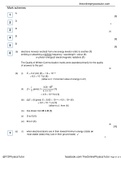
(a) electrons move(or excited) from one energy level(or orbit) to another (1)
6 emitting or absorbing a definite frequency / wavelength / colour (1)
or photon energy(of electromagnetic radiation) (1)
The Quality of Written Communication marks were awarded primarily for the quality
of answers to this part
(2)
(b) (i) Ei = 5.2 (eV) (1) × 1.6 × 10–19
= 8.3 × 10⁻¹⁹(J) (1)
(allow e.c.f. if incorrect value of energy in eV)
(ii) (f = gives) f = (1)
= 4.9 × 10¹⁴ Hz (1)
(iii) (ΔE = hf gives) E = 6.63 × 10–34 × 4.9 × 1014 (1)
= 3.2 × 10⁻¹⁹ (J) (1)
(allow e.c.f. from (ii))
(iv) line drawn from B to D (1)
(v) D to E (1)
(vi) B to C (1)
(9)
[11]
(a) (i) when electrons/atoms are in their lowest/minimum energy (state) or
7 most stable (state) they (are in their ground state)
1
@TOPhysicsTutor facebook.com/TheOnlinePhysicsTutor Page 27 of 44
, theonlinephysicstutor.com
(ii) in either case an electron receives (exactly the right amount of) energy
excitation promotes an (orbital) electron to a higher energy/up a level
ionisation occurs (when an electron receives enough energy) to leave
the atom
3
(b) electrons occupy discrete energy levels
and need to absorb an exact amount of/enough energy to move to a higher level
photons need to have certain frequency to provide this energy or e = hf
energy required is the same for a particular atom or have different energy levels
all energy of photon absorbed
in 1 to 1 interaction or clear a/the photon and an/the electrons
4
(c) energy = 13.6 × 1.60 × 10−19 = 2.176 × 10⁻¹⁸ (J)
hf = 2.176 × 10⁻¹⁸
f = 2.176 × 10⁻¹⁸ ÷ 6.63 × 10−34 = 3.28 × 10¹⁵ Hz 3 sfs
4
[12]
8
(a) (i) k.e. = (1)
= 26 (eV) (1) (25.6 eV)
(ii) (use of λdB = gives) λdB = (1)
= 2.4 × 10⁻¹⁰ m (1) (2.42 × 10⁻¹⁰ m)
4
@TOPhysicsTutor facebook.com/TheOnlinePhysicsTutor Page 28 of 44
, theonlinephysicstutor.com
(b) (use of hf = E1 – E2 gives) f = (1)
(= 1.05 × 10¹⁵ (Hz))
(use of λ = gives) λ = (1)
= 2.9 × 10⁻⁷ m (1) (2.86 × 10⁻⁷ m)
3
[7]
(a) (i) (use of d sin θ = nλ gives) 2λ = d sin 35.8° (1)
9
(= 1.67 × 10⁻⁶)
= 4.9 × 10⁻⁷m (1) (4.87 × 10⁻⁷m)
(ii)
E (= hf = 6.63 × 10–34 × 6.16 × 1014) = 4.1 × 10⁻¹⁹(J) (1) (4.0(8) × 10–19(J))
= 2.6 (eV) (1) (2.55 (eV)
(for E = 4.1 × 10⁻¹⁹(J) = 2.56 (eV)
5
@TOPhysicsTutor facebook.com/TheOnlinePhysicsTutor Page 29 of 44
Mark schemes
A
1 [1]
D
2 1
D
3 [1]
B
4 [1]
B
5 [1]
(a) electrons move(or excited) from one energy level(or orbit) to another (1)
6 emitting or absorbing a definite frequency / wavelength / colour (1)
or photon energy(of electromagnetic radiation) (1)
The Quality of Written Communication marks were awarded primarily for the quality
of answers to this part
(2)
(b) (i) Ei = 5.2 (eV) (1) × 1.6 × 10–19
= 8.3 × 10⁻¹⁹(J) (1)
(allow e.c.f. if incorrect value of energy in eV)
(ii) (f = gives) f = (1)
= 4.9 × 10¹⁴ Hz (1)
(iii) (ΔE = hf gives) E = 6.63 × 10–34 × 4.9 × 1014 (1)
= 3.2 × 10⁻¹⁹ (J) (1)
(allow e.c.f. from (ii))
(iv) line drawn from B to D (1)
(v) D to E (1)
(vi) B to C (1)
(9)
[11]
(a) (i) when electrons/atoms are in their lowest/minimum energy (state) or
7 most stable (state) they (are in their ground state)
1
@TOPhysicsTutor facebook.com/TheOnlinePhysicsTutor Page 27 of 44
, theonlinephysicstutor.com
(ii) in either case an electron receives (exactly the right amount of) energy
excitation promotes an (orbital) electron to a higher energy/up a level
ionisation occurs (when an electron receives enough energy) to leave
the atom
3
(b) electrons occupy discrete energy levels
and need to absorb an exact amount of/enough energy to move to a higher level
photons need to have certain frequency to provide this energy or e = hf
energy required is the same for a particular atom or have different energy levels
all energy of photon absorbed
in 1 to 1 interaction or clear a/the photon and an/the electrons
4
(c) energy = 13.6 × 1.60 × 10−19 = 2.176 × 10⁻¹⁸ (J)
hf = 2.176 × 10⁻¹⁸
f = 2.176 × 10⁻¹⁸ ÷ 6.63 × 10−34 = 3.28 × 10¹⁵ Hz 3 sfs
4
[12]
8
(a) (i) k.e. = (1)
= 26 (eV) (1) (25.6 eV)
(ii) (use of λdB = gives) λdB = (1)
= 2.4 × 10⁻¹⁰ m (1) (2.42 × 10⁻¹⁰ m)
4
@TOPhysicsTutor facebook.com/TheOnlinePhysicsTutor Page 28 of 44
, theonlinephysicstutor.com
(b) (use of hf = E1 – E2 gives) f = (1)
(= 1.05 × 10¹⁵ (Hz))
(use of λ = gives) λ = (1)
= 2.9 × 10⁻⁷ m (1) (2.86 × 10⁻⁷ m)
3
[7]
(a) (i) (use of d sin θ = nλ gives) 2λ = d sin 35.8° (1)
9
(= 1.67 × 10⁻⁶)
= 4.9 × 10⁻⁷m (1) (4.87 × 10⁻⁷m)
(ii)
E (= hf = 6.63 × 10–34 × 6.16 × 1014) = 4.1 × 10⁻¹⁹(J) (1) (4.0(8) × 10–19(J))
= 2.6 (eV) (1) (2.55 (eV)
(for E = 4.1 × 10⁻¹⁹(J) = 2.56 (eV)
5
@TOPhysicsTutor facebook.com/TheOnlinePhysicsTutor Page 29 of 44