1 / Official PTCB Practice Exam - Answers - Solutions
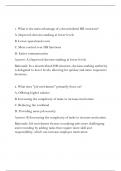
1.A major role of the Pharmacy and Therapeutics (P&T) Committee is devel- oping:
A.the formulary status of drugs. A.
the formulary status of drugs.
B.operational budgets. B.
operational budgets.
C.dispensing policies and procedures. C.
dispensing policies and procedures.
D.pharmacy technician training. D.
pharmacy technician training: The key (A) is correct because a Pharmacy and Therapeutics (P&T) Committee is a multidisciplinary committee required to meet on a routine basis to make decisions about the care of patients with a focus on the safe and effective use of
medications; overseeing and making decisions for an institution's formulary is an example of the P&T Committee's responsibilities. .Which patient monitoring function identifies drugs to avoid using togeth- er?
A.Drug-drug interaction 3 / A.
Drug-drug interaction
B.Drug-laboratory test interaction
B.
Drug-laboratory test interaction
C.Therapeutic intervention
C.
Therapeutic intervention
D.Intravenous compatibility D.
Intravenous compatibility: The key (A) is correct because drug-drug interaction data provides information on whether drugs may be safely taken together; if not, the data may advise to monitor therapy, consider therapy modification, or avoid the combination altogether.
3.A pharmacy technician receives the following prescription:
Hydrocortisone 2.5% cream and Aquaphor in 1:1
Quantity: 4 oz total
What quantity of hydrocortisone 2.5% cream, in g, should be entered on the
compounding record? Official PTCB Practice Exam - Answers - Solutions
Study online at https://quizlet.com/_52c6pi
A.30
A.
30
B.60
B.
60
C.90
C.
90
D.120
D.
120: The key (B) is correct because a 1:1 compound contains an equal
amount of both ingredients. First convert 4 oz to g and then divide the
total in half. 1 oz = 30 g, so 4 oz = 120 g. 120 g divided by 2 = 60 g.
4.According to USP Chapter 797, how should a pharmacy technician recap a needle to prevent a needle stick?
A.A needle should never be recapped A.
A needle should never be recapped
1.A major role of the Pharmacy and Therapeutics (P&T) Committee is devel- oping:
A.the formulary status of drugs. A.
the formulary status of drugs.
B.operational budgets. B.
operational budgets.
C.dispensing policies and procedures. C.
dispensing policies and procedures.
D.pharmacy technician training. D.
pharmacy technician training: The key (A) is correct because a Pharmacy and Therapeutics (P&T) Committee is a multidisciplinary committee required to meet on a routine basis to make decisions about the care of patients with a focus on the safe and effective use of
medications; overseeing and making decisions for an institution's formulary is an example of the P&T Committee's responsibilities. .Which patient monitoring function identifies drugs to avoid using togeth- er?
A.Drug-drug interaction 3 / A.
Drug-drug interaction
B.Drug-laboratory test interaction
B.
Drug-laboratory test interaction
C.Therapeutic intervention
C.
Therapeutic intervention
D.Intravenous compatibility D.
Intravenous compatibility: The key (A) is correct because drug-drug interaction data provides information on whether drugs may be safely taken together; if not, the data may advise to monitor therapy, consider therapy modification, or avoid the combination altogether.
3.A pharmacy technician receives the following prescription:
Hydrocortisone 2.5% cream and Aquaphor in 1:1
Quantity: 4 oz total
What quantity of hydrocortisone 2.5% cream, in g, should be entered on the
compounding record? Official PTCB Practice Exam - Answers - Solutions
Study online at https://quizlet.com/_52c6pi
A.30
A.
30
B.60
B.
60
C.90
C.
90
D.120
D.
120: The key (B) is correct because a 1:1 compound contains an equal
amount of both ingredients. First convert 4 oz to g and then divide the
total in half. 1 oz = 30 g, so 4 oz = 120 g. 120 g divided by 2 = 60 g.
4.According to USP Chapter 797, how should a pharmacy technician recap a needle to prevent a needle stick?
A.A needle should never be recapped A.
A needle should never be recapped