Sustainability management
0) Preface
Movement towards sustainable development
The Sustainable Development Goals (SDGs)
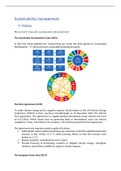
In 2015 the UNGA adopted the ‘Transforming our world: the 2030 Agenda for Sustainable
Development’. 17 interconnected, sustainable development goals:
The Paris Agreement (2015)
To tackle climate change and its negative impacts. World leaders at the UN Climate Change
Conference (COP21) in Paris reached a breakthrough on 12 December 2015: the historic
Paris Agreement. The Agreement is a legally binding international treaty entered into force
on 4/11/2016. Which means that no governing body or international court can enforce
compliance. Today, 192 Parties (191 countries + the EU) have joined the Paris Agreement.
The Agreement sets long-term goals to guide all nations:
Substantially reduce global greenhouse gas emissions to limit the global temperature
increase in this century to 2 °C while pursuing efforts to limit the increase even
further to 1.5 °C.
Review countries’ commitments every 5 years.
Provide financing to developing countries to mitigate climate change, strengthen
resilience and enhance abilities to adapt to climate impacts.
The European Green Deal (2019)
,Movement towards sustainable development, sustainable economies, and sustainable
businesses.
“The European Green Deal is about improving the well-being of people. Making Europe
climate-neutral and protecting our natural habitat will be good for people, planet, and
economy. No one will be left behind.” The EU will:
Become climate-neutral by 2050.
Protect human life, animals, and plants by cutting pollution.
Help companies become world leaders in clean products and technologies.
Help ensure a just and inclusive transition.
The European Commission is expected to propose rules in January deciding whether gas and
nuclear projects will be included in the EU "sustainable finance taxonomy”. This is a list of
economic activities and the environmental criteria they must meet to be labeled as green
investments.
3 pillars of sustainable development (economic, ecological, ethical)
New ways of thinking about:
How we should live (transform the way we build, create safe and affordable housing,
invest in public transport, green public spaces)
How we should manage our businesses (knowing that resources are scarce)
How we should shape our economies (make energy affordable)
The importance of redesigning and reconceptualizing businesses
Why re-design and re-conceptualize businesses?
To meet global needs: a large % of the world’s population lacks the basic
requirements of a decent human life. To meet these needs, the world’s economy
must produce sustainable goods and distribute them to those who need it.
Businesses do not operate in isolation (increasingly integrated global economy)
Economic activities transgress the biophysical boundaries of our planet
1) The coming age of sustainable business
The world’s current challenges
Extreme poverty: is declining but the progress is uneven (half the people living in extreme
poverty in 2015 can be found in just 5 countries, in Sub-Sahara Africa poverty is rising).
Political repression/war
Political rights: free and fair elections. Candidates who are elected are the ones that
rule, political parties are competitive, the interests of minority groups are well
represented in politics and government etc.
, Civil liberties: freedoms of expression, assembly, association, education, and religion.
Having an established and generally fair legal system that ensures the rule of law,
allows free economic activity, strives for equality of opportunity for everyone etc.
You only live in a free country when political rights and civil liberties are in place.
Population growth: the world’s population continues to grow, albeit at a slower pace than at
any time since.
The 47 least developed countries are among the world’s fastest growing
Is compounded by the effects of climate change, climate variability and sea-level rise.
Food security = adequate access to food in both quality and quantity.
Progress on malnutrition is too slow to achieve the 2025 and 2030 global nutrition
targets!
Globalization = the Global Value Chain (GVC) breaks up the production process across
countries. Firms specialize in a specific task and do not produce the whole product (raw
materials & service inputs -> parts, components & semifinished goods -> finished goods).
GVCs increase income, create better jobs, and reduce poverty.
The gains from GVCs are not equally shared, and GVCs can hurt the environment.
An increasingly integrated global economy means that such challenges and problems
anywhere in the world will directly influence those living elsewhere.
The Earth’s biosphere is under threat (depletion of natural resources, species extinction,
emissions of our waste products etc.) from just the type of economic growth that many
assume will be the solution to these challenges.
2 business paradigms
The old paradigm The new paradigm
Economic growth There are many ways to pursue profitability
Ethical & ecological considerations = burden Environmental responsibility ≠ a side-
Laws restrict businesses constraint on the pursuit of profit.
Economics and ecology = zero-sum game Self-interest and ethical responsibility do
not conflict: it is in our own interest that we
take care of the environment
Current misguided assumptions: economic growth will solve our challenges and businesses
can operate independent of environmental and ethical concerns.
The alternative: integrating economics, ecology, and ethics
Economics, ecology, ethics
Businesses should be practiced in a way that is economically vibrant enough to address the
real needs of billions of people, yet ecologically informed so that the earth’s capacity to
, support life is not diminished by that activity, and ethically sensitive enough that human
dignity is not lost or violated in the process.
These 3 pillars of a sustainability (the triple bottom line) are connected and are all directed
at the same question: What are the best ways for human beings to live and flourish within
the biosphere that is their only home?
Economics is concerned with the ways in which human beings produce and distribute
the goods and services that they need and desire.
Ecology is concerned with the relationships by which humans (and other living
beings) interact with their natural environment.
Ethics is concerned with the basic question of how humans ought to live their lives.
Individuals, government, and business
Other misguided assumptions:
The beliefs, attitudes, desires, and values of individuals are taken as given. Businesses
and governments merely respond to their demands. The government chooses how
that demand is fulfilled through subsidizing different sectors.
Public policy should prepare to meet an ever-growing demand for energy resources,
a demand best met by increasing the supply of the already dominant energy sources.
Leading governments to subsidize fossil fuels and nuclear power.
The implicit view is that consumers and governments are the active players in energy
policy while businesses remain a relatively passive spectator.
The uncritical trust in economic growth, the mistaken separation of economics from ecology
and ethics, and the artificial separation of individuals from institutions and governments are
part of this dominant political and economic paradigm.
Governments not only regulate businesses, but it also promotes, directs, and serves
businesses’ interests. Businesses not only respond to consumers’ demands, but it also helps
create and shape that demand through advertising and marketing.
Economic growth: problem or solution
Idea that “a bigger economy is a better one”. Reigning economic and political paradigm:
unguided economic growth can, will, and should go on indefinitely. It assumes that
0) Preface
Movement towards sustainable development
The Sustainable Development Goals (SDGs)
In 2015 the UNGA adopted the ‘Transforming our world: the 2030 Agenda for Sustainable
Development’. 17 interconnected, sustainable development goals:
The Paris Agreement (2015)
To tackle climate change and its negative impacts. World leaders at the UN Climate Change
Conference (COP21) in Paris reached a breakthrough on 12 December 2015: the historic
Paris Agreement. The Agreement is a legally binding international treaty entered into force
on 4/11/2016. Which means that no governing body or international court can enforce
compliance. Today, 192 Parties (191 countries + the EU) have joined the Paris Agreement.
The Agreement sets long-term goals to guide all nations:
Substantially reduce global greenhouse gas emissions to limit the global temperature
increase in this century to 2 °C while pursuing efforts to limit the increase even
further to 1.5 °C.
Review countries’ commitments every 5 years.
Provide financing to developing countries to mitigate climate change, strengthen
resilience and enhance abilities to adapt to climate impacts.
The European Green Deal (2019)
,Movement towards sustainable development, sustainable economies, and sustainable
businesses.
“The European Green Deal is about improving the well-being of people. Making Europe
climate-neutral and protecting our natural habitat will be good for people, planet, and
economy. No one will be left behind.” The EU will:
Become climate-neutral by 2050.
Protect human life, animals, and plants by cutting pollution.
Help companies become world leaders in clean products and technologies.
Help ensure a just and inclusive transition.
The European Commission is expected to propose rules in January deciding whether gas and
nuclear projects will be included in the EU "sustainable finance taxonomy”. This is a list of
economic activities and the environmental criteria they must meet to be labeled as green
investments.
3 pillars of sustainable development (economic, ecological, ethical)
New ways of thinking about:
How we should live (transform the way we build, create safe and affordable housing,
invest in public transport, green public spaces)
How we should manage our businesses (knowing that resources are scarce)
How we should shape our economies (make energy affordable)
The importance of redesigning and reconceptualizing businesses
Why re-design and re-conceptualize businesses?
To meet global needs: a large % of the world’s population lacks the basic
requirements of a decent human life. To meet these needs, the world’s economy
must produce sustainable goods and distribute them to those who need it.
Businesses do not operate in isolation (increasingly integrated global economy)
Economic activities transgress the biophysical boundaries of our planet
1) The coming age of sustainable business
The world’s current challenges
Extreme poverty: is declining but the progress is uneven (half the people living in extreme
poverty in 2015 can be found in just 5 countries, in Sub-Sahara Africa poverty is rising).
Political repression/war
Political rights: free and fair elections. Candidates who are elected are the ones that
rule, political parties are competitive, the interests of minority groups are well
represented in politics and government etc.
, Civil liberties: freedoms of expression, assembly, association, education, and religion.
Having an established and generally fair legal system that ensures the rule of law,
allows free economic activity, strives for equality of opportunity for everyone etc.
You only live in a free country when political rights and civil liberties are in place.
Population growth: the world’s population continues to grow, albeit at a slower pace than at
any time since.
The 47 least developed countries are among the world’s fastest growing
Is compounded by the effects of climate change, climate variability and sea-level rise.
Food security = adequate access to food in both quality and quantity.
Progress on malnutrition is too slow to achieve the 2025 and 2030 global nutrition
targets!
Globalization = the Global Value Chain (GVC) breaks up the production process across
countries. Firms specialize in a specific task and do not produce the whole product (raw
materials & service inputs -> parts, components & semifinished goods -> finished goods).
GVCs increase income, create better jobs, and reduce poverty.
The gains from GVCs are not equally shared, and GVCs can hurt the environment.
An increasingly integrated global economy means that such challenges and problems
anywhere in the world will directly influence those living elsewhere.
The Earth’s biosphere is under threat (depletion of natural resources, species extinction,
emissions of our waste products etc.) from just the type of economic growth that many
assume will be the solution to these challenges.
2 business paradigms
The old paradigm The new paradigm
Economic growth There are many ways to pursue profitability
Ethical & ecological considerations = burden Environmental responsibility ≠ a side-
Laws restrict businesses constraint on the pursuit of profit.
Economics and ecology = zero-sum game Self-interest and ethical responsibility do
not conflict: it is in our own interest that we
take care of the environment
Current misguided assumptions: economic growth will solve our challenges and businesses
can operate independent of environmental and ethical concerns.
The alternative: integrating economics, ecology, and ethics
Economics, ecology, ethics
Businesses should be practiced in a way that is economically vibrant enough to address the
real needs of billions of people, yet ecologically informed so that the earth’s capacity to
, support life is not diminished by that activity, and ethically sensitive enough that human
dignity is not lost or violated in the process.
These 3 pillars of a sustainability (the triple bottom line) are connected and are all directed
at the same question: What are the best ways for human beings to live and flourish within
the biosphere that is their only home?
Economics is concerned with the ways in which human beings produce and distribute
the goods and services that they need and desire.
Ecology is concerned with the relationships by which humans (and other living
beings) interact with their natural environment.
Ethics is concerned with the basic question of how humans ought to live their lives.
Individuals, government, and business
Other misguided assumptions:
The beliefs, attitudes, desires, and values of individuals are taken as given. Businesses
and governments merely respond to their demands. The government chooses how
that demand is fulfilled through subsidizing different sectors.
Public policy should prepare to meet an ever-growing demand for energy resources,
a demand best met by increasing the supply of the already dominant energy sources.
Leading governments to subsidize fossil fuels and nuclear power.
The implicit view is that consumers and governments are the active players in energy
policy while businesses remain a relatively passive spectator.
The uncritical trust in economic growth, the mistaken separation of economics from ecology
and ethics, and the artificial separation of individuals from institutions and governments are
part of this dominant political and economic paradigm.
Governments not only regulate businesses, but it also promotes, directs, and serves
businesses’ interests. Businesses not only respond to consumers’ demands, but it also helps
create and shape that demand through advertising and marketing.
Economic growth: problem or solution
Idea that “a bigger economy is a better one”. Reigning economic and political paradigm:
unguided economic growth can, will, and should go on indefinitely. It assumes that