Functional Movement Screen (FMS) Exam QA (Graded A)
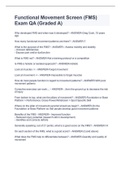
Who developed FMS and when was it developed? - ANSWER-Greg Cook, 15 years ago How many functional movement patterns are there? - ANSWER-7 What is the purpose of the FMS? - ANSWER-- Assess mobility and stability - Uncover deficiencies - Expose pain and/or dysfunction What is FMS not? - ANSWER-Not a training protocol or a competition Is FMS a holistic or isolated approach? - ANSWER-Holistic Look at muscles -> - ANSWER-Forget movement Look at movement -> - ANSWER-Impossible to forget muscles How do most people function in regard to movement patterns? - ANSWER-With poor movement patterns Corrective exercises can work.... - ANSWER-...from the ground up to decrease the risk of injury From bottom to top, what are the pillars of movement? - ANSWER-Foundation or Base Platform > Performance: Gross Power/Athleticism > Sport Specific Skill Where on the pillar of movement pyramid should we begin? - ANSWER-On the Foundation or Base Platform so that people develop good movement patterns Benefits of the FMS - ANSWER-- Improved function - Reduced injury potential (research still in development) - Identifies and corrects deficits Generally speaking, out of 21 points, what is a good score on the FMS? - ANSWER-14 On each section of the FMS, what is a good score? - ANSWER-2 (and above) What does the FMS help to differentiate between? - ANSWER-Quantity and quality of movement Mobility - ANSWER-- Muscle flexibility - Joint ROM - Freedom of movement Stability - ANSWER-The ability to... - Maintain posture - Control motion Equipment for FMS - ANSWER-Low tech, universal scoring method 7 exercises for FMS - ANSWER-1. Deep Squat 2. Hurdle Step 3. In-Line Lunge 4. Shoulder Mobility 5. Active Straight Leg Raise 6. Trunk Stability Push-Up 7. Rotary Stability Purpose of Deep Squat - ANSWER-- Extremity mobility - Core Stability - Mobility/stability of the shoulders/scapulothoracic region Upper Results of Deep Squat - ANSWER-Limited glenohumeral and/or thoracic spine mobility Lower Results of Deep Squat - ANSWER-Poor closed kinetic chain (when there is contact with the floor): ankle dorsiflexion and knee/hip flexion Core Results of Deep Squat - ANSWER-Poor stability Purpose of Hurdle Step - ANSWER-- Asymmetry in stepping/stride mechanics - Pelvis/core stability (looking at abductors of hip) - Bilateral mobility/stability of the hips, knees, and ankles Upper Results of Hurdle Step - ANSWER-Possible limitations to glenohumeral ROM Lower Results of Hurdle Step - ANSWER-- Poor pelvic stability - Poor hip flexion and/or extension Core Results of Hurdle Step - ANSWER-Poor stability Purpose of Incline Lunge - ANSWER-- Assesses stresses during rotation, deceleration, and lateral movements - Spine stabilization - Mobility/stability of the foot, ankle, knee, hip Lower Results of Incline Lunge - ANSWER-ROM deficiencies can be observed on both sides (even though only one is being scored) Core Results of Incline Lunge - ANSWER-Dynamic stability through a full-split stance Upper Results of Incline Lunge - ANSWER-Limited mobility in thoracic spine Purpose of Shoulder Mobility - ANSWER-- Assesses reciprocal upper extremity movements - Assess the complimentary nature of glenohumeral and scapulothoracic mobility - Scapular stability depends on thoracic mobility - Clearing test Where is the Clearing Test mostly seen and what does it look for? - ANSWER-In PT and Athletic Training settings. It looks for any sort of neurological impingement Results of Shoulder Mobility - ANSWER-- Shortening of pectoralis minor, latissmus dorsi, and rectus abdominus caused by overdevelopment of these muscles can be observed through rounded shoulders and lack of free glenohumeral ROM - Postural control and core stability Purpose of Active Straight Leg Raise - ANSWER-- Active mobility - Passive contralateral extension (leg on ground extends w/o foot pointing outward) - Core stability Results of Active Straight Leg Raise - ANSWER-- Differentiate between issues with core stability and passive ROM Flexion Limitations of Active Straight Leg Raise - ANSWER-Gluteus maximus/ITB and hamstrings Extension Limitations of Active Straight Leg Raise - ANSWER-Iliopsoas/anterior pelvis Purpose of Trunk Stability Push-Up - ANSWER-- Reflex core stability (NOT upper body strength) - Sagittal plane spinal stability during closed kinetic chain - Clearing Test Core Trunk Stability Push-Up Results - ANSWER-Poor stability resulting from inadequate connection between PMs of push-up motion and pelvis Upper Trunk Stability Push-Up Results - ANSWER-- Possible weakness of PMs of push-up - Possible limitation of hip and/or thoracic spine mobility Rotary Stability Purpose - ANSWER-- Analyze multi-plane pelvis, core and shoulder girdle stability - Neuromuscular coordination and energy - Fundamental climbing/crawling pattern - Clearing exam Core Rotary Stability Results - ANSWER-Poor reflex stability Possible limitations in Rotary Stability Results - ANSWER-Scapular and hip stability Possible ROM limitations in Rotary Stability Results - ANSWER-Knee, hip, spine and mobility What now..? - ANSWER-- Create an algorithm - Identify deficiencies - Analyze results - Synthesize composite parts to create treatment plan Steps in the Treatment Algorithm - ANSWER-1. Score of 0 (pain) -> refer to a qualified medical professional 2. Address mobility 3. Address stability (end range function) 4. Movement pattern retraining 5. Asymmetries take priority Is overload an effective corrective? - ANSWER-No General guidelines - ANSWER-- Address 1's first - Asymmetries take priority - Focus o the worst - it will typically improve the rest - The FMS treatment plan does not necessarily preclude an athlete from regular lifting routine Should you focus on tactile or verbal input? - ANSWER-Tactile (touching them) What is important not to forget in regard to asymmetries? - ANSWER-The more functional side What should you focus on for mobility? - ANSWER-End range What should you focus on for stability? - ANSWER-Fine-tuned control, not maximum force What is stability a challenge to? - ANSWER-Posture rather than traditional strength training exercise What is always the goal before progressing? - ANSWER-Improvement (proper technique) What need to be in place for training movement patterns? - ANSWER-Adequate mobility and stability Reactive Neuromuscular Training (RNT) - ANSWER-- Additional corrective exercise technique - Additional, focused recruitment to normalize faulty movement patterns - Push the body into deficiency so it has to react to get itself out Is RNT mental or ph

Geschreven voor
- Instelling
- FMS
- Vak
- FMS
Documentinformatie
- Geüpload op
- 11 februari 2023
- Aantal pagina's
- 5
- Geschreven in
- 2022/2023
- Type
- Tentamen (uitwerkingen)
- Bevat
- Vragen en antwoorden
Onderwerpen
-
functional movement screen
-
functional movement screen fms exam qa graded a
-
who developed fms and when was it developed
-
how many functional movement patterns are there
-
what is the purpose of the

Ook beschikbaar in voordeelbundel