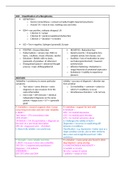
A01 – Classification of schizophrenia
DEFINITION =
o Severe mental illness = contact w/reality/insight impaired (psychosis)
o Around 1% = more in men, working class and cities
DSM = one positive, subtypes dropped, US
o Criterion A = symps
o Criterion B = social/occupational dysfunction
o Criterion C = Duration = 6 months
ICD = Two+ negative, Subtypes (paranoid), Europe
POSITIVE = Excess/distortion NEGATIVE = Reduction/loss
o Hallucinations = sensory exp. With no o Speech poverty = freq/quality (less
basis… (auditory, visual, olfactory, tactile) complex syntax, few clauses, etc)
o Delusions = Beliefs with no basis… o Avolition = loss of motivation to carry
(paranoid, of grandeur, of reference) out tasks (goal directed) = lowered
o Disorganised speech = abnormal thought activity levels
process = topic shifting/gibberish o Affective flattening = Reduction in
range/intensity of emotional expression
o Anhedonia = Inability to experience
pleasure
AO3/A01
Reliability = consistency to assess particular Validity = accuracy of diagnosis = disorder sep
symptoms from all other
o Test-retest = same clinician = same o Co-morbidities = common = extent to
diagnosis on sep occasions from the which 2+ conditions co-occur
same information o Simultaneous disorders = schz not sep
o Inter-rater = diff clinicians = identical
independent diagnoses on the same
patient = kappa score = 0.7+ = generally
good
P: Limitation = research supports view = issues P: Limitation = support for lack valid
concerning test-retest and inter-rater reliability E: BUCKLEY =
E: READ = 50% = Co-morbid depression
Test-retest = 37% concordance rates 15% = Co-morbid panic disorder
1970 STUDY = 47% = Co-morbid substance abuse
194 British + 134 US psychiatrists = diagnosis on E: Challenges the validity of both =
the basis of a case-study description Diagnostics = incorrect in establishing diff
69% US = diagnosed schiz, 2% British between 2 conditions.
E: Never fully reliable = not useful way Classification = e.g. depression = better seen as a
single condition combo, due to their similarity
Not a clear and straightforward tool = little
usefulness
P: Strength = more reliable over time P: Limitation = many symps also found in other
E: BECK = Increase in inter-rater reliability (dep/bipolar) = symp overlap.
54% CR’s = 2 experienced practitioners’ E: KONSTANTAREAS AND HEWITT =
diagnoses = 153 patients 14 autistic vs 14 schz
SODERBERG = No schz = symps of autism
81% CR’S when use DSM 7 autistics = symps of schz
, E: More over time = even if reliability not perfect E: KETTER = lead to misdiagnosis and years of
= common lang = comm. of ideas and findings = delay in receiving relevant treatment = further
better understanding of disorder = devel of degeneration can occur = higher levels of suicide
effective treatments more likely = beneficial = = negative effect on patients’ lives = undermines
improve QofEL i use as beneficial tool
A01 – Biological explanations of schizophrenia – GENETIC BASIS
Genetic basis = runs in families = higher risk
No one gene responsible = diff combos make more vulnerable
DEFINITION =
o Severe mental illness = contact w/reality/insight impaired (psychosis)
o Around 1% = more in men, working class and cities
DSM = one positive, subtypes dropped, US
o Criterion A = symps
o Criterion B = social/occupational dysfunction
o Criterion C = Duration = 6 months
ICD = Two+ negative, Subtypes (paranoid), Europe
POSITIVE = Excess/distortion NEGATIVE = Reduction/loss
o Hallucinations = sensory exp. With no o Speech poverty = freq/quality (less
basis… (auditory, visual, olfactory, tactile) complex syntax, few clauses, etc)
o Delusions = Beliefs with no basis… o Avolition = loss of motivation to carry
(paranoid, of grandeur, of reference) out tasks (goal directed) = lowered
o Disorganised speech = abnormal thought activity levels
process = topic shifting/gibberish o Affective flattening = Reduction in
range/intensity of emotional expression
o Anhedonia = Inability to experience
pleasure
AO3/A01
Reliability = consistency to assess particular Validity = accuracy of diagnosis = disorder sep
symptoms from all other
o Test-retest = same clinician = same o Co-morbidities = common = extent to
diagnosis on sep occasions from the which 2+ conditions co-occur
same information o Simultaneous disorders = schz not sep
o Inter-rater = diff clinicians = identical
independent diagnoses on the same
patient = kappa score = 0.7+ = generally
good
P: Limitation = research supports view = issues P: Limitation = support for lack valid
concerning test-retest and inter-rater reliability E: BUCKLEY =
E: READ = 50% = Co-morbid depression
Test-retest = 37% concordance rates 15% = Co-morbid panic disorder
1970 STUDY = 47% = Co-morbid substance abuse
194 British + 134 US psychiatrists = diagnosis on E: Challenges the validity of both =
the basis of a case-study description Diagnostics = incorrect in establishing diff
69% US = diagnosed schiz, 2% British between 2 conditions.
E: Never fully reliable = not useful way Classification = e.g. depression = better seen as a
single condition combo, due to their similarity
Not a clear and straightforward tool = little
usefulness
P: Strength = more reliable over time P: Limitation = many symps also found in other
E: BECK = Increase in inter-rater reliability (dep/bipolar) = symp overlap.
54% CR’s = 2 experienced practitioners’ E: KONSTANTAREAS AND HEWITT =
diagnoses = 153 patients 14 autistic vs 14 schz
SODERBERG = No schz = symps of autism
81% CR’S when use DSM 7 autistics = symps of schz
, E: More over time = even if reliability not perfect E: KETTER = lead to misdiagnosis and years of
= common lang = comm. of ideas and findings = delay in receiving relevant treatment = further
better understanding of disorder = devel of degeneration can occur = higher levels of suicide
effective treatments more likely = beneficial = = negative effect on patients’ lives = undermines
improve QofEL i use as beneficial tool
A01 – Biological explanations of schizophrenia – GENETIC BASIS
Genetic basis = runs in families = higher risk
No one gene responsible = diff combos make more vulnerable