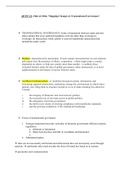
ARTICLE: Hale & Held, ‘Mapping Changes in Transnational Governance’
TRANSNATIONAL GOVERNANCE: forms of interaction between states and non
states entities that cross national boundaries at levels other than sovereign to
sovereign. all interactions, while 'global' is used for transborder interactions that
include the entire world
Realism: characterized by uncertainty. If each country must prioritize its own interests
and cannot trust the promises of others, cooperation - which might make a country
dependent on others, or help one country more than another - is unlikely.these
structural barriers make the idea of global governance either nonsensical, or at most
epiphenomenal to the balance of power between states
'neoliberal institutionalism', or 'modified structural realism: information and
structuring repeated interactions, institutions change the environment in which states
operate, ena- bling them to structure incentives so as to make cheating less attractive.
5 trends:
i. the merging of 'domestic' and 'international' politics;
ii. the increased role of non-state actors in global politics;
iii. the emergence of private governance;
iv. the shift to new modes of eliciting compliance with transborder standards;
v. and the growing complexity of the institutional landscape.
Forms of transnational governance
1. Transgovernmental networks: networks of domestic government officials (experts,
regulators)
a. Informal or formalized
b. Share best practices and info to coordinate and harmonize
c.
2. Arbitration bodies:
rules are not necessarily and formal and enforcement does not necessarily occur through
sanction. ransborder rules need not take the form of formal law based in or custom.
persuasion and communication
TRANSNATIONAL GOVERNANCE: forms of interaction between states and non
states entities that cross national boundaries at levels other than sovereign to
sovereign. all interactions, while 'global' is used for transborder interactions that
include the entire world
Realism: characterized by uncertainty. If each country must prioritize its own interests
and cannot trust the promises of others, cooperation - which might make a country
dependent on others, or help one country more than another - is unlikely.these
structural barriers make the idea of global governance either nonsensical, or at most
epiphenomenal to the balance of power between states
'neoliberal institutionalism', or 'modified structural realism: information and
structuring repeated interactions, institutions change the environment in which states
operate, ena- bling them to structure incentives so as to make cheating less attractive.
5 trends:
i. the merging of 'domestic' and 'international' politics;
ii. the increased role of non-state actors in global politics;
iii. the emergence of private governance;
iv. the shift to new modes of eliciting compliance with transborder standards;
v. and the growing complexity of the institutional landscape.
Forms of transnational governance
1. Transgovernmental networks: networks of domestic government officials (experts,
regulators)
a. Informal or formalized
b. Share best practices and info to coordinate and harmonize
c.
2. Arbitration bodies:
rules are not necessarily and formal and enforcement does not necessarily occur through
sanction. ransborder rules need not take the form of formal law based in or custom.
persuasion and communication