WEEK 1
Marketing = is the activity, set of institutions, processes for creating, communicating,
delaying exchanging offerings that have value for customers, clients, partners and society at
large. → create value
Purpose of businesses → creating and keeping customers
Basic function of marketing → making a profit while keeping customers
These definitions imply
1. That marketing has a central role for business success
2. The purpose of marketing is to make a profit
3. The costs to acquire a new customer are higher than the costs to keep an existing one
4. A company must not only understand customers but also its competition
The marketing concept
• The achievement of corporate goals through meeting and exceeding customer needs and
expectations better than the competition. (p.6)
• Three conditions should be met:
1. Customer orientation →
2. Integrated effort
3. Goal achievement
MARKET ORIENTATION → looking at your consumers
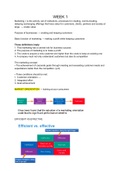
EFFICIENT VS EFFECTIVE
,PRODUCT ORIENTATION → cost focused
MARKET ORIENTATION → focused on customer needs
Benefits of the marketing concept
• Creation of customer value,
• Leading to customer satisfaction,
• And (hopefully) customer loyalty
• Through long-term customer relationships
Exceeding the customer satisfaction leads → to expectations → lowering the satisfaction
from delight towards neutral in the long-term
, CUSTOMER LOYALTY= returning customers, built on convenience, quality of service and
social interaction
Levels of marketing
• Strategic level: business level (what and why?) – Mission, vision, marketing audit, SWOT
analysis, high-level marketing objectives.
• Operational or tactical level: product or service marketing (who, how, where, when?) – How
to use the product (or service) mix to create competitive advantage and then how to
implement these decisions.
Macroenvironment
• Political and legal forces
• Economical forces
• Ecological forces – physical environment
• Social and cultural forces
• Technological forces PEEST analysis, also known as PEST or PESTLE…
SWOT-analysis
• Macroenvironment opportunities and threats in the market
• Microenvironment strengths and weaknesses of the company
Marketing = is the activity, set of institutions, processes for creating, communicating,
delaying exchanging offerings that have value for customers, clients, partners and society at
large. → create value
Purpose of businesses → creating and keeping customers
Basic function of marketing → making a profit while keeping customers
These definitions imply
1. That marketing has a central role for business success
2. The purpose of marketing is to make a profit
3. The costs to acquire a new customer are higher than the costs to keep an existing one
4. A company must not only understand customers but also its competition
The marketing concept
• The achievement of corporate goals through meeting and exceeding customer needs and
expectations better than the competition. (p.6)
• Three conditions should be met:
1. Customer orientation →
2. Integrated effort
3. Goal achievement
MARKET ORIENTATION → looking at your consumers
EFFICIENT VS EFFECTIVE
,PRODUCT ORIENTATION → cost focused
MARKET ORIENTATION → focused on customer needs
Benefits of the marketing concept
• Creation of customer value,
• Leading to customer satisfaction,
• And (hopefully) customer loyalty
• Through long-term customer relationships
Exceeding the customer satisfaction leads → to expectations → lowering the satisfaction
from delight towards neutral in the long-term
, CUSTOMER LOYALTY= returning customers, built on convenience, quality of service and
social interaction
Levels of marketing
• Strategic level: business level (what and why?) – Mission, vision, marketing audit, SWOT
analysis, high-level marketing objectives.
• Operational or tactical level: product or service marketing (who, how, where, when?) – How
to use the product (or service) mix to create competitive advantage and then how to
implement these decisions.
Macroenvironment
• Political and legal forces
• Economical forces
• Ecological forces – physical environment
• Social and cultural forces
• Technological forces PEEST analysis, also known as PEST or PESTLE…
SWOT-analysis
• Macroenvironment opportunities and threats in the market
• Microenvironment strengths and weaknesses of the company