WGU D094 Educational Psych With Complete Solutions.
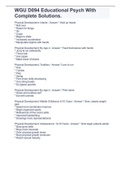
Physical Development: Infants * Hold up heads * Roll over * Reach for things * Sit * Crawl * Begin to Walk * Increased coordination * Manipulate objects with hands Physical Development: By Age 2 * Feed themselves with hands * Jump & run awkwardly * Throw ball * Use zipper * Make tower of blocks Physical Development: Toddlers *Love to run * Hop * Tumble * Play * Swing * Fine motor skills developing * Can string beads * Do jigsaw puzzles Physical Development: By Age 4 * Print name * Dress and undress self * Eat with utensils Physical Development: Middle Childhood: 6-10 Years * Slow, steady weight gain * Speed and coordination improve * Begin organized sports * Refinement of fine motor skills * Improved handwriting * Drawings more representational Physical Development: Adolescence: 10-18 Years * Girls begin puberty earlier * Boys grow taller * Boys more muscular * Girls' physical growth slows * Boys physical growth continues * Reach sexual maturity At which developmental stage would a child be expected to tie shoes? Primary school How does female growth differ than male growth during the adolescent stage? Females usually complete physical growth before males Which characteristic is consistent with a student in the early childhood physical development stage? Ties shoelaces Which characteristic is consistent with a student in the middle childhood physical development stage? Refining of motor coordination Piaget * scheme, schema * adaptation * assimilation, disequilibrium, equilibrium, & accommodation * Learn from interaction with peers and environment Vygotsky * Scaffolding * Zone of Proximal Development (ZPD) * More knowledgeable other (MKO) * Using language (as a mediator) ** explaining, giving examples, asking leading questions * Social & Cultural interactions important Piaget Stages * Sensorimotor Stage * Preoperational Stage * Concrete Operational Stage * Formal Operational Stage Sensorimotor Stage (Birth - 2 years) * Learn through movement and senses * Reflexive or active * Sucking * Grabbing * Looking * Listening *Object permanence ** unseen things still exist Preoperational Stage (Preschool/Kinder) * Prelogical thought * Play and pretend * Language develops * Forms many new schemes * Egocentrism ** all about me * Centration ** focus on only one aspect at a time Concrete Operational Stage (Elementary) * Logical thought * Need concrete, hands-on, experience * Mental reversal * Seriation * Sorting * Classifying * Conservation Formal Operational Stage (Middle school/High school) * Abstract thought * Higher order thinking & reasoning * Mental manipulations * Systematic problem-solving, critical thinking * Hypothesize * Predict Vygotsky Stages * No specific stages * Support learning from lower level to higher level and more complex knowledge and skills at all ages Erikson - Psychosocial (8 Stages of Identity Development) 1. Trust vs. Mistrust 2. Autonomy vs. Shame & Doubt 3. Initiative vs. Guilt 4.Industry vs. Inferiority 5. Identity vs. Role Confusion 6. Intimacy vs. Isolation Trust vs. Mistrust * Babies * Provide love, care, food * Need comfort and safety Autonomy vs. Shame & Doubt * Toddlers * Need for independence * Me do stage * Insist on doing things on own Initiative vs. Guilt * Preschool/Kinder * Exploration * Asking lots of questions * Trying new things on own Industry vs. Inferiority * Elementary * Intellectual curiosity * School performance * Need positive reinforcement * Praise * Avoid undue competition or criticism Identity vs. Role Confusion * Adolescents * Develop sense of self * Influenced by other's reactions * Peers important * Social role models important
Geschreven voor
- Instelling
- WGU D094
- Vak
- WGU D094
Documentinformatie
- Geüpload op
- 1 november 2022
- Aantal pagina's
- 14
- Geschreven in
- 2022/2023
- Type
- Tentamen (uitwerkingen)
- Bevat
- Vragen en antwoorden
Onderwerpen
-
wgu d094 educational psych with complete solutions
Ook beschikbaar in voordeelbundel