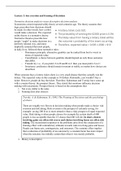
Lecture 2: loss aversion and framing of decisions
Normative decision analysis versus descriptive decision analysis
Economists coined expected utility theory several centuries ago. The theory assumes that
logic prescribes how decisions should
be made. In other words, how a robot
would make a decision. The expected
utility theory is a normative theory.
Normative theories prescribe how
people “ought” to make decisions in a
perfectly rational way, and many
implicitly assumed that most people,
in daily lives, followed these normative rules:
- Dominance principle: alternative gambles can be ranked from best to worst in
terms of expected value.
- Cancellation: a choice between gambles should depend on only those outcomes
that differ.
- Transitivity: i.e., if you prefer A to B and B to C then you must prefer A to C.
- Invariance: preference should remain invariant or stable, no matter how choices are
described.
When someone buys a lottery ticket, there is a very small chance that they actually win the
lottery. The expected value in this example is 10 dollars. Rationally, you wouldn’t buy a
ticket. However, people do buy the ticket. Therefore, Kahneman and Tversky have come up
with a counter theory: the prospect theory. They stated that emotions influence decision
making with uncertainty. Prospect theory is based on the assumptions that
1. Not every dollar is the same
2. Framing does alter choices:
Tversky, A. & Kahneman, D. (1981) The Framing of Decisions and the psychology
of choice.
There are roughly two flavors in decision making when people make a choice: risk
aversion and risk taking. Risk aversion is the prospect of certainly saving, for
example: saving 200 lives is more attractive than a risky prospect of equal expected
value. Risk taking is when people choose for example the certain death of 400
people is less acceptable than the 2/3 chance that 600 will die. In short, choices
involving gains are often risk averse and choices involving losses are often risk
taking. The inconsistent responses to the problems arise from the conjunction of a
framing effect with contradictory attitudes towards risks involving gains and losses.
People can frame acts, contingencies, and outcomes. The certainty effect implies
that a reduction of probability of an outcome by a constant factor has more impact
when the outcome was initially certain than when it was merely probable.
3. Money is descriptive
, Prospect theory
As stated, Tversky and Kahneman came
up with a counter theory: Prospect theory
(1979). It is an example of a descriptive
decision analysis. It describes how
people make decisions. The theory
provides better description of choice
under risk and uncertainty. The key
ingredient is the value function. It shows
three principles: the reference point,
sensitivity, and loss aversion.
Reference point
People make decisions based on their own reference point.
Sensitivity
If it is already bad, it doesn’t matter if it gets slightly worse. That is, the difference between
$10 and $20 seems bigger than the difference between $1000 and $1010
Loss Aversion
Definition: the disutility (displeasure/pain) associated with a loss of given amount is larger
than the utility associated with a gain of the same or similar magnitude. We want to keep
things the way they are, even if we originally didn’t choose it. Therefore, we want to avoid
potential losses generated by change.
Example: new prisoner gets a cell of 8m2, but an imprisoned person degrades from a 10m2
cell to 8m2 cell. The reference point is other, and so the emotions are different. The sensitivity
of the imprisoned person is less because he is already in jail.
Lecture 3: Mental accounting
Mental accounting is the set of cognitive operations used by individuals and households to
organize, evaluate, and keep track of financial activities. It is the entire process of coding,
categorizing, and evaluating events. Three components of mental accounting receive the most
attention:
1. Perceiving outcomes: how outcomes are perceived and experienced, and how
decision is made and subsequently evaluated. Perceiving outcomes has to deal with
opening and closing accounts, Transaction utility, Advance purchases, sunk costs and
payment depreciation and payment decoupling
1. Transaction utility is the perceived value of the deal (negative/positive) = price
paid – reference price. This idea is described by the beer @ the beach from
supermarket versus bar
2. Opening and closing accounts: As people dislike incurring losses much more
than they enjoy making gains, and people are willing to gamble in the domain
of losses, investors will hold onto stocks that have lost value and will be eager
to sell stocks that have risen in value (= disposition effect). In other words,
people will hold on to stocks (keep them “open”), because they have already
lost but will close stocks when they have little return.
Normative decision analysis versus descriptive decision analysis
Economists coined expected utility theory several centuries ago. The theory assumes that
logic prescribes how decisions should
be made. In other words, how a robot
would make a decision. The expected
utility theory is a normative theory.
Normative theories prescribe how
people “ought” to make decisions in a
perfectly rational way, and many
implicitly assumed that most people,
in daily lives, followed these normative rules:
- Dominance principle: alternative gambles can be ranked from best to worst in
terms of expected value.
- Cancellation: a choice between gambles should depend on only those outcomes
that differ.
- Transitivity: i.e., if you prefer A to B and B to C then you must prefer A to C.
- Invariance: preference should remain invariant or stable, no matter how choices are
described.
When someone buys a lottery ticket, there is a very small chance that they actually win the
lottery. The expected value in this example is 10 dollars. Rationally, you wouldn’t buy a
ticket. However, people do buy the ticket. Therefore, Kahneman and Tversky have come up
with a counter theory: the prospect theory. They stated that emotions influence decision
making with uncertainty. Prospect theory is based on the assumptions that
1. Not every dollar is the same
2. Framing does alter choices:
Tversky, A. & Kahneman, D. (1981) The Framing of Decisions and the psychology
of choice.
There are roughly two flavors in decision making when people make a choice: risk
aversion and risk taking. Risk aversion is the prospect of certainly saving, for
example: saving 200 lives is more attractive than a risky prospect of equal expected
value. Risk taking is when people choose for example the certain death of 400
people is less acceptable than the 2/3 chance that 600 will die. In short, choices
involving gains are often risk averse and choices involving losses are often risk
taking. The inconsistent responses to the problems arise from the conjunction of a
framing effect with contradictory attitudes towards risks involving gains and losses.
People can frame acts, contingencies, and outcomes. The certainty effect implies
that a reduction of probability of an outcome by a constant factor has more impact
when the outcome was initially certain than when it was merely probable.
3. Money is descriptive
, Prospect theory
As stated, Tversky and Kahneman came
up with a counter theory: Prospect theory
(1979). It is an example of a descriptive
decision analysis. It describes how
people make decisions. The theory
provides better description of choice
under risk and uncertainty. The key
ingredient is the value function. It shows
three principles: the reference point,
sensitivity, and loss aversion.
Reference point
People make decisions based on their own reference point.
Sensitivity
If it is already bad, it doesn’t matter if it gets slightly worse. That is, the difference between
$10 and $20 seems bigger than the difference between $1000 and $1010
Loss Aversion
Definition: the disutility (displeasure/pain) associated with a loss of given amount is larger
than the utility associated with a gain of the same or similar magnitude. We want to keep
things the way they are, even if we originally didn’t choose it. Therefore, we want to avoid
potential losses generated by change.
Example: new prisoner gets a cell of 8m2, but an imprisoned person degrades from a 10m2
cell to 8m2 cell. The reference point is other, and so the emotions are different. The sensitivity
of the imprisoned person is less because he is already in jail.
Lecture 3: Mental accounting
Mental accounting is the set of cognitive operations used by individuals and households to
organize, evaluate, and keep track of financial activities. It is the entire process of coding,
categorizing, and evaluating events. Three components of mental accounting receive the most
attention:
1. Perceiving outcomes: how outcomes are perceived and experienced, and how
decision is made and subsequently evaluated. Perceiving outcomes has to deal with
opening and closing accounts, Transaction utility, Advance purchases, sunk costs and
payment depreciation and payment decoupling
1. Transaction utility is the perceived value of the deal (negative/positive) = price
paid – reference price. This idea is described by the beer @ the beach from
supermarket versus bar
2. Opening and closing accounts: As people dislike incurring losses much more
than they enjoy making gains, and people are willing to gamble in the domain
of losses, investors will hold onto stocks that have lost value and will be eager
to sell stocks that have risen in value (= disposition effect). In other words,
people will hold on to stocks (keep them “open”), because they have already
lost but will close stocks when they have little return.