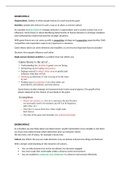
Lecture intro.1
Organizations: Entities in which people interact to reach economic goals
Societies: people who interact in such a way as to share a common culture
An example of game theory is strategic behavior in organizations and in society (culture has an in
influence). Game theory is about identifying determinants of human decisions in strategic situations
and mathematical models that describe strategic situations.
With game theory you can come up with a competitive strategy and cooperative opportunities. Both
competitive and cooperative aspects are important in a business.
Game theory takes out some elements and simplifies, so are less/not important factors excluded
Decisions from people influence each other
Single person decision problem is a problem that only affects you
Game theory studies strategic environments that involve several players. The payoff of the
players depends on the choices of everybody in the game
Lecture intro.2
In a situation we only think about one determinant: payoff maximization if you simplify is, but there
are many more determinants which determine what our behavior will be.
We also have a lot of biases, for example a future bias
Culture also affects the way we make decisions, how we behave and perceive things and behavior
With a deeper understanding of (the dynamics of) culture…
You can take distance but not be too distant: you become engaged.
You more easily feel comfortable within a diverse (work) environment.
You are enabled to cooperate and collaborate in a diverse environment effectively.
, Your aptitude in cross-cultural communication increases, fostering adaptation.
You better understand and solve work-related issues dealing with a diverse workforce
Your empathy increases
There are also different cultural levels, for example on national levels (between countries),
organizational levels (between corporates), occupational culture (between different kinds of
employees
Culture (according to Schein): the sum of
workable solutions for problems of
external adaptation and internal
integration that a group, an organization,
or a country has found
So assumptions translate into values
which translates into artifacts
Culture (according to Hofstede): “the
collective programming of the mind
distinguishing the members of one group
or category of people from others’’
Hofstede has it also divided in dimension:
1. Power Distance Index (PDI)
“Power Distance has been defined as the
extent to which the less powerful
members of organizations and
institutions (like the family) accept and
expect that power is distributed
unequally. This represents inequality
(more versus less), but defined from
below, not from above. It suggests that a
society's level of inequality is endorsed
by the followers as much as by the leaders.”
2. Uncertainty Avoidance Index (UAI)
Uncertainty Avoidance is not the same as
risk avoidance; it deals with a society's
tolerance for ambiguity. It indicates to
what extent a culture programs its
members to feel either uncomfortable or
comfortable in unstructured situations.
Unstructured situations are novel,
unknown, surprising and different from
usual. Uncertainty avoiding cultures try to
minimize the possibility of such situations
by strict behavioral codes, laws and rules,
disapproval of deviant opinions, and a belief in absolute Truth; 'there can only be one Truth
and we have it'
, 3. Individualism vs. Collectivism (IDV)
‘’Individualism on the one side versus its
opposite,
Collectivism: as a societal, not an
individual characteristic, is the degree to
which people in a society are integrated
into groups.
On the individualist side we find cultures
in which the ties between individuals are
loose: everyone is expected to look after
him/herself and his/her immediate family. On the collectivist side we find cultures in which
people from birth onwards are integrated into strong, cohesive in-groups, often extended
families (with uncles, aunts and grandparents) that continue protecting them in exchange for
unquestioning loyalty and oppose other in-groups.”
4. Masculinity vs. Femininity (MAS)
“Masculinity versus its opposite,
Femininity, again as a societal, not as an
individual characteristic, refers to the
distribution of values between the
genders. which is another fundamental
issue for any society, to which a range of
solutions can be found. The IBM studies
revealed that (a) women's values differ less
among societies than men's values; (b) men's
values from one country to another contain a
dimension from very assertive and
competitive and maximally different from women's values on the one side, to modest and caring and
similar to women's values on the other. The assertive pole has been called 'masculine' and the
modest, caring pole 'feminine'. The women in feminine countries have the same modest, caring
values as the men; in the masculine countries they are somewhat assertive and competitive,
but not as much as the men, so that these countries show a gap between men's values and
women's values. In masculine cultures there is often a taboo around this dimension”
[dimensions added later:]
5. Long-Term Orientation vs. Short-
Term Orientation (LTO)
The long-term pole; Values found at
this pole were perseverance, thrift,
ordering relationships by status, and
having a sense of shame
short term pole; Values were
reciprocating social obligations,
respect for tradition, protecting one’s
‘face’, and personal steadiness and
stability
6. Indulgence vs. Restraint (IND)
Indulgence stands for a society that
allows relatively free gratification of
Organizations: Entities in which people interact to reach economic goals
Societies: people who interact in such a way as to share a common culture
An example of game theory is strategic behavior in organizations and in society (culture has an in
influence). Game theory is about identifying determinants of human decisions in strategic situations
and mathematical models that describe strategic situations.
With game theory you can come up with a competitive strategy and cooperative opportunities. Both
competitive and cooperative aspects are important in a business.
Game theory takes out some elements and simplifies, so are less/not important factors excluded
Decisions from people influence each other
Single person decision problem is a problem that only affects you
Game theory studies strategic environments that involve several players. The payoff of the
players depends on the choices of everybody in the game
Lecture intro.2
In a situation we only think about one determinant: payoff maximization if you simplify is, but there
are many more determinants which determine what our behavior will be.
We also have a lot of biases, for example a future bias
Culture also affects the way we make decisions, how we behave and perceive things and behavior
With a deeper understanding of (the dynamics of) culture…
You can take distance but not be too distant: you become engaged.
You more easily feel comfortable within a diverse (work) environment.
You are enabled to cooperate and collaborate in a diverse environment effectively.
, Your aptitude in cross-cultural communication increases, fostering adaptation.
You better understand and solve work-related issues dealing with a diverse workforce
Your empathy increases
There are also different cultural levels, for example on national levels (between countries),
organizational levels (between corporates), occupational culture (between different kinds of
employees
Culture (according to Schein): the sum of
workable solutions for problems of
external adaptation and internal
integration that a group, an organization,
or a country has found
So assumptions translate into values
which translates into artifacts
Culture (according to Hofstede): “the
collective programming of the mind
distinguishing the members of one group
or category of people from others’’
Hofstede has it also divided in dimension:
1. Power Distance Index (PDI)
“Power Distance has been defined as the
extent to which the less powerful
members of organizations and
institutions (like the family) accept and
expect that power is distributed
unequally. This represents inequality
(more versus less), but defined from
below, not from above. It suggests that a
society's level of inequality is endorsed
by the followers as much as by the leaders.”
2. Uncertainty Avoidance Index (UAI)
Uncertainty Avoidance is not the same as
risk avoidance; it deals with a society's
tolerance for ambiguity. It indicates to
what extent a culture programs its
members to feel either uncomfortable or
comfortable in unstructured situations.
Unstructured situations are novel,
unknown, surprising and different from
usual. Uncertainty avoiding cultures try to
minimize the possibility of such situations
by strict behavioral codes, laws and rules,
disapproval of deviant opinions, and a belief in absolute Truth; 'there can only be one Truth
and we have it'
, 3. Individualism vs. Collectivism (IDV)
‘’Individualism on the one side versus its
opposite,
Collectivism: as a societal, not an
individual characteristic, is the degree to
which people in a society are integrated
into groups.
On the individualist side we find cultures
in which the ties between individuals are
loose: everyone is expected to look after
him/herself and his/her immediate family. On the collectivist side we find cultures in which
people from birth onwards are integrated into strong, cohesive in-groups, often extended
families (with uncles, aunts and grandparents) that continue protecting them in exchange for
unquestioning loyalty and oppose other in-groups.”
4. Masculinity vs. Femininity (MAS)
“Masculinity versus its opposite,
Femininity, again as a societal, not as an
individual characteristic, refers to the
distribution of values between the
genders. which is another fundamental
issue for any society, to which a range of
solutions can be found. The IBM studies
revealed that (a) women's values differ less
among societies than men's values; (b) men's
values from one country to another contain a
dimension from very assertive and
competitive and maximally different from women's values on the one side, to modest and caring and
similar to women's values on the other. The assertive pole has been called 'masculine' and the
modest, caring pole 'feminine'. The women in feminine countries have the same modest, caring
values as the men; in the masculine countries they are somewhat assertive and competitive,
but not as much as the men, so that these countries show a gap between men's values and
women's values. In masculine cultures there is often a taboo around this dimension”
[dimensions added later:]
5. Long-Term Orientation vs. Short-
Term Orientation (LTO)
The long-term pole; Values found at
this pole were perseverance, thrift,
ordering relationships by status, and
having a sense of shame
short term pole; Values were
reciprocating social obligations,
respect for tradition, protecting one’s
‘face’, and personal steadiness and
stability
6. Indulgence vs. Restraint (IND)
Indulgence stands for a society that
allows relatively free gratification of