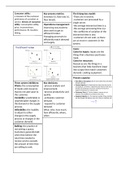
Consumer utility: Key process metrics: The Erlang loss model:
a measure of the customer Inventory (i), flow rate (r), -There are m servers.
preference of a product or flow time(t). -customers are processed by a
service. Drivers of consumer single server.
utility: consumption utility, Operations management: -the average interarrival time is a.
price, inconvenience, Improving way business -the average processing time is p.
performance, fit, location, does work to get to
timing.
-the coefficient of variation of the
efficient frontier. interarrival time is one.
Managing processes to -customers do not wait, so there
efficiently match demand are at most m customers in the
and supply. system.
Costs:
Costs for inputs: inputs are the
things that a business purchases:
meat.
Costs for resources:
Resources are the things in a
business that help transform input
into output that match customers
demand: cooking equipment.
Process capacity:
Three system inhibitors: Key decisions:
Waste: the consumption -process analysis and
of inputs and resources improvement.
that do not add value to -process productivity and
the customer. quality.
Variability: predictable or -anticipate customer
unpredictable changes in demand.
the demand or the supply -respond to customer
process. demand.
Inflexibility: the inability What, who, how much,
to adjust to either how efficiently, where,
changes in the supply when
process or changes in the
customer demand.
Balking: the practice of
not joining a queue.
Customers generally balk
when they believe the
total time needed to
receive service exceeds
the amount of time they
are willing to wait.
a measure of the customer Inventory (i), flow rate (r), -There are m servers.
preference of a product or flow time(t). -customers are processed by a
service. Drivers of consumer single server.
utility: consumption utility, Operations management: -the average interarrival time is a.
price, inconvenience, Improving way business -the average processing time is p.
performance, fit, location, does work to get to
timing.
-the coefficient of variation of the
efficient frontier. interarrival time is one.
Managing processes to -customers do not wait, so there
efficiently match demand are at most m customers in the
and supply. system.
Costs:
Costs for inputs: inputs are the
things that a business purchases:
meat.
Costs for resources:
Resources are the things in a
business that help transform input
into output that match customers
demand: cooking equipment.
Process capacity:
Three system inhibitors: Key decisions:
Waste: the consumption -process analysis and
of inputs and resources improvement.
that do not add value to -process productivity and
the customer. quality.
Variability: predictable or -anticipate customer
unpredictable changes in demand.
the demand or the supply -respond to customer
process. demand.
Inflexibility: the inability What, who, how much,
to adjust to either how efficiently, where,
changes in the supply when
process or changes in the
customer demand.
Balking: the practice of
not joining a queue.
Customers generally balk
when they believe the
total time needed to
receive service exceeds
the amount of time they
are willing to wait.