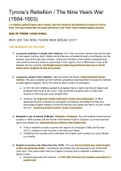
Tyrone’s Rebellion / The Nine Years War
(1594-1603)
= a rebellion against English rule in Ireland, after the monarchy had attempted to extend its control
there. This was needed after the break with Rome in the 1530s, which created religious tensions.
EARL OF TYRONE = HUGH O’NEILL
WHY DID THE NINE YEARS WAR BREAK OUT?
THE REASONS FOR THE NYW
1. Long term problems in Anglo-Irish relations - the Tudor monarchs claimed they had the right
to rule Ireland, but they didn’t. Dublin and its Pale was controlled through a Lord Deputy, but the
situation beyond the pale was complex - Anglo-Irish members of the nobility maintained their
own private armies and acted as quasi-kings in their regions. Due to differences in way of life
between the two countries, the English living in Ireland argued that the best way to control
Ireland was to anglicise its laws and customs.
2. Long term causes of the rebellion - after the break with Rome, Ireland remained Roman
Catholic. This was a problem as Irish Catholic sympathies might lead them to support a Catholic
crusade against England. Henry VIII chose to follow a policy of conciliation
● In 1541 the Irish chieftains agreed to recognise Henry’s right to be King of Ireland and
surrender their lands to the crown - they would then be given back to make them
tenants-in-chief and were given English titles.
● However, the Anglo-Irish nobility continued to remain semi-independent, so Mary
appointed the Earl of Sussex as an English Lord Deputy. He fortified the Pale and
encouraged English settlers to move into territory just outside the Pale to try and ‘civilise’
the Irish - introducing English customs, known as plantation.
3. Elizabeth’s rule of Ireland (1559-94) - Elizabeth = Protestant. The Irish Catholic threat became
a reality in 1569 onwards with the Revolt of the Northern Earls in England, so a more hard-line
policy was needed e.g. replacing laws and traditions with English ones.
● Tried to establish councils to govern the regions of Connaught (1569) and Munster
(1571), modelled on the Councils of the North and Wales
● Traditional Irish counties were subdivided into English-style counties ran using officials
e.g. sheriffs
4. English incursions into Ulster from the 1570s - this was the most Gaelic part, where English
control was extremely limited - controlled by the O’Neill clan and disputed by the O’Donnells
(rival clan). They were united when two English Courtiers tried to establish a settlement in
Eastern Ulster
● England responded with violence - in 1575, 500 O’Donnell clan members were killed in a
surprise raid.
, 5. Resentment from the Earl of Tyrone and other Ulster lords - before 1590, he had been
prepared to work with the English government when it suited him. He accepted an English title to
try and assert his right to be the heir of the O’Neill clan. When the government tried to assert
their control more directly in Ulster, Tyrone tried to neutralise the threat with a marriage alliance
with the sister of one of the new English incomers, Sir Bagenal, and eloped when he refused -
creating personal hostility.
● Another Ulster Lord, Maguire, was resentful about intrusion in Fermanagh, a region he
had previously controlled.
● Maguire and O’Donnell were married to Tyrone’s daughters - the lords had been plotting
against the English since the early 1590s which made it hard for T to remain neutral.
6. English mismanagement of the Anglo-Irish chieftains - in May 1593, Maguire attacked
English officials in Sligo
➔ Tyrone was the leading lord in the region and was ordered by the Lord Deputy to arrest
him, but he refused
➔ However, when Maguire then attacked an English garrison based at Ulster, he was forced
to cooperate with Sir Bagenal and capture Maguire.
➔ Tyrone felt overlooked - his help had not been acknowledged.
ALSO, other influential members of the nobility felt overlooked e.g. the Earl of Ormond (never appointed
to Lord Deputy even though he was Elizabeth’s cousin - appointments to office were dominated by
minor English officials who used their position for personal gain).
7. Tyrone’s decision to rebel - Elizabeth was concerned about the situation in Ulster
● O’Donnell had been in contact with the Catholic Philip II of Spain to ask for support (but
he was too busy with the Netherlands)
● In August 1594 Tyrone promised the new Lord Deputy to restore peace in Ulster and
cooperate in return for complete control over Ulster. Elizabeth’s government was not
prepared to give him this as they didn’t trust him.
● Ultimately, his loyalties to his Irish roots and Catholic faith were stronger than his newer
links to an English government that seemed to be increasingly untrustworthy.
SUPPORT FOR TYRONE WITHIN IRELAND
Large and well organised army:
- English and Spanish captains trained his men
- Imported weapons and ammunition
- An army of 1,000 cavalry, 4,000 musketmen, and 1,000 pikemen in 1595
- Equipped with modern weapons - muskets and pikes
Also had the support of other Ulster chieftains, including O’Donnell and Maguire (traditional feuds were
forgotten against a common enemy)
Tyrone’s successes encouraged other Chieftains outside of Ulster to join - spread to Connaught in 1595.
By 1596 the rebels had 6,000 foot soldiers and 1,200 cavalry, compared to the 5,732 English footmen
and 617 cavalry.
- So, Elizabeth was forced to send the largest army of her reign in 1599, under the leadership of
Robert Devereux (2nd Earl of Essex)
(1594-1603)
= a rebellion against English rule in Ireland, after the monarchy had attempted to extend its control
there. This was needed after the break with Rome in the 1530s, which created religious tensions.
EARL OF TYRONE = HUGH O’NEILL
WHY DID THE NINE YEARS WAR BREAK OUT?
THE REASONS FOR THE NYW
1. Long term problems in Anglo-Irish relations - the Tudor monarchs claimed they had the right
to rule Ireland, but they didn’t. Dublin and its Pale was controlled through a Lord Deputy, but the
situation beyond the pale was complex - Anglo-Irish members of the nobility maintained their
own private armies and acted as quasi-kings in their regions. Due to differences in way of life
between the two countries, the English living in Ireland argued that the best way to control
Ireland was to anglicise its laws and customs.
2. Long term causes of the rebellion - after the break with Rome, Ireland remained Roman
Catholic. This was a problem as Irish Catholic sympathies might lead them to support a Catholic
crusade against England. Henry VIII chose to follow a policy of conciliation
● In 1541 the Irish chieftains agreed to recognise Henry’s right to be King of Ireland and
surrender their lands to the crown - they would then be given back to make them
tenants-in-chief and were given English titles.
● However, the Anglo-Irish nobility continued to remain semi-independent, so Mary
appointed the Earl of Sussex as an English Lord Deputy. He fortified the Pale and
encouraged English settlers to move into territory just outside the Pale to try and ‘civilise’
the Irish - introducing English customs, known as plantation.
3. Elizabeth’s rule of Ireland (1559-94) - Elizabeth = Protestant. The Irish Catholic threat became
a reality in 1569 onwards with the Revolt of the Northern Earls in England, so a more hard-line
policy was needed e.g. replacing laws and traditions with English ones.
● Tried to establish councils to govern the regions of Connaught (1569) and Munster
(1571), modelled on the Councils of the North and Wales
● Traditional Irish counties were subdivided into English-style counties ran using officials
e.g. sheriffs
4. English incursions into Ulster from the 1570s - this was the most Gaelic part, where English
control was extremely limited - controlled by the O’Neill clan and disputed by the O’Donnells
(rival clan). They were united when two English Courtiers tried to establish a settlement in
Eastern Ulster
● England responded with violence - in 1575, 500 O’Donnell clan members were killed in a
surprise raid.
, 5. Resentment from the Earl of Tyrone and other Ulster lords - before 1590, he had been
prepared to work with the English government when it suited him. He accepted an English title to
try and assert his right to be the heir of the O’Neill clan. When the government tried to assert
their control more directly in Ulster, Tyrone tried to neutralise the threat with a marriage alliance
with the sister of one of the new English incomers, Sir Bagenal, and eloped when he refused -
creating personal hostility.
● Another Ulster Lord, Maguire, was resentful about intrusion in Fermanagh, a region he
had previously controlled.
● Maguire and O’Donnell were married to Tyrone’s daughters - the lords had been plotting
against the English since the early 1590s which made it hard for T to remain neutral.
6. English mismanagement of the Anglo-Irish chieftains - in May 1593, Maguire attacked
English officials in Sligo
➔ Tyrone was the leading lord in the region and was ordered by the Lord Deputy to arrest
him, but he refused
➔ However, when Maguire then attacked an English garrison based at Ulster, he was forced
to cooperate with Sir Bagenal and capture Maguire.
➔ Tyrone felt overlooked - his help had not been acknowledged.
ALSO, other influential members of the nobility felt overlooked e.g. the Earl of Ormond (never appointed
to Lord Deputy even though he was Elizabeth’s cousin - appointments to office were dominated by
minor English officials who used their position for personal gain).
7. Tyrone’s decision to rebel - Elizabeth was concerned about the situation in Ulster
● O’Donnell had been in contact with the Catholic Philip II of Spain to ask for support (but
he was too busy with the Netherlands)
● In August 1594 Tyrone promised the new Lord Deputy to restore peace in Ulster and
cooperate in return for complete control over Ulster. Elizabeth’s government was not
prepared to give him this as they didn’t trust him.
● Ultimately, his loyalties to his Irish roots and Catholic faith were stronger than his newer
links to an English government that seemed to be increasingly untrustworthy.
SUPPORT FOR TYRONE WITHIN IRELAND
Large and well organised army:
- English and Spanish captains trained his men
- Imported weapons and ammunition
- An army of 1,000 cavalry, 4,000 musketmen, and 1,000 pikemen in 1595
- Equipped with modern weapons - muskets and pikes
Also had the support of other Ulster chieftains, including O’Donnell and Maguire (traditional feuds were
forgotten against a common enemy)
Tyrone’s successes encouraged other Chieftains outside of Ulster to join - spread to Connaught in 1595.
By 1596 the rebels had 6,000 foot soldiers and 1,200 cavalry, compared to the 5,732 English footmen
and 617 cavalry.
- So, Elizabeth was forced to send the largest army of her reign in 1599, under the leadership of
Robert Devereux (2nd Earl of Essex)