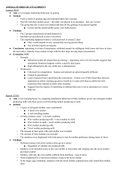
Long-term memory: Encoding.
I]The information processing model posits that long-term memory is a system that encodes, stores,
and retrieves information.
A. The way information is encoded critically influences later access to that information.
B. A number of factors, described in detail below, influence encoding. These factors include level of
processing (shallow or deep) done with an item, timing of practice (massed or spaced), how a person
organizes information, a person’s reference to the self during learning, distinctiveness of an item,
and testing during learning.
II. Levels of processing
The levels-of-processing framework posits that information is processed differently depending upon
the instructions and the task and can vary from relatively shallow processing to relatively deep
processing. The best retention occurs when processing is elaborative (deep). This concept was first
introduced by Craik and Lockhart in 1972 and has been replicated in dozens of experiments.
A. Shallow processing 1. Shallow processing or maintenance rehearsal focuses on the physical
features of an item rather than its meaning. 2. Examples of physical features include color, length,
font, or sound of an item. 3. Shallow processing can involve the simple repetition of items. 4. For
example, we see pennies every day, but may have difficulty recalling the information on the front or
back of a penny. 5. Simply repeating an item over and over again for a test will not commit that item
to memory for a long period of time.
B. Deep processing 1. Deep processing or elaborative rehearsal focuses on the meaning of an item
and involves forming associations between old and new information, with an effort on making
elaborate connections with existing knowledge. 2. Examples include processing that focuses on the
pleasantness of an item, the definition of an item, and the item’s relationship to other items. 3.
When learning new vocabulary, it is best to associate the new item, a vocabulary word, with
something you already know well. 4. Recent work by Nairne and colleagues (2010) demonstrates
that one effective way to process information to is to relate it to your survival. 5. In preparing for a
test, relating course material to information you already know or to something personal in your own
life (self-referent) will enhance its retrieval.
III. Timing of practice
A. Massed practice 1. Massed practice occurs when an individual attempts to learn material all in
one setting, with practice crammed into one or two long sessions. 2. Massed practice is not as
effective as spaced or distributed practice for long-term retention.
B. Spaced practice 1. Spaced practice, also referred to as distributed practice, involves repeated
practice of multiple sessions that are spaced out in time. 2. Spaced practice is far more effective for
long-term retention. 3. Baddeley and colleagues (1978) demonstrated that post office workers who
practiced typing for an hour each day showed better retention than those who practiced typing for
the same total amount of time, but instead massed their practice (i.e., practiced 2 hours a day).
4. When students are studying, they should be sure to space study sessions over time. If a student
plans to study 10 hours for a test, devoting 1 hour each day for 10 days to studying or 2 hours a day
for 5 days would be effective. Studying 5 hours each day for the 2 days before the test would not be
nearly as effective.
, IV. Self-referent encoding
A. When people organize material around their own lives and experiences, they can elaborate on
material easily, and they always have access to the cues (the cues are salient to the individual who
created them). B. For example, if you are learning state or country capitals, relating them to your
own travels and experience can improve memory. If you associate Michigan with your grandfather
who loves Lance crackers, you may find it easier to remember that the capital of Michigan is Lansing.
Or if you associate the United Kingdom with your friend Landon, you could remember the capital of
the United Kingdom is London
V. Distinctiveness and organization
A. Distinctiveness: Items that are unique or distinct from others are often remembered best. When
an item is naturally distinctive, as is a black swan in a lake filled with white swans, it will be
remembered better than the other items that are similar to each other. This is known as the von
Restorff effect. Students can work to make an item distinct by elaborating on it and providing great
detail about it, and the benefit will be similar.
B. Organization: Organizing information also facilitates memory. If someone has a list of items that
includes clothing, sporting equipment, food, and travel destinations all mixed together, organizing
those items by category will improve recall. The category heading can be used to prompt recall, and
relating the items within a category to each other will allow them to serve as cues for each other.
Students could work to impose an organization on course material, and that structure will help guide
retrieval during tests.
C. Subjective organization: For material that does not have an obvious structure, imposing some
personal organizational strategy or structure on the material can enhance retention. Subjective
organization involves developing a personal way to categorize and recall information.
VI. Testing effect
A. Taking a memory test not only assesses what a person knows, but can also enhance later
retention.
B. This phenomenon is known as the testing effect or test-enhanced learning. This effect was first
demonstrated by Gates (1917) and later expanded by Carrier & Pasher (1992) and Roediger &
Karpicke (2006; see also Karpicke & Roediger, 2008).
C. Recent experiments demonstrate that people who study and then are tested on material retain
that information more effectively over long durations relative to people who study and then study
some more (even though both groups spend the same amount of time with the material).
D. When students study, they should not simply reread their book or even focus on their highlights.
They should quiz themselves on the material regularly, so they have a sense of what they know and
don’t know and practice and strengthen the connections among associated information in their
brain.
I]The information processing model posits that long-term memory is a system that encodes, stores,
and retrieves information.
A. The way information is encoded critically influences later access to that information.
B. A number of factors, described in detail below, influence encoding. These factors include level of
processing (shallow or deep) done with an item, timing of practice (massed or spaced), how a person
organizes information, a person’s reference to the self during learning, distinctiveness of an item,
and testing during learning.
II. Levels of processing
The levels-of-processing framework posits that information is processed differently depending upon
the instructions and the task and can vary from relatively shallow processing to relatively deep
processing. The best retention occurs when processing is elaborative (deep). This concept was first
introduced by Craik and Lockhart in 1972 and has been replicated in dozens of experiments.
A. Shallow processing 1. Shallow processing or maintenance rehearsal focuses on the physical
features of an item rather than its meaning. 2. Examples of physical features include color, length,
font, or sound of an item. 3. Shallow processing can involve the simple repetition of items. 4. For
example, we see pennies every day, but may have difficulty recalling the information on the front or
back of a penny. 5. Simply repeating an item over and over again for a test will not commit that item
to memory for a long period of time.
B. Deep processing 1. Deep processing or elaborative rehearsal focuses on the meaning of an item
and involves forming associations between old and new information, with an effort on making
elaborate connections with existing knowledge. 2. Examples include processing that focuses on the
pleasantness of an item, the definition of an item, and the item’s relationship to other items. 3.
When learning new vocabulary, it is best to associate the new item, a vocabulary word, with
something you already know well. 4. Recent work by Nairne and colleagues (2010) demonstrates
that one effective way to process information to is to relate it to your survival. 5. In preparing for a
test, relating course material to information you already know or to something personal in your own
life (self-referent) will enhance its retrieval.
III. Timing of practice
A. Massed practice 1. Massed practice occurs when an individual attempts to learn material all in
one setting, with practice crammed into one or two long sessions. 2. Massed practice is not as
effective as spaced or distributed practice for long-term retention.
B. Spaced practice 1. Spaced practice, also referred to as distributed practice, involves repeated
practice of multiple sessions that are spaced out in time. 2. Spaced practice is far more effective for
long-term retention. 3. Baddeley and colleagues (1978) demonstrated that post office workers who
practiced typing for an hour each day showed better retention than those who practiced typing for
the same total amount of time, but instead massed their practice (i.e., practiced 2 hours a day).
4. When students are studying, they should be sure to space study sessions over time. If a student
plans to study 10 hours for a test, devoting 1 hour each day for 10 days to studying or 2 hours a day
for 5 days would be effective. Studying 5 hours each day for the 2 days before the test would not be
nearly as effective.
, IV. Self-referent encoding
A. When people organize material around their own lives and experiences, they can elaborate on
material easily, and they always have access to the cues (the cues are salient to the individual who
created them). B. For example, if you are learning state or country capitals, relating them to your
own travels and experience can improve memory. If you associate Michigan with your grandfather
who loves Lance crackers, you may find it easier to remember that the capital of Michigan is Lansing.
Or if you associate the United Kingdom with your friend Landon, you could remember the capital of
the United Kingdom is London
V. Distinctiveness and organization
A. Distinctiveness: Items that are unique or distinct from others are often remembered best. When
an item is naturally distinctive, as is a black swan in a lake filled with white swans, it will be
remembered better than the other items that are similar to each other. This is known as the von
Restorff effect. Students can work to make an item distinct by elaborating on it and providing great
detail about it, and the benefit will be similar.
B. Organization: Organizing information also facilitates memory. If someone has a list of items that
includes clothing, sporting equipment, food, and travel destinations all mixed together, organizing
those items by category will improve recall. The category heading can be used to prompt recall, and
relating the items within a category to each other will allow them to serve as cues for each other.
Students could work to impose an organization on course material, and that structure will help guide
retrieval during tests.
C. Subjective organization: For material that does not have an obvious structure, imposing some
personal organizational strategy or structure on the material can enhance retention. Subjective
organization involves developing a personal way to categorize and recall information.
VI. Testing effect
A. Taking a memory test not only assesses what a person knows, but can also enhance later
retention.
B. This phenomenon is known as the testing effect or test-enhanced learning. This effect was first
demonstrated by Gates (1917) and later expanded by Carrier & Pasher (1992) and Roediger &
Karpicke (2006; see also Karpicke & Roediger, 2008).
C. Recent experiments demonstrate that people who study and then are tested on material retain
that information more effectively over long durations relative to people who study and then study
some more (even though both groups spend the same amount of time with the material).
D. When students study, they should not simply reread their book or even focus on their highlights.
They should quiz themselves on the material regularly, so they have a sense of what they know and
don’t know and practice and strengthen the connections among associated information in their
brain.